

How Will PP Market Perform with Limited Demand?
Preamble: High feedstock costs underpinned PP market prices, but fundamentals hindered the price increase. PP mainstream prices inched lower as the demand peak in October didn’t appear as expected. The downstream demand played a crucial role in whether PP market will rebound in the future.
Less-than-expected demand dampened the PP market in October.
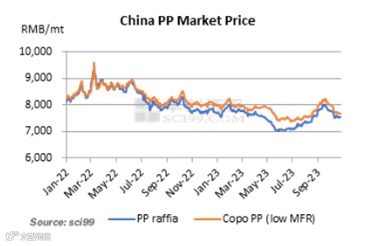
China’s PP market prices dropped after increments in October 2022. PP prices mounted up in early October on the back of stronger crude oil prices and bettered downstream demand. But after PP prices went up, downstream converters resisted high-priced feedstock. Subdued demand dragged down PP prices. Crude oil values appreciated successively during China’s National Day holiday, bolstering the market sentiment and PP prices. Besides, the market demand for PP improved with downstream users replenishing the inventory after the holiday, which further boomed PP prices. However, the price uptrend lasted for a short time. After PP prices ramped up, downstream stockpiling initiatives softened, resulting in stalemated dealings. Meanwhile, crude oil prices and the PP futures prices lost ground, putting a dampener on PP prices.
China’s PP market prices inched down and then moved sideways in October 2023, reflecting lowered mainstream prices. The supply of low-MFR copolymer mounted up with higher production ratios, but its downstream consumption performed poorly. Therefore, low-MFR copolymer prices decreased, and the downward range was larger than raffia prices. For PP raffia, its supply climbed on capacity expansions, maintenance decreases and post-National Day holiday inventory accumulation. After the holiday, downstream processors maintained low operating rates because of scarce orders and soft profitability, and then they were wary about stocking up. Deals were concluded flexibly based on low-priced goods, but softer-than-expected deals dragged down PP prices. In late October, the PP inventory at major producers was consumed passably with more arrangements for unit maintenance, and the price decline slowed down accordingly. Prices turned range-bound gradually.
Generally, PP prices performed differently in October 2022 and October 2023, but they were dominated by supply-demand fundamentals and affected by feedstock costs as well.
PP industry chain products all registered a decline in prices amid tepid demand in October.
Industrial Chain Price
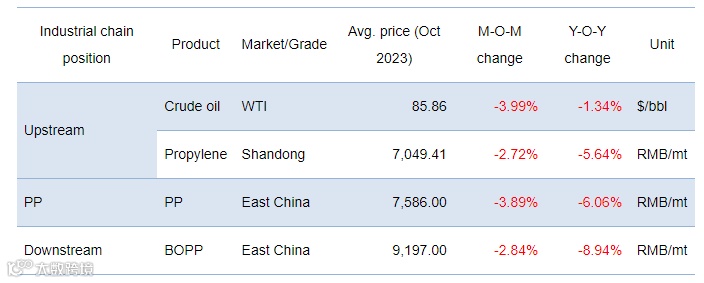
PP and its upstream and downstream products’ prices moved down in October amid soft fundamentals. Therein, crude oil values decreased the most because of lackluster demand. In the U.S., the demand for gasoline declined, and the positive influences brought by the oil production cut extension softened gradually. PP mainstream prices inched lower amid rising supply but limited demand. BOPP prices declined with weaker costs and sparse new orders. Last, propylene prices saw the smallest dip, dampened by lower costs and soft demand, even though propylene supply decreased with frequent shutdown of PDH units. All PP industrial chain products saw a Y-O-Y decline, which was credited to higher crude oil prices in October 2022.
PP industrial chain operating rates saw ups and downs in October. Therein, operating rates in the PP industry mounted up, and PP supply increased with capacity expansions and maintenance decreases. Operating rates in the propylene industry inched up but stayed low, even though propylene output rose. Operating rates in the BOPP industry declined because limited new orders impaired the production activity of enterprises. Compared with the same period of last year, operating rates regarding the PP industrial chain all dropped this month, reflecting producers’ weaker production willingness given scarce demand.
It is predicted that China’s PP prices will trend downwards in November amid an imbalance between supply and demand. Feedstock prices are expected to linger at highs, buoying PP prices strongly from the cost side. As for fundamentals, PP supply is likely to increase amid fewer unit turnarounds and newly added capacity, while the downstream demand for PP may soften gradually. As for PP copolymer, there were fewer new orders for copolymer after the sales promotion policies regarding home appliances and automobiles ended. Later, the demand for PP copolymer is likely to continue to fall in November. The demand performance will still rely on stimulus policy and players’ confidence.
Taking East China as an example, the PP raffia price is expected to be RMB 7,350-7,800/mt, and low-MFR copolymer prices are likely to be RMB 7,450-7,950/mt in November. The average prices of PP raffia from November 2023 to January 2024 are predicted to be RMB 7,450/mt, RMB 7,400/mt and RMB 7,480/mt separately.
All information provided by SCI is for reference only, which shall not be reproduced without permission.
Please click "Read more" for the full article.