

Asian PX Market in Upward Trajectory in Q3 but May Weaken in Q4
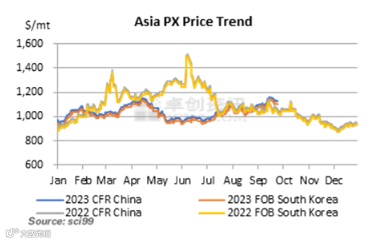
In the third quarter of 2023, Asian PX prices continued their upward trajectory, with an average price of $1,071.59/mt CFR China, up 4.19% from $1,028.45/mt in the second quarter. PX prices reached a year-high as a result of the quick increase in crude oil prices, as well as the improvement in China’s supply and demand structure.
PX prices saw two rounds of increases in Q3, 2023.
The intensive good news was seen in July’s oil market, including the ongoing decline in the U.S. oil stocks, Saudi Arabia's voluntary production cut, and the prospect of warmer demand, resulting in consecutive rises in international crude oil prices. The 2.5 million mt/a PTA unit at Hengli Petrochemical (Huizhou) was placed into operation in July at the same time as numerous PX producers in China reduced production, which improved China's domestic supply and demand structure. The first wave of price increases for PX followed.
In August, oil prices mainly consolidated, providing PX with only modest cost support. As market participants were careful in their negotiations and attention was focused on the listing of PX futures, China's PX stockpile increased in the meantime.
Brent oil prices briefly surpassed $94/bbl in September. Due to the maintenance of units at PetroChina Sichuan Petrochemical and Zhejiang Petroleum and Chemical, PX output loss quickly increased. The PTA producers also continued to operate at a high rate. PX prices entered the second rising channel and reached $1,160/mt, a new high for the year, driven by the aforementioned factors.
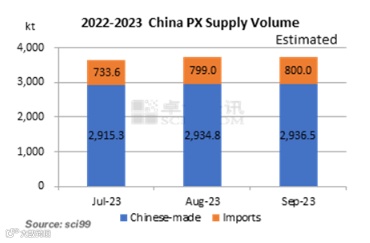
Supply pattern: Domestic output changed little while imports gained.
From July to September, the total supply of PX in China read 3,648.9kt, 3,733.8kt, and 3,625.1kt, respectively.
The 1.6 mln mt/a unit at Fujian Fuhaichuang Petrochemical and the 1 mln mt/a unit at Hainan Refining and Chemical were restarted in the third quarter, which offset the output loss brought on by annual maintenance at PetroChina Sichuan Petrochemical and PetroChina Urumqi Petrochemical as well as the production reduction at Zhejiang Petroleum and Chemical. Therefore, there were only small adjustments in China’s domestic PX output. However, PX imports climbed to 700-800kt per month as the supply gap widened.
Demand pattern: PX consumption in the PTA industry reached a new high.
Hengli Petrochemical (Huizhou) put began operating its 2.5 mln mt/a PTA unit on July 11, 2023, contributing to an increase in PX consumption of over 130kt each month.
Moreover, the quarterly average operating rate of PTA units was as high as 78.99%, up 3.72 percentage points from the second quarter and 7.30 percentage points from the same period last year.
Although PTA manufacturers are facing growing theoretical profit losses, under the “refining-aromatics-polyester” integrated development model, the companies’ capacity to absorb low processing costs in a single link has improved. Additionally, the demand in the polyester industry was high compared with the same time in previous years, which allowed PTA producers to keep their operating rates high. The output of PTA hit a new record high of 5.72 mln mt in August, which significantly drove up PX demand.
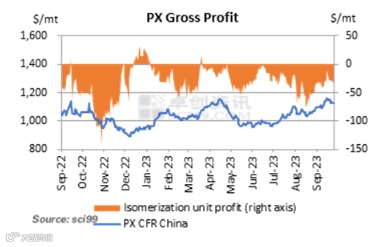
Profitability: PX profits witnessed widening losses due to rising costs.
Due to the impact of the peak gasoline consumption period in the U.S., there was a large rise in demand for oil blending in the third quarter of 2023. Some MX sources from Japan, South Korea, and other regions were delivered to the U.S. as arbitrage space became available (the MX volume shipped from South Korea to the U.S. was 29.809kt in July, 39.668kt in August, and 34.759kt in September). The total supply of MX was also constrained due to the economic problems associated with toluene disproportionation, which contributed to an increase in MX prices overall in the third quarter.
Despite being in a growing trend as well, the PX market’s price increase was less than that of MX as a result of escalating inventory levels. The xylene isomerization process was in a loss state in the third quarter, and the loss has grown as a result of hiking costs. An enterprise in Shandong closed its 800kt/a PX plant, and Qingdao Lidong Chemical lowered its operating rate to 40% as a result.
Outlook: PX market to consolidate in Q4, 2023.
It is estimated that the PX market in the fourth quarter of 2023 will have a broad range of consolidations. Concerns about tight supply and weak demand may cause wide fluctuations in the crude oil market. However, the overall operating rate of the PX market in Asia is relatively low, which provides certain support to PX prices. However, due to doubts about the sustainability of demand, the falling risk of PX prices has escalated.
Cost: The Federal Reserve expects to raise interest rates again within the year, which will result in a strong US dollar, high US bond yields, and other systemic financial issues, all of which will increase market fears. However, the energy demand in China is relatively stable, and the early replenishment of alternative energy sources in Europe has formed a certain boost. Overall, macro risks still exist, and the crude oil price will probably go range-bound.
Supply: It is predicted that the PX supply in China will be stable-to-rising in the fourth quarter. Zhejiang Petroleum & Chemical is expected to raise the operating rate at its 9,000kt/a unit to 85%, whereas Ningbo Zhongjin Petrochemical will take 60-day maintenance for its 1,600 kt/a unit in November. There will be no new PX capacity in the coming year. It is expected that the monthly output of PX from October to December will be 2,890kt, 2,810kt, and 2,980kt, respectively, and the imports will remain in the range of 700-800kt.
Demand: It is estimated that the demand growth may be slower than expected. Hainan Yisheng Petrochemical is predicted to put its 2.5 mln mt/a PTA unit into operation in the fourth quarter, and China Resources Chemical Innovative Materials may restart its 2.2 mln mt/a PTA unit. However, with PTA processing costs reaching a 10-year low and production losses increasing, a portion of the rise in demand will be offset by maintenance on the 4.2 mln mt/a device in Ningbo and the 1.1 mln mt/a device in Zhuhai, which may not result in the improvement in demand that was anticipated.
PX prices are expected to see weakening consolidations in the near term directed by cost trends, although displaying some resistance to falls. As the dominating contract month shifts to February and March of the next year, the game mood among all sides may heat up, and the PX price may go downward at the end of the year.
All information provided by SCI is for reference only, which shall not be reproduced without permission.
Please click "Read more" for the full article.