

Tissue Price Likely to Stabilize in H2 January Backed by More Active Restocking
In H1 of January, the tissue market demand gradually increased, and the market trading became more active. Besides, due to lower inventory after previous downtimes, the tissue price in Hebei was raised slightly. However, because of sustaining inventory pressure in other regions, the tissue price still went down. It is estimated that the tissue price may stabilize in H2 of the month as restocking becomes active.
Tissue price trends varied in H1 of January
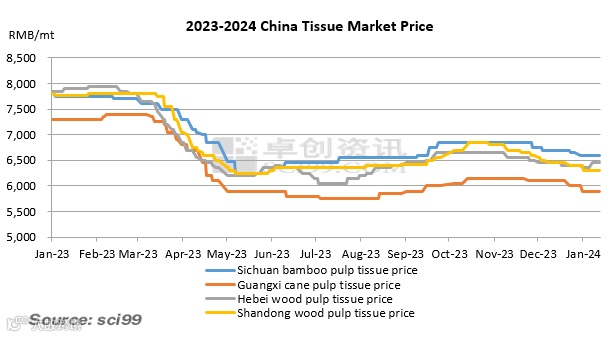
In H1 of January, the tissue demand warmed up somewhat as downstream players stocked up. Besides, as inventory decreased after previous maintenance downtimes, tissue prices in Hebei were raised slightly. However, players in other regions still suffered inventory pressure, and local tissue prices still edged down. As of January 15, the wood pulp tissue jumbo roll price in Hebei was RMB 6,450/mt, up RMB 50/mt or 0.78% from late December, and that in Shandong was RMB 6,300/mt, down RMB 100/mt or 1.56% from late December. The bamboo pulp tissue jumbo roll price in Southwest China was RMB 6,600/mt, down RMB 50/mt or 0.75% from late December, and the cane pulp tissue jumbo roll price in Guangxi was RMB 6,000/mt, down RMB 100/mt or 1.67% from late December.
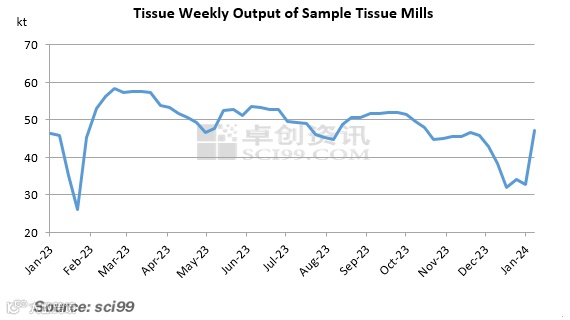
Tissue output increased somewhat in H1 January as tissue mills became more active
During the first week of January, the operating rate of sample tissue mills reached 43.51%, down 20% compared to the average weekly operating rate in 2023. The low operating rate was mainly due to extensive downtimes in Hebei, Shandong, Guangxi and Sichuan. Downstream players started to purchase bolstered by previous downtimes, and during the second week, the weekly average operating rate recovered to a relatively normal level at 61.12%.
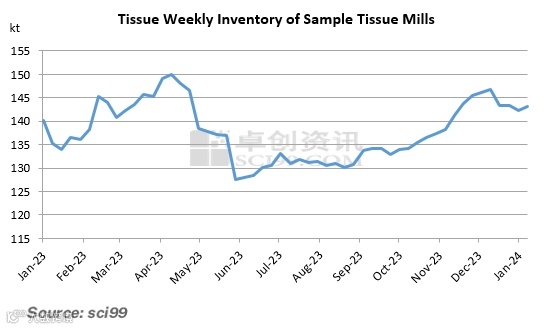
Tissue trading recovered slightly in H1 January but still characterized by essential purchases
Backed by previous maintenance and price hikes, tissue jumbo rolls procurement of downstream converters increased, and the tissue inventory of tissue mills dropped in general. By mid-January, the tissue inventory of sample tissue mills dropped slightly by 0.14% from that in late December, but it was still 4 percentage points higher compared to the average inventory level in 2023. The inventory pressure on tissue mills is expected to alleviate as downstream restocking becomes active ahead of the Spring Festival holiday.
The tissue price is likely to remain stable under both bullish and bearish factors
On the supply side, operating rates gradually recovered at tissue mills, but some small-sized ones remain shut. The weekly operating rate is still around 10% lower than the peak in 2023.
On the demand side, restocking activities at downstream converters before the Spring Festival holiday have started, and market trading gradually increased. Considering the stock preparation for February, the demand factor is generally bullish.
Pulp prices hovered at highs due to firm import offers, and the spot market is under pressure but the price drop may be limited. Thus, the cost factor may have no bearish influence on the tissue market.
In summary, both tissue supply and demand recover to some extent, and the cost factor sees limited changes. Thus, the mainstream tissue price may remain stable in H2 of January.
All information provided by SCI is for reference only, which shall not be reproduced without permission.
Please click "Read more" for the full article.