

PBR, SBR and NR Price Correlation Climbs on Financial Attributes
Snapshot: Rubber, rubber chemicals, fabric cords, bead steel wires, etc. are required in tire production. Therein, rubber is the main feedstock determining the performance and processing technology of tire. In tire production, natural rubber is generally used as the main feedstock, combined with synthetic rubber such as SBR and PBR to achieve the target performance. As the formula control of natural rubber and PBR in tire production is between 5% and 8%, the alternative demand leads to a close price correlation between natural rubber and synthetic rubber.
In 2024, PBR, SBR and natural rubber prices enjoyed higher correlation.
From 2024, as an important feedstock for tire production, prices of PBR, SBR and natural rubber registered a high correlation. From 2019, the price trends among the three remained basically consistent. However, due to various accounting methods and more flexible adjustments in synthetic rubber supply, there is a periodic price spread among the three prices under the premise of consistent trends. Yet, from H2, 2023, the price trends of the three converged, and the correlation coefficient rose from 0.75 in 2023 to 0.95 in 2024.
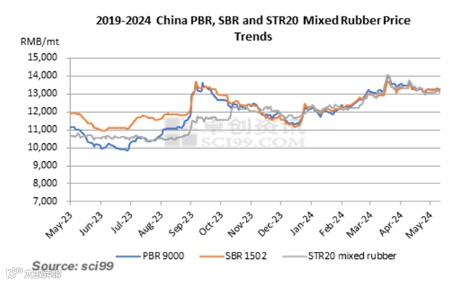
On the one hand, after the listing of synthetic rubber futures, due to cross-variety arbitrage between natural rubber and synthetic rubber, etc., the correlation among the three was closer. On the other hand, prices of feedstock butadiene remained in an uptrend overall from early 2024, underpinning the synthetic rubber market. Thus, the price of synthetic rubber went higher accordingly. Meanwhile, the price of natural rubber also remained high in the tug of war between supply and demand. The price spread between synthetic rubber and natural rubber narrowed.
The PBR price stayed high, and the impact of cost waned.
As seen from the PBR price in the past 13 years, the PBR 9000 price lingered at RMB 10,000-13,000/mt more than 80% of the time. Excluding special factors, the PBR 9000 price was mainly concentrated at RMB 13,000-14,000/mt. Thus, the PBR price is at a high level at present. Downstream users are reluctant to purchase high-priced PBR, curbing the increment in PBR price.
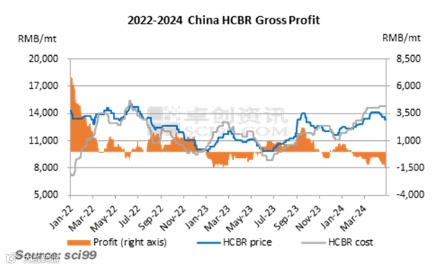
As seen from the historical correlation, changes in butadiene price mainly affect the price spread among SBR, PBR and natural rubber. Yet, after the listing of PBR futures, there is no obvious deviation in the prices of the three. On the one hand, after the listing of PBR futures, changes in PBR price also affected the butadiene market. On the other hand, the spot price of PBR was at a high level, in the wake of rising costs. Affected by a drop in alternative demand, the PBR price remained relatively stable at RMB 13,000-13,500/mt.
It is projected that the price correlation among SBR, PBR and natural rubber may continue to be high, and the price spread may enlarge periodically.
Overall, there will still be a high correlation among SBR, PBR and natural rubber in the future, but the price of synthetic rubber may be lower than that of natural rubber. On the one hand, the seasonal fluctuation characteristics of the three prices are basically consistent, with similar price ups and downs. On the other hand, since the listing of PBR futures in 2023, players in the spot industry gradually changed their operation trade, and the futures and spot markets saw closer integration, so the correlation between natural rubber and synthetic rubber leveled up. Besides, changes in natural rubber supply and demand as well as cost changes of synthetic rubber will still affect the price spread among the three in the coming days.
From the perspective of industrial supply and demand, global natural rubber capacity is expected to further ramp up in 2024. The output of natural rubber may climb, especially in emerging rubber-producing countries such as Cote d’Ivoire, Cambodia and Myanmar. Due to relatively ample spot inventory, in 2024, the import volume of natural rubber in China may inch down Y-O-Y. In terms of domestic output, the purchase price of feedstock may be relatively high, so farmers may show high enthusiasm for rubber tapping. Therefore, in 2024, the total supply of natural rubber may see a minor drop.
In terms of demand, with feedstock prices rising, the profit at tire enterprises may be squeezed. Coupled with the recovery of domestic demand, the total demand for natural rubber in 2024 may remain stable. Thus, in the natural rubber market, the supply is likely to drop, but the demand may stay steady. Overall, the natural rubber price is expected to fluctuate upwards in 2024.
In 2024, players should pay attention to the interference of the El Nino event on the release of output in major producing areas. Besides, from the perspective of industry policies, the rotation storage policy is uncertain. The United Steelworkers Union (USW) announced that it filed an antidumping application on truck and bus tires from Thailand, which might trigger adjustments in supply diversion. Besides, there is an impact of the new European battery bill on China’s new energy vehicle exports.
In terms of cost, in 2024, the increment in butadiene supply may be narrower than that in demand. Yet, considering the limited improvement in end demand, rising downstream supply may pressure the price, further curbing the butadiene price. In 2024, newly added butadiene units may be released limitedly in H1. Coupled with unit maintenance and high exports, the butadiene price in H1 may be higher from H2. However, in H2, 2024, the support from supply may weaken, in tandem with the release of new capacity. Despite new downstream units kicking off, the commissioning status may be uncertain. Thus, in H2, 2024, the rebound in butadiene price may be lower than that in H1.
In 2024, China’s natural rubber prices may move up amid eased oversupply. In terms of the PBR market, in H2, 2024, new PBR units are planned to come online, so the supply-demand imbalance may be enlarged constantly. Besides, the cost is likely to go down in H2. Therefore, the PBR price may dip in H2. It is estimated that the price of PBR may be lower than that of natural rubber, and the price spread may enlarge.
All information provided by SCI is for reference only, which shall not be reproduced without permission.
Please click "Read more" for the full article.