

Regular IIR Market Price Rises in Q1, To Fall in Q2
Introduction: In Q1 of 2024, China’s regular IIR market price fluctuated upwards, which was attributed to the tight supply. Looking ahead to Q2, the market price may fluctuate downward, with increasing supply and falling costs.
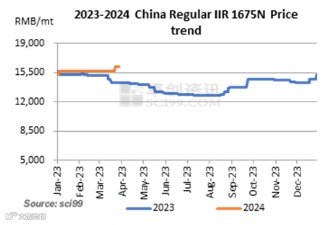
Supply crunch drove regular IIR prices higher in Q1.
In Q1, the market price of regular IIR moved upwards, and the average market price fluctuated between RMB 15,250/mt and RMB 16,250/mt. As of March 28, the average price of regular IIR 1675N in East China was RMB 15,775/mt in Q1, which increased by 8.1% from the beginning of the last quarter and 4.9% from the same period last year. The price reached its peak in late March at RMB 16,500/mt and hit the bottom in early January at RMB 15,000/mt, with a price spread of RMB 1,500/mt. Persistent supply tightness along with rising costs jointly contributed to the price increase.
Looking at different stages, from Q4 of 2023 to January 2024, the spot supply of some imported resources continued to tighten, and domestic IIR producers did not arrange production for regular IIR, which changed the supply-demand pattern in the IIR market. At this stage, the inventory of Chinese-made and imported resources was reduced, which in turn boosted market prices. In February, the demand registered a lukewarm performance due to the Spring Festival holiday, and the market price leveled off. In March, the cost showed a rising trend, and the replenishment of some imported resources was subject to delays. At this stage, tight supply and a gradual recovery in demand elevate the market price.
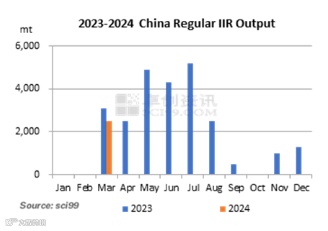
The output of regular IIR was relatively low in Q1 as all of China’s domestic producers did not produce regular IIR in January and February. In March, the domestic output of regular IIR was restored and reached 2,500mt, down 19.35% Y-O-Y. This decrease was attributed to the oversupply situation in 2023 with the high import volume. In the face of market competition and profit losses, China’s domestic IIR producers maintained a low level of regular IIR production and even stopped producing it during some periods. As a result, the existing volume in the market and the operating rate remained low.
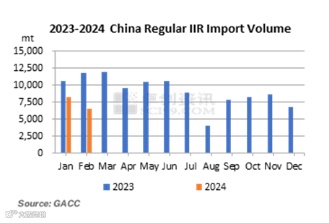
From January to February 2024, China imported a total of 14,800mt of regular IIR, a decrease of 34% compared to the same period last year. The import volume in January was 8,252.12mt, up 20.62% M-O-M but down 22.42% Y-O-Y. The import volume significantly declined to 6,562.32mt in February, decreasing by 20.48% M-O-M and 44.4% Y-O-Y. From January to February, Russia, as a major trading partner, significantly reduced its exports to China to 11,377.98mt, down 11.31% M-O-M and 41.41% Y-O-Y. China’s spot market faced tight supply due to the reduced import volume of regular IIR and low output of Chinese-made goods, which also lent support to market prices.
The production cost of IIR rose in Q1.
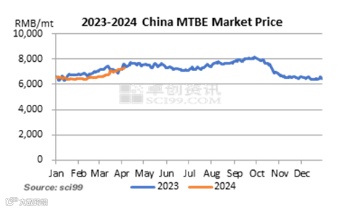
In Q1, China’s MTBE market price showed an upward trend. The monthly average price was closed at RMB 6,923/mt on March 27, which increased by RMB 373/mt or 5.69% from last month, and RMB 401/mt or 6.1% from the average price in January. The MTBE price in March notched the highest increase, which was attributed to considerable exports and reduced spot supply as many domestic MTBE units underwent maintenance or temporary shutdowns. At the same time, as the weather warmed, gasoline end consumption gradually recovered, and coupled with the strong international oil prices, market players’ mentality was boosted. As a result, the MTBE price increased significantly. In terms of regular IIR, the production cost was pushed up with the rising prices of MTBE. Accordingly, domestic IIR producers raised their EXW prices in mid-March, leading to positive sentiment from market participants and pushing up market prices.
Regular IIR market in Q2 may find it difficult to exceed Q1.
In terms of supply, it is expected that domestic producers’ output may see a slight increase, and some imported resources may arrive, which might alleviate the supply shortage.
As for demand, due to the current high price levels, tire producers and other downstream producers are inclined to digest existing feedstock inventory, only maintaining replenishment based on rigid demand and being cautious about new orders. Although the overall operating rate of downstream industries will likely remain stable, it is unlikely to significantly boost the demand for IIR.
As for feedstock, the MTBE market is expected to experience a downward trend, although it may be relatively strong in April. With the reduction in exports, the gradual restart of previously shut-down MTBE units and stable downstream demand, MTBE prices are expected to fall. In May and June, domestic MTBE supply is expected to increase, potentially further pressuring prices downward.
Hence, the regular IIR market price may fluctuate downwards in Q2.
All information provided by SCI is for reference only, which shall not be reproduced without permission.
Please click "Read more" for the full article.