

H1, 2024 Edible and Industrial Ethanol Price Fell
Introduction: The economic situation at home and abroad was complex and changeable in H1, 2024, and the supply of edible and industrial ethanol in China was more than the demand, so the price slipped. Although competition among suppliers intensified, rationality still existed. Under the influence of production losses most of the time, ethanol enterprises no longer blindly pursued market share expansion, and based on the current supply and demand status, maintenance of ethanol units was earlier than in previous years. The economic recovery growth in H2, 2024 is expected, but there is also suspense. Several sets of industrial ethanol units are planned to be put into production, and the new corn will be introduced to the market, which will increase the uncertainty in the ethanol market. However, the cost support for the ethanol market cannot be ignored. It is expected that the downward pressure on ethanol prices in H2, 2024 may be lower than that in H1, 2024 despite fierce competition in the ethanol market.
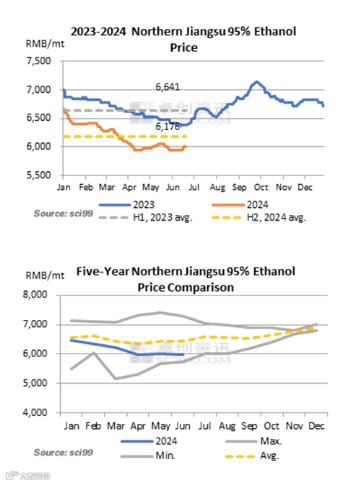
Price: Mainstream market prices of 95% ethanol in H1, 2024 trended down, and the national average price fell to the lowest point since August 2020.
The national average price of 95% ethanol in China fell for most of H1, 2024, and only rose in May. From a relative level, the national average price of 95% ethanol (in cash, self-delivery, tax included, the same below) was RMB 6,030/mt as of June 21, 2024, down 9.89% from the last trading day of 2023. The average price in H1, 2024 was RMB 6,208.24 /mt, down 8.13% from the average price in H1, 2023 and 9.09% from the average price in H2, 2023.
The highest price of 95% ethanol in H1, 2024 was RMB 6,665/mt in early January, and the lowest price was RMB 5,985/mt at the end of May. The main factors affecting the ethanol prices were supply and demand. In terms of supply, the ethanol output trended up, and competition between edible ethanol and industrial ethanol intensified. Cost support strengthened in Q2, affecting the ethanol price. As production losses expanded and demand impacted the ethanol inventory of ethanol enterprises, the unit maintenance was brought forward by two months to May. Then, sellers enhanced their prices amid supply reduction. As a result, the ethanol prices in May both moved up in northern China and southern China.
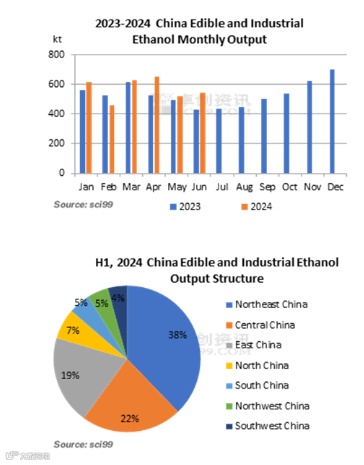
Supply: The ethanol output showed an upward trend on both a year-on-year and month-on-month basis. China’s edible and industrial ethanol output was 3,403kt in H1, 2024, an increase of 7.91% over H1, 2023 and 5.25% over H2, 2023. From regional output, the ethanol output in Northeast China, Central China and East China ranked the top three, accounting for 38%, 22% and 20% respectively of the total, an increase of 2 percentage points, 3 percentage points and 6 percentage points respectively compared with the same period last year. The rapid output decline in East China was mainly due to the low production enthusiasm under the profit loss from producing cassava-based ethanol. From the grades, the output of general-grade ethanol and premium-grade ethanol accounted for 38% and 37% of the total, down 0.6 percentage points and 3 percentage points respectively from the same period last year. The output of anhydrous ethanol (including coal-based ethanol) accounted for 25% of the total, up 3 percentage points from the same period last year. Among them, the decline in output of premium-grade ethanol was mainly due to the decline in downstream demand. The increase in the output of anhydrous ethanol was mainly affected by the commissioning of newly added coal-based ethanol. According to SCI, the output of coal-based ethanol from January to May reached 255kt, an increase of 128% over the same period last year. In addition, the supply and demand of fuel ethanol and the demand for by-product DDGS also had impacts on the output of edible and industrial ethanol.
In terms of import, China’s ethanol import volume has remained low since 2024. According to GACC, the import volume of undenatured ethanol in China was 59.799mt, up 94.89% Y-O-Y. As China’s domestic market supply was basically saturated and the arbitrage window between China and foreign markets was unstable, China’s ethanol imports in 2024 were relatively small.
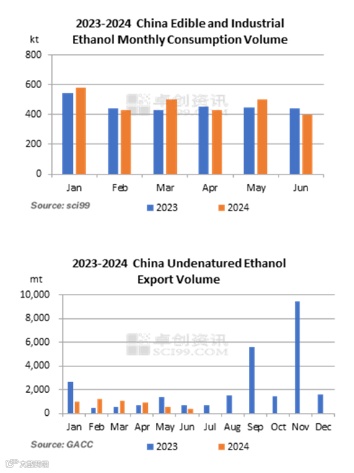
Demand: The demand for ethanol from different fields was mixed in H1, 2024. China’s consumption volume of edible and industrial ethanol was 2,840kt in H1, 2024, up 100kt over the same period last year. Among them, the consumption of ethanol in the liquor field decreased most significantly, with a range of 20%-40%. This was mainly because the sales at small liquor plants fell, leading to a decrement in ethanol consumption. Besides, the demand for ethanol from high-end brands also dropped with changes in technology. In H1, 2024, the purchase volume of ethanol from major downstream chemical enterprises increased, among which the increase in downstream ethyl acetate field was the most obvious. The output of ethyl acetate reached around 1,160kt from January to June, an increase of nearly 200kt over the same period last year. It was roughly estimated that the consumption of ethanol in the ethyl acetate field in H1, 2024 was 672.8kt, an increase of about 116kt over the same period last year. In addition, the purchase of ethanol from the ethyl methyl carbonate field rose with the commissioning of some newly added units. As of H1, 2024, the purchase volume of ethanol in East China alone was close to 100kt. However, the demand for ethanol from ethyl methyl carbonate showed a differentiated trend, and the industry concentration further increased. With the integration of the industry, small enterprises had a short operating time and reduced ethanol consumption, but large enterprises had a long operating time and enhanced ethanol consumption. In addition, from the perspective of ethanol quality, both premium-grade ethanol and anhydrous ethanol can meet ethyl methyl carbonate customers’ needs. The industry’s new unit was more tolerant of feedstock ethanol, and the number of ethyl methyl carbonate enterprises purchasing premium-grade ethanol increased, but the proportion of anhydrous ethanol consumption in the industry was still large.
In terms of export, the export volume of ethanol in China since 2024 decreased Y-O-Y. According to GACC, the export volume of undenatured ethanol from January to May was around 4,680.314mt, down 18.891% Y-O-Y. Overall, the ethanol produced by the traditional processes lacked the price advantages in export respect.
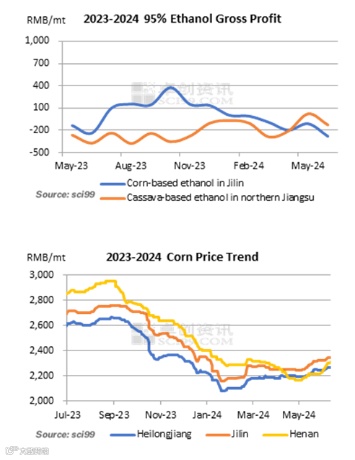
Cost and gross profit: Different regions saw different costs, and the production of ethanol via main processes suffered profit losses. In H1, 2024, for corn-based ethanol in different regions, Henan had the lowest production cost, while Jilin had a relatively high cost. From the corn price trend, the price of corn in Henan was lower than that in Northeast China in April and May, resulting in the lowest cost of corn-based ethanol and the strongest competitiveness of ethanol prices in Henan. In addition, considering the delivery freight in Northeast China and the geographical advantage in Henan, the production profit of corn-based ethanol in Henan was the highest, while Jilin and Heilongjiang were under production losses most of the time. From the production profit of ethanol via different processes, the profit from producing cassava-based ethanol was poor. The RMB exchange rate fluctuations and shipping costs were important factors affecting the price of imported cassava slices. Moreover, the occasional centralized procurement from China’s cassava-based ethanol producers also caused the price of cassava slices to rise. Therefore, prices of cassava slices and cassava-based ethanol diverged for a time, resulting in a high production cost of cassava-based ethanol. As for corn-based ethanol, in addition to the prices of ethanol and corn, the price of the by-product DDGS played an important role in the production of ethanol enterprises. Influenced by the feedstock corn, the by-product DDGS toxins exceed the standard. Moreover, the downstream demand for DDGS was weak. Therefore, sales pressure on DDGS enterprises was higher than in the same period last year. The price fluctuations of DDGS in June exerted a significant impact on the profits of ethanol enterprises.
Looking ahead to H2, 2024, factors affecting the ethanol market will be the commissioning progress of the new coal-based ethanol units, the boosting effect of the domestic economic recovery on the demand side, and the accelerated fluctuations in corn prices before and after the new corn is put on the market.
The commissioning of industrial ethanol will speed up in H2, 2024, and supply pressure will still exist.
In H2, 2024, multiple coal-based ethanol units are planned to be put into production, including 500kt/a unit at Shandong Hengxin Group, 250kt/a at Xinjiang Tianli Petrochemical and 250kt/a unit at Henan Ruibai New Materials. It is predicted that the capacity of edible and industrial ethanol in H2, 2024 will increase 950kt/a to 15,469kt/a. In addition, the maintenance of fermented ethanol units has been arranged in advance in May-June, and that of other units will be arranged in July-August. Therefore, the overall output loss in H2, 2024 may be lower than that in the same period of previous years. However, if the production profit of ethanol continues to be poor, the production resumption of shut-down units may be delayed. At present, at least two units in Heilongjiang will remain in shutdown for transformation for a long time. Therefore, the output of fermented ethanol output in H2, 2024 may not exceed that in H1, 2024, but the output of industrial ethanol will exceed that in H1, 2024. After the new corn is introduced to the market in Q4, the output of corn-based ethanol is expected to grow. Overall, the probability of edible and industrial ethanol output in H2, 2024 exceeding that in H1, 2024 still exists.
Downstream profit is poor, but demand is expected to be better in H2, 2024 than in H1, 2024.
From a seasonal perspective, ethanol demand in the second half of a year is usually better than that in the first half. The main pressure on ethanol prices in H1, 2024 was mainly from the weak demand. Therefore, from the perspective of ethanol itself, improved downstream demand and profits will help ethanol prices rise from the bottom. From a macroeconomic perspective, expectations for H2, 2024 are slightly better than those for H1, 2024. Although there is still pressure, it is predicted that policies will continue to focus on new momentum, and industrial prosperity may improve. As ethanol downstream products are close to the end products, it is projected that downstream demand in H2, 2024 may be slightly better than in H1, 2024, but there is not much room for improvement.
The corn price may rise, strengthening the cost support to ethanol prices.
In Q3, the corn price is usually at a relatively high level due to the low supply pressure. In Q4, the new corn will be introduced to the market, pushing up the corn supply. However, players should be wary of output fluctuations caused by weather. In addition, Q4 is also the production peak season for the deep processing of corn, which may provide some support for the corn price.
On the whole, it is expected that the highest price of edible and industrial ethanol in H2, 2024 will be lower than that in H2, 2024, and the lowest price in most regions will be higher than that in H1, 2024. The fluctuation range will narrow. Although the competition among suppliers has intensified, the continuous profit losses have led to tight cash flow. Therefore, ethanol enterprises pay more attention to costs and are urgent to pursue profits. As a result, mainstream ethanol prices are reckoned to inch up as the cost support is expected to strengthen. Prices of 95% corn-based ethanol in Northeast China are estimated at RMB 5,650-6,300/mt; those of 95% cassava-based ethanol in northern Jiangsu are estimated at RMB 5,900-6,400/mt; those of 95% molasses-based ethanol in Guangxi are estimated at RMB 6,200-7,000/mt.

All information provided by SCI is for reference only, which shall not be reproduced without permission.
Please click "Read more" for the full article.