

China Methanol Market May Fall After Rising in H2, 2024
Introduction: In H1, 2024, China’s methanol market prices fluctuated upwards on the whole. Import volume declines and downstream demand rallies greatly supported methanol prices. However, high feedstock prices resulted in negative feedback from downstream users, and methanol prices fell after rising. For H2, 2024, SCI predicts that China’s methanol market prices may rise first and then drop on the expectations of relatively high supply but weak demand recovery.
In H1, 2024, China’s methanol market opened low and then fluctuated upwards, with the overall price level going higher compared with that in 2023. Taking the spot price in Taicang of Jiangsu as an example, the price averaged RMB 2,636/mt from January to May 2024, up 7.90% Y-O-Y. Up to May 31, 2024, the national average price of methanol was RMB 2,484/mt, up 7.44% compared with the price at the beginning of the year.
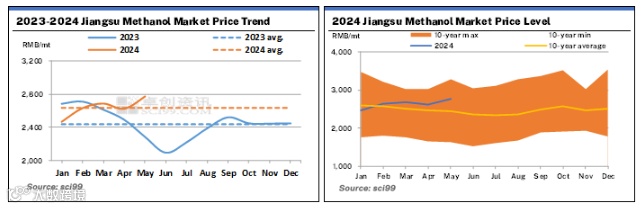
China’s methanol market prices fluctuated upwards in H1, 2024, which was closely related to the rise in energy prices, the decline in import supply and the recovery of downstream demand.
Methanol import volume dropped unexpectedly, while domestic output increased Y-O-Y.
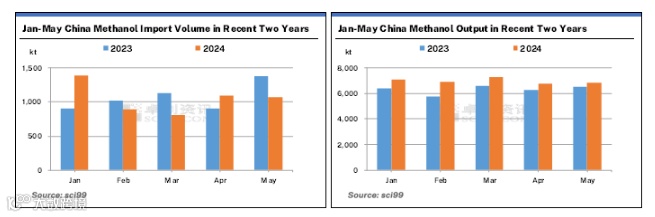
From January to May 2024, China’s methanol import volume totaled 5,245.2kt, down 1.73% Y-O-Y. Intensive planned or unplanned production outages and oversell at overseas producers and low transport efficiency all affected import supply. On the other hand, benefiting from crude oil price rises, the demand from downstream industries represented by the CTO/MTO industry recovered quickly, so the port inventory kept sliding, especially in Jiangsu. Normally, the methanol inventory in Jiangsu is 400kt-700kt, while in H1, 2024, the volume was only 200-400kt, a low level in recent five years. In May, traditional downstream plants in East China and a few inland downstream plants intensively took delivery of goods from Taicang, with the weekly delivery volume once surpassing 50kt in early May. As a result, the port inventory in Taicang dropped constantly within a short period. With merchantable resources getting increasingly tighter, the spot price in the Taicang market climbed to the highest in the first half of the year.
As for China’s domestic methanol output, relatively high profits stimulated methanol enterprises’ production positivity. Moreover, the extent of unit overhauls in spring has declined in recent years. From January to May 2024, the methanol industrial operating rate was maintained at 68%-75%, higher than the level of 64%-70% in the same period of 2023. Accordingly, the domestic methanol output totaled 34,893.9kt, up 10.83% Y-O-Y. In terms of different feedstock, the output of methanol produced by coal and coke oven gas increased by 13.07% and 5.02% Y-O-Y respectively, while that of methanol produced by natural gas decreased by 4.67% Y-O-Y.
International crude oil prices rose, promoting methanol downstream demand recovery.
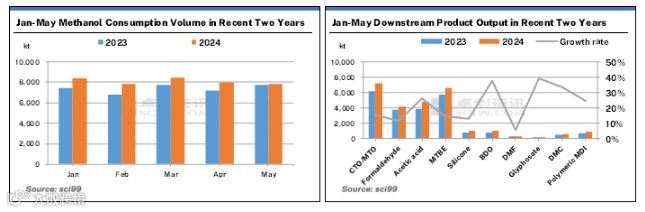
From January to May 2024, Brent crude oil prices averaged $83.5/bbl, up 3.16% Y-O-Y. Crude oil price rises improved methanol downstream product demand. China’s methanol downstream consumption volume totaled 40,556.6kt during this period, up 9.75% Y-O-Y. As the largest methanol downstream industry in China, the operating rate of the CTO/MTO industry fluctuated at 68%-88% from January to May 2024, while that was only 70%-80% in the same period of 2023. Thereinto, MTO units maintained high operating rates of 65%-86%, higher than the level of 51%-70% in the same period of 2023. In terms of downstream product output, CTO/MTO, MTBE, silicone and formaldehyde saw a Y-O-Y rise of over 10%. In addition, glyphosate, BDO, DMC, acetic acid and polymeric MDI witnessed a Y-O-Y increase of over 20%.
Looking ahead to H2, 2024, China’s methanol market prices may fall after rising, with the changes in supply-demand fundamentals and costs remaining the key price drivers.
On the supply side, China’s methanol output is predicted to remain at a relatively high level in H2, but the growth may slow down. For one thing, newly added methanol capacity is limited. For another, current methanol feedstock prices are still relatively firm, while downstream demand may weaken influenced by possible crude oil price declines, which may impact the production positivity of methanol producers. As for import supply, some overseas units are still planned to take maintenance, but from September to December, 5,050kt/a newly added methanol capacity is scheduled to be released, which may offset the output loss caused by unit maintenance. China’s methanol import volume is estimated at 7,520kt in H2, higher than that in H1. Overall, the methanol supply may be relatively loose in H2.
On the demand side, downstream demand has weakened in the wake of high methanol prices, and the operating rate of the CTO/MTO industry has slid to a low level. In the second half of the year, international crude oil prices may first rise and then drop, but the price ceiling is likely to be lower than the level in September 2023. The poor profitability of MTO units may remain a major drag to the methanol demand growth. However, many other downstream industries including acetic acid, MTBE, formaldehyde, BDO, silicone and DMC still have startup plans of newly added units in H2, which may boost methanol consumption to some extent. It is still needed to pay attention to their actual startup time, considering the low profits and weak demand in some industries. Overall, it’s still hard for the methanol demand to see stable and substantial improvement in the second half of the year.
On the cost side, the coal supply in China may remain relatively loose, but the demand is expected to improve somewhat. The demand increment may be larger than supply growth, supporting coal prices to rise, but the extent may be limited due to the high inventory at each link. Overall, the coal prices may still provide some cost support to methanol prices in H2, 2024. As for import cost, the unit maintenance plans in Southeast Asia and South America are predicted to underpin non-Iranian methanol prices, and the time that import prices are higher than domestic market prices may be longer, bolstering the coastal market prices to a large extent.
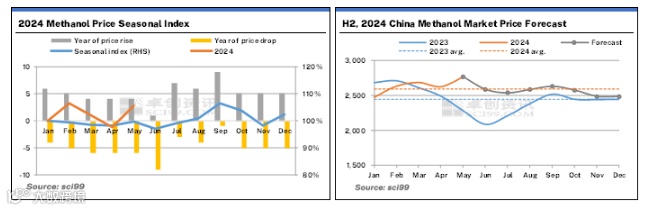
On the whole, China’s methanol market prices may first rebound slightly and then fluctuate downwards. In August and September, the consumption peak season is expected to support methanol prices from the demand side, but the supply recovery with the gradual end of methanol unit maintenance may curb its upside potential. In addition, at the end of the year, methanol prices may also see some drops under the influence of the consumption slack season. It is predicted that the spot price in Taicang may fluctuate in the range of RMB 2,400-2,600/mt, with the highest point occurring in August or September and the lowest, in November or December.
All information provided by SCI is for reference only, which shall not be reproduced without permission.
Please click "Read more" for the full article.