

PBR Price Sees Growth but Pressure Builds
Snapshot: Recently, the PBR market price rose continuously, and the highest offer hit RMB 16,000/mt. The price of synthetic rubber futures hit RMB 16,715/mt, refreshing the record high. In the coming days, buyers may show resistance to current prices. Besides, with the PBR price being much higher than the natural rubber price, the decline in substitute demand is also likely to squeeze the increment in the PBR price.
The PBR price climbed significantly in June.
In late May 2024, the PBR price began to increase. In June, the increment widened, and the highest price of synthetic rubber futures hit RMB 16,715/mt, up RMB 5,185/mt or 45% from the low point since listing, and up RMB 2,375/mt from end-May. The rise in the price of synthetic rubber future enlarged the influence of the tight butadiene supply, leading to a notable rise in the butadiene EXW price. Driven by the strong atmosphere of the synthetic rubber futures market and the rapid rise in cost, the PBR price trended up accordingly. Yet, buyers showed resistance to current high prices. Transactions were generated from a few orders on rigid demand and short covering. At the same time, the basis enlarged, providing opportunities for arbitragers, so the spot PBR was traded at higher prices.
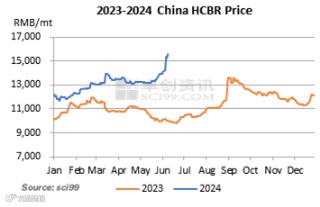
The price of synthetic rubber futures increased, and the cost strongly bolstered the PBR market.
The rise in the price of synthetic rubber futures enlarged the imbalance between supply and demand of butadiene. The expected tight supply of butadiene boosted players’ bullish sentiments. The gross profit of the PBR industry shrank constantly. In mid-May, as the bearish expectations failed to match the reality of tight supply, the butadiene price stopped falling and moved up. In June, the tight supply failed to be alleviated. Particularly, the inventory at ports was low in East China. There were limited butadiene resources available in East China and South China, so some resources in Lianyungang flowed to southern regions, resulting in a fall in the resources flowing into the Shandong market. In the northern market, with the unit restarts at Heze Kexin Chemical and PetroChina Jinzhou Petrochemical, the spot butadiene resources available for merchant sales in Northeast China and Shandong also slid. The spot butadiene supply tightened, strongly buoying the butadiene price.
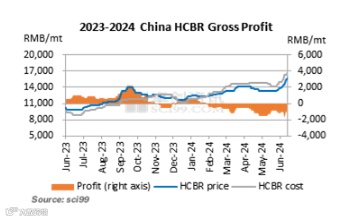
In the short run, the PBR price is expected to mainly hover at highs, and the increment may be minor.
Cost: In the short term, the butadiene market price is predicted to continue to trend up. As for supply, there may be limited resources available in the market. In northern regions, with some PBR units being restarted, there are likely to be fewer resources for merchant sales at butadiene producers. In East China, although the butadiene unit in Fujian has resumed normal production, and there are some imported resources at ports, the overall spot butadiene resources available in the market are not ample. Thus, the supply may continue to bolster the butadiene price. In terms of demand, most downstream users are expected to be cautious about purchasing butadiene at high prices, but the operating rate of the downstream PBR industry may bounce back, underpinning the butadiene price.
Related products: After the rise, the PBR price once became RMB 975/mt higher than the STR20# mixed rubber price. The decline in the substitute demand may also drag down the PBR price. In the short term, the natural rubber market price may fluctuate downwards. As for supply, with the volume of new field latex rising in China and overseas, there may be more shiploads arriving at China’s ports. Yet, with the low domestic inventory, the supply in the market is likely to remain tight. In terms of demand, new orders at downstream tire enterprises are insufficient. Particularly, the demand for expensive feedstock in the all-steel tire industry may remain weak curbed by high inventory. There may be a lack of favorable factors for the natural rubber price. With the natural rubber price falling, the price spread between PBR and natural rubber is expected to further widen, weighing on the PBR price.
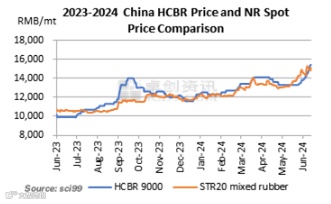
In conclusion, the cost may strongly bolster the PBR market, while the related product may curb the upper end of the PBR price in the short term. In terms of fundamentals, in the wake of the unit restarts at PetroChina Jinzhou Petrochemical and Heze Kexin Chemical, the operating rate has recovered to around 60%. In late June, with the private units being restarted, the operating rate of the PBR industry may further increase, weighing on the PBR market. As for demand, China’s domestic end demand is likely to remain weak. The demand for replacement tires may weaken, putting pressure on the tire sales. At the same time, due to the rise in ocean freight and the tight shipping space, tire exports may slow down. Tire enterprises are expected to adjust production to avoid the pileup in the inventory. Besides, the high feedstock prices are also likely to constrain the production willingness of downstream plants. Overall, the fundamentals may weigh on the PBR price in the short term, but the cost is expected to strongly bolster the market. Thus, the fluctuation range of the PBR price will be possibly limited.
All information provided by SCI is for reference only, which shall not be reproduced without permission.
Please click "Read more" for the full article.