

Analysis of Rubber Profitability in Q1
Snapshot: In recent years, the rubber industry has seen shrinking profits due to the expansion of capacity and a slowdown in demand, and the production of some products even experienced losses. However, in light of industrial policy adjustments or when supply growth slows down relative to demand growth, a few products have managed to maintain favorable profitability. In Q1 of 2024, affected by the cost side, industry profits further shrank.
Among the 16 rubber products under SCI’s monitoring, in 2023, the profits from producing 13 products were positive, accounting for 81%, while the production of 3 products incurred losses. Products with stronger profitability included EPDM, chloroprene rubber, NBR, antioxidants, and SEBS; whereas natural rubber, IIR, and isoprene rubber producers suffered losses. In the long-term view, the profitability of rubber products in 2023, except for SBR, PBR, EPDM, chloroprene rubber, and carbon black, is generally below the average level of the past five years.
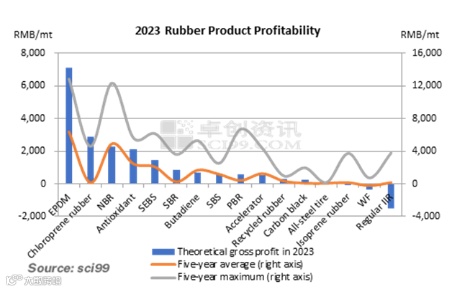
In Q1 of 2024, some rubber products saw a decrease in profitability compared to the previous quarter.
In terms of price, the prices of major rubber products saw a significant quarter-over-quarter increase, especially for butadiene and its downstream synthetic rubber (SBR, PBR, SBS, SEBS, NBR, SBL and NBL), natural latex and special synthetic rubber (IIR, EPDM and isoprene rubber). Although product prices rose due to cost pressures, the increases in prices were generally lower than those in their feedstock prices, resulting in a downward profitability trend for most rubber products in Q1, with only accelerators, butadiene, and EPDM showing a quarter-over-quarter increase. Currently, products with higher profitability mainly include EPDM, butadiene, and antioxidant.
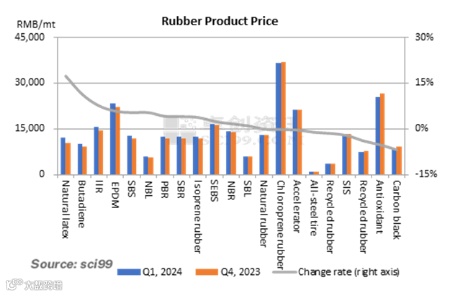
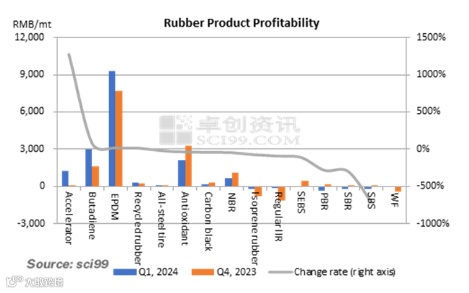
Butadiene industrial chain: Smooth cost transmission but hindered profit transfer downstream
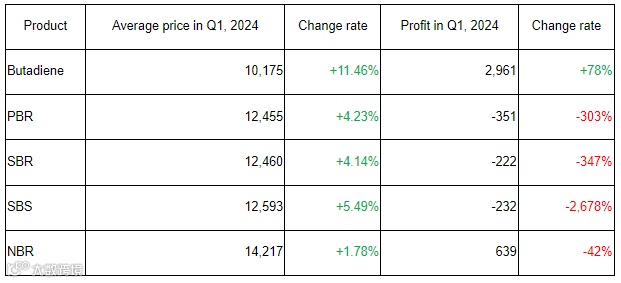
In Q1 of 2024, butadiene prices rose rapidly, reaching an average price of RMB 10,175/mt as of March 18, with a quarter-over-quarter increase of 11.46%, leading the growth across the chain. SCI attributes the price increase to three main factors: firstly, the low operating rate of cracking units and the unexpected shutdown of some units resulted in tight supply. Secondly, less deep-sea cargo was replenished to the Asian market. Thirdly, the increase in spot demand in the South Korean market attracted some exports, exacerbating the supply tension in China’s domestic market. These factors led to a continual rise in the price of butadiene, hitting a new high since June 2022. Driven by costs, the prices of downstream products such as PBR, SBR, SBS, and NBR generally increased, with relatively smooth transmission of price. However, in terms of profit transmission, profits in the industrial chain remained concentrated at the butadiene end. On one hand, due to low operating rates of cracking units, the supply growth rate of butadiene lagged behind demand growth, leading to higher price increases compared to downstream products. On the other hand, despite the cost support provided by feedstock price increases for downstream products, weak demand growth limited the rise in product prices. As a result, profits from producing downstream products were compressed. In the short term, profits in the industrial chain are expected to stay concentrated on the butadiene end, with challenges in transferring profits downstream.
Butadiene Industrial Chain Cost and Profit Transmission
EPDM Leads the Rubber Industry in Profitability.
Among the various rubber products, EPDM has attracted widespread attention for its outstanding profitability. As shown in the chart below, its high profitability began at the end of 2020 and peaked between 2021 and 2022. Although its current profitability has declined, the profit of nearly RMB 10,000/mt remains a highlight among rubber and petrochemical products. The rise in the profit from producing EPDM is due to factors including the implementation of the anti-dumping policy, which changed the supply pattern. Starting from December 20, 2020, the Ministry of Commerce began imposing anti-dumping duties on EPDM imported from the U.S., South Korea, and the EU. In 2023, the import volume of EPDM decreased by more than 30% compared to 2019, leading to supply shortages and price increases, which, in turn, drove up profits. Additionally, the variety and lack of substitutability among EPDM grades mean that the supply side has a greater impact on pricing. Overall, EPDM is more profitable than other downstream products of ethylene and propylene.
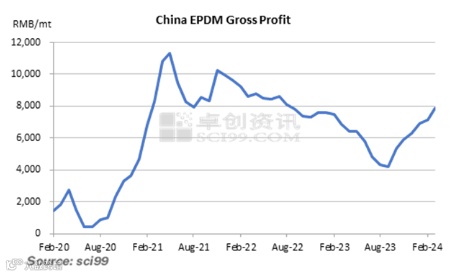
Overall, the profitability of rubber products in Q1 of 2024 shrank, with product price increases generally falling short of those of feedstock. The profitability of synthetic rubber decreased significantly, mainly due to consistent cost increases, strong supply and weak demand. The profit from producing SBS gradually shifted from a high-profit era to a period of negative profits. Limited cost fluctuations and supply shortages led to continuous price increases for butadiene and EPDM, bringing higher profits.
Looking ahead to Q2, with the expected maintenance of some synthetic rubber units, demand recovery and limited potential for further increases in butadiene prices, it is expected that theoretical losses from producing synthetic rubber may narrow. Due to their higher profitability, butadiene and EPDM producers are expected to maintain favorable profits in the short term, but they may also face a narrowing trend. Firstly, after the continual price increases in Q1, the potential for further price rises for butadiene may be limited in Q2 following the release of additional supply. As a result, the butadiene price may dwindle from the high level, and the profitability may narrow. However, profits within the industrial chain remain concentrated at the butadiene end, with ineffective downstream transmission of profits. Secondly, for EPDM, the market is facing a shortage of spot goods, and with potential unit maintenance, there is still the possibility of price increases. Nevertheless, due to downstream resistance to high prices, increases may be limited. Therefore, the profit from producing EPDM may still be high but may register a downward trend.
All information provided by SCI is for reference only, which shall not be reproduced without permission.
Please click "Read more" for the full article.