

All-Steel Tire Price to Face Headwinds in Rising Despite High Cost Pressure
Introduction: In 2024, the prices of major tire feedstock rose strongly. Particularly, the rubber prices saw notable increases recently, causing a rise in the cost of tire production. To cope with the high cost pressure and ensure profits and stable market competitiveness, players showed willingness to raise tire prices. However, the weak end demand and high pressure on goods circulation may weigh on the actual increase in tire prices.
Feedstock prices rose continuously, especially rubber prices.
Recently, the prices of major tire feedstock have fluctuated to different degrees. Among them, the rubber prices saw obvious YoY and MoM increases. As of September 28, the monthly average prices of rubber rose by over 6.2% MoM and 18% YoY. Therein, the natural rubber price moved up by around 33% YoY. The weak rubber tapping in China and overseas triggered a tight natural rubber supply, pushing up the natural rubber price. The reasons for the rise in synthetic rubber prices were as follows. First, the feedstock butadiene price hovered at highs, driving up the prices of synthetic rubber. Second, the price of the related product trended up, lending support to the rise in prices of synthetic rubber.
At the same time, the prices of carbon black and additives dropped YoY. However, as additives accounted for a low proportion of tire feedstock, the fall in additive prices eased the high cost pressure limitedly. Although carbon back takes up a larger proportion in feedstock, the decline in the carbon black price failed to offset the cost pressure caused by the rises in the prices of other feedstock. As a result, the tire cost trended at highs. Therefore, tire enterprises showed higher willingness to raise tire prices.
The end markets were mixed. The replacement tire market registered weak demand.
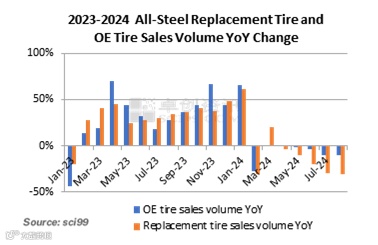
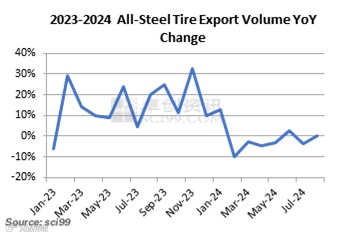
In 2024, China’s all-steel tire market performance remained weak. From January to August, the total sales volume of all-steel tires fell by 4.17% YoY. The sales volume in the export and OE tire markets changed slightly and dropped by around 1% compared to the high base of 2023. Yet, the total sales volume of replacement tires fell by around 10% YoY, dragging down the overall sales volume to some extent.
Entering 2024, the commercial vehicles market flourished first and then weakened. From January to August, the total output of commercial vehicles slid by less than 1% YoY, indicating strong production of commercial vehicles in 2024, thereby bolstering the demand for OE all-steel tires. At the same time, according to data from GACC, the total export volume from January to August fell by around 1% YoY, showing the strong resilience of China’s tire exports.
However, the replacement tire market performed weakly, significantly dragging down the overall sales volume. At first, the recovery in the macroeconomy and consumption was relatively slow in 2024. There was no sign of warming up in the fixed asset investment, and the startup of new infrastructure projects underperformed. From January to August, China’s real estate development investment growth rate dropped by 10.2% YoY. Thus, the number of construction machinery vehicles that were highly related to real estate development declined notably, weighing on the demand for all-steel replacement tires. Second, China’s road transport market stayed insipid. Goods were tight while vehicles were ample, resulting in an oversupply of transport capacity. On a squeeze of profits, end users showed thin interest in replacing tires, dragging down the sales volume of replacement tires, thereby curbing the tire prices.
Against high cost and weak demand, the all-steel tire price may face headwinds in rising in the short term.
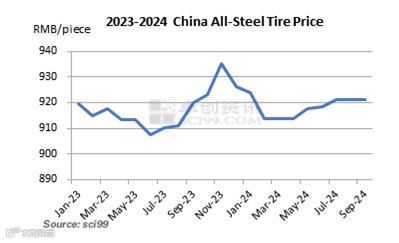
Cost: In the short term, the natural rubber price is likely to fall from highs, but the average price may be higher than that in September. Backed by the decline in supply in October, the prices of synthetic rubber may hover at highs. The carbon black price is expected to trend down dragged by the feedstock coal tar and sliding demand. Overall, the tire cost may stay high in October, bolstering the tire price to some extent.
Demand: It is the peak season of commercial vehicle production in Q4, when the output may rise month on month in Q4, underpinning the demand for OE all-steel tires. At the same time, with the growth of global infrastructure slowing down, the overseas tire demand is likely to weaken somewhat. Given the pressure from the high base in 2023, the tire exports are possible to drop MoM in the short term. Besides, some tire enterprises announced price increases and plan to execute new price strategies in October, leading to slower transactions of replacement tires in October. In addition, the end demand may fail to improve significantly, curbing the increment in tire prices somewhat.
In conclusion, the prices of feedstock rose notably, strengthening the cost pressure on tire production and thereby bolstering the rise in tire prices. Although tire enterprises announce price increases, the end market fails to support them and the tire demand may remain weak, which is likely to curb the actual price rise to a large extent.
All information provided by SCI is for reference only, which shall not be reproduced without permission.
Please click "Read more" for the full article.