



Summary of PBR Market in H1, 2024: PBR Price Rises by Over 20% in H1 but to Drop in H2
Snapshot: In H1, 2024, the PBR price rose continuously and hit a 3-year high. The price of synthetic rubber futures dominant contract reached a high since its listing. In H2, 2024, with the cost pressure easing, supply rising and demand trending steadily, the PBR price is expected to drop somewhat.
Market review: The PBR price mainly trended up, and the average price in H1, 2024 was higher than the historical average.
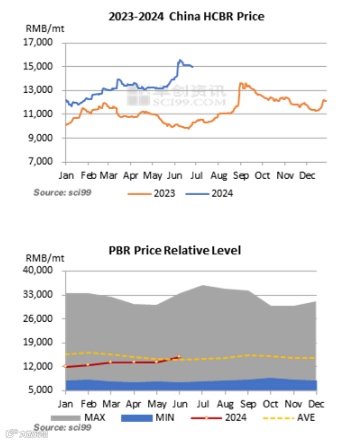
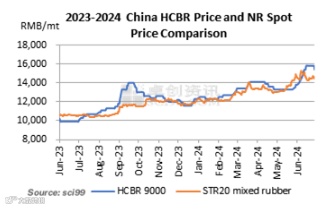
In H1, 2024, the PBR price mainly registered an uptrend. As of June 28, the market price of HCBR 9000 in North China closed at RMB 14,950/mt, up 22.54% from January 2. The highest point appeared in mid-June at RMB 15,600/mt, up 30% from the highest point in H1, 2023. The lowest point appeared in mid-January at RMB 11,700/mt, up 18.78% from the lowest point in H1, 2023.
In terms of the price relative level in the past 10 years, the monthly average price of PBR in H1, 2024 moved up month by month and went above the historical average in June 2024.
Fundamentals review: The cost rose notably, but the fundamentals changed limitedly Y-O-Y.
2023-2024 China PBR Fundamentals
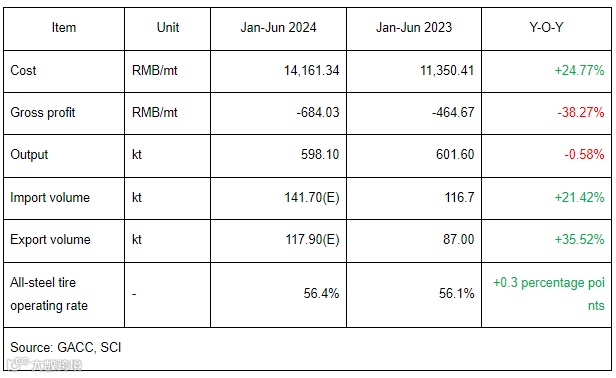
As shown in the table above, in H1, 2024, the production cost of the PBR industry increased significantly, while the gross profits declined. There was no obvious favorable factor in fundamentals. The PBR price climbed beyond expectations. Therefore, in H1, 2024, the influence of supply and demand on the PBR market weakened, while the changes in cost became the key factor strongly affecting the PBR market. Besides, the rise in the prices of synthetic rubber futures and natural rubber also bolstered the rise in the PBR price.
The cost perked up notably, underpinning the bottom of the PBR price.
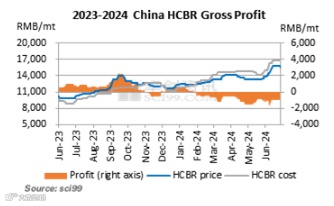
In H1, 2024, the butadiene price rose notably, bolstering the bottom of the PBR price. The cost changed ahead of the PBR price. The long-term negative gross profits strongly underpinned the bottom of the PBR price. In January and February, the expected unit maintenance in Q2 intensively affected the butadiene market. Besides, some external butadiene units were shut down, leading to a tight supply. Thus, the butadiene price edged up, bolstering the PBR market. On the other hand, downstream users replenished PBR resources before the Spring Festival, promoting the cost to transfer downstream. Thus, the PBR price trended up, and the profit losses were narrow. In March, affected by shutdowns or production cuts of external units, China’s butadiene import volume declined somewhat, leading to a constant low inventory at the port in East China. Limited butadiene resources circulated in the market. In addition, the operating rate of China’s crackers was not high. Some butadiene units were shut down unexpectedly, and the restarts of some units were postponed. Thus, China’s butadiene supply was insufficient, strongly bolstering China’s butadiene price. The PBR cost hit a 3-year high, putting high pressure on the profits of the PBR industry, so the PBR price rose passively. In H1, 2024, the average cost of China’s HCBR production was RMB 14,161.34/mt, up 24.77% Y-O-Y, while the gross profit dropped by 38.28% Y-O-Y.
The prices of related products moved up, driving up the upper end of the PBR price.
Synthetic rubber futures: On July 28, 2023, the synthetic rubber futures were listed. In June 2024, the price of synthetic rubber futures rose by around RMB 2,200/mt to a new high since its listing, lending some essential support for the rise in the spot PBR price. There were two main drivers of the rise in the price of synthetic rubber futures in H1, 2024. First, spurred by the real estate strategy, the prices of commodity futures moved up in tandem. Thus, the price of synthetic rubber futures moved up. Second, players worried about the delivery of new PBR resources in July, and the feedstock butadiene price climbed. Thus, the prices of synthetic rubber futures and spot PBR both perked up and reached new highs constantly.
Natural rubber: Natural rubber and synthetic rubber are usually mixed in the production of rubber products, and the properties of natural rubber are superior to those of synthetic rubber, so the natural rubber price strongly affects the upper end of the PBR price. In H1, 2024, the natural rubber price fluctuated upwards. Due to the climate anomalies in overseas production areas, the output release underperformed. At the same time, the insufficient feedstock inventory at processing plants drove up the feedstock price, which hit a new high since 2017. The cost was the main driver of the rise in the natural rubber price in Q1. In Q2, although the rubber tapping work started in major production areas, the increase of rainfall in domestic and overseas production areas affected the pace of the overall rubber tapping work, leading to a slow release of the new field latex output. At the same time, the import volume shrank, so the overall spot supply was relatively tight, and the inventory at all links was consumed continuously. Particularly, after some downstream tire enterprises replenished natural rubber on rigid demand, the natural rubber resources circulating in the market were scant, driving up the price of spot natural rubber. The rise in the natural rubber price provided some scope for the rise in the PBR price. Since late June, with the natural rubber price falling, the PBR price was much higher than the natural rubber price, so the PBR price dropped from highs.
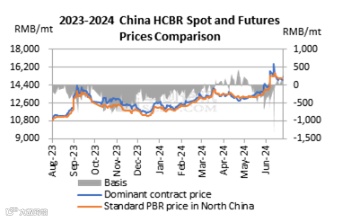
Source: SHFE, SCI
Demand:
In H1, 2024, the operating rates of the all-steel tire industry and the semi-steel tire industry trended differently. In 2024, the growth of China’s real estate industry slowed down, resulting in a tepid demand for replacement all-steel tires. Thus, the tire inventory was consumed slowly. At the same time, the global infrastructure industry was sluggish, and the rise in ocean freight chipped away at China’s advantages of tire exports, so China’s all-steel tire exports slowed down, and the overall performance was weaker than that in 2023. Dragged by the soft replacement tire market and exports, the tire inventory at enterprises faced pressure, leading to a downward trend in the operating rate of the all-steel tire industry. As for the semi-steel tire industry, the production and sales of semi-steel tires were both strong in H1, 2024 boosted by the rapid development of new energy vehicles and the increase in export orders.
H2, 2024 outlook: In H2, 2024, the tire output may be lower than that in H1, while the PBR output may be higher than that in H1. Against weak fundamentals, the PBR price is expected to mainly slide in line with the cost.
Cost: The cost is likely to fall in H2, 2024, weakening the support for the bottom of the PBR price.
The butadiene market price is expected to fall from highs in H2, 2024, with the highest points appearing in July. The average price may be higher than that in H1.
In H2, 2024, the overall maintenance of China’s butadiene units is expected to weaken, and some new butadiene units are expected to go into production in Q4, leading to a rise in China’s butadiene supply, thereby weakening the support for the butadiene price. In terms of imports, the butadiene price in Northeast Asia may be high, attracting some deep-sea cargos for arbitrage. In August, some butadiene resources from Europe and the U.S. may arrive in the Asian market. Some Southeast Asian resources are also under negotiation, which may flow into Northeast Asia. Yet, considering the shipping cost for deep-sea cargo, the import continuity may be uncertain. The expected rise in the butadiene supply is expected to weigh on the butadiene price. However, as new units may come on stream in H2, 2024, and the increment in the theoretical downstream consumption volume is likely to be larger than that in supply, the demand may bolster the butadiene price to some extent. Therefore, players are cautious about the decrement in the butadiene price in H2. The average butadiene price is likely to be slightly higher than that in H1, dragging down the PBR price.
Supply: New PBR units may go into production, and limited units are scheduled to take maintenance, resulting in a rise in the supply, thereby curbing the PBR price.
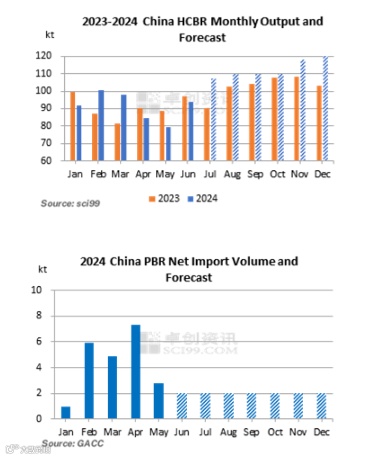
In H1, 2024, there was no newly added PBR capacity, and there were many units taking maintenance. According to SCI, the 120kt/a new PBR unit at Zhejiang Transfar Synthetic Materials is expected to take a trial run in late July, and the 150kt/a unit at Shandong Yulong Petrochemical may take a trial run in Q4. As of the end of 2024, the PBR capacity in China is predicted to reach 2,102kt/a. In H1, with low gross profits, PBR units took turnarounds intensively, so the PBR output dropped by 0.58% Y-O-Y. The overhauled units at PetroChina Dushanzi Petrochemical and Xinjiang Lande Fine Petrochemical are likely to be restarted in July. The restart time of the units at Nanjing Yangzi Petrochemical and Rubber and Shandong Wintter Chemical is undetermined. The units at Zhenhua New Materials and Shandong Yihua Rubber & Plastic Technology have been restarted. There may be fewer units taking maintenance in H2, and new capacity is expected to come on stream, weighing on the PBR market.
Net imports: The international situation may hardly see significant changes in the short term. The export trade partners of European countries are likely to be stable. Thus, China’s PBR import volume is expected to hover at highs. Yet, with the spread between domestic prices and import prices narrowing and Chinese-made PBR output increasing, the increment in the import volume may be limited. As for exports, driven by the expected loose supply of Chinese-made resources and the recovery in overseas demand, the PBR exports are likely to ramp up. Overall, the net import volume of PBR may remain positive. The PBR supply is expected to pick up in H2, 2024.
Demand: The downstream tire output is expected to edge down in H2, 2024, and the demand may be lower than that in H1.
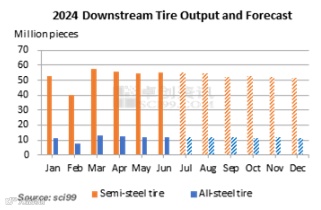
According to SCI, the output of all-steel tires in H2, 2024 is predicted to drop by over 1% from H1, while that of semi-steel tires may rise by around 2% from H1 but register a downtrend. In H2, the replacement all-steel tire market is likely to remain weak, and the exports may be lower than before. All-steel tire enterprises are expected to fail to consume the inventory, dragging down the operating rate. Thus, it is projected that the all-steel tire output may slide in H2. Bolstered by the rapid growth of the new energy vehicle industry and the passenger car data, the semi-steel tire industry will possibly perform better than the all-steel tire industry. On the whole, the seasonal characteristics of tire production in H2 may be not obvious. The unfavorable factors including the hot weather are expected to curb the rise in the tire output. The tire output may be lower than that in H1. In conclusion, the demand for PBR is likely to be weak, failing to drive up the PBR price effectively.
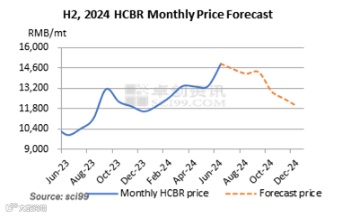
It is projected that the PBR market price may fall from highs in H2, 2024, while the average price is expected to be higher than that in H1.
Although players are positive about the macro economy in H2, 2024, the PBR price may fail to break the highest point in H1 affected by the decline in cost and demand and the rise in supply. Besides, curbed by the fall in cost, the PBR price is likely to drop from highs, with the highest point appearing in early July and the lowest point appearing in Q4. Yet, bolstered by the high price base and the limited decrement in cost, the PBR price may trend within the range of RMB 12,000-14,500/mt in H2, which is higher than that in H1.
All information provided by SCI is for reference only, which shall not be reproduced without permission.
Please click "Read more" for the full article.
