

Uncoated Woodfree Paper Prices to Trend Sideways
Intro: In H1 2024, the uncoated woodfree paper market first rose and then dropped, and the average market price went down slightly from that in Q4 2023. The delay of publishers' orders restricted price hikes despite cost support. In H2 of the year, as the Chinese economy maintains stable and positive development, the uncoated woodfree paper market is expected to rebound following the seasonal pattern in Q3, but it may edge down at the end of the year.
In H1 2024, the highest uncoated woodfree paper market price appeared in late March at RMB 5,913/mt, while the lowest one appeared in mid-January at RMB 5,650/mt, with a difference of 4.65% between the highest and lowest prices. In January, the market trading was flat near the Spring Festival holiday, and some distributors offered discounts to promote sales. In late March, the pulp price stepped up, boosting downstream paper prices. Some paper mills actively posted price increase notices, and the market sentiment turned bullish. In April and May, due to revisions in textbook content, the release of publishing orders was delayed by roughly half a month. In addition to the influence of the traditional slack season, some end users consumed their own stock and showed limited purchasing interest. Thus, the uncoated woodfree paper price dropped slightly despite cost support from high pulp prices. In June, sellers tentatively raised prices, but due to insufficient demand support, the implementation encountered resistance. As of late June, the uncoated woodfree paper market price was RMB 5,719/mt, which was at a relatively low level compared to the past five years.
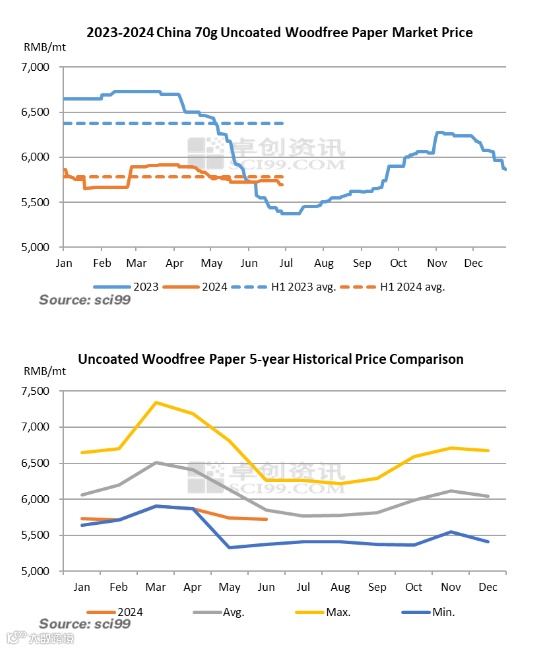
Uncoated woodfree paper price edged down despite solid cost support
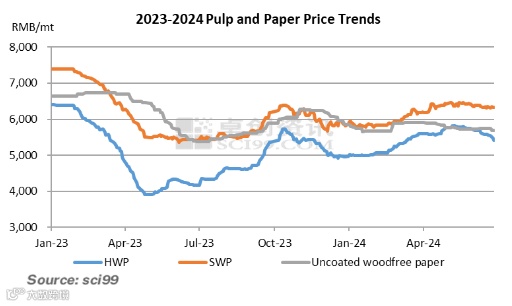
In H1 of 2024, the pulp price was supported by expectations for supply tightening due to a series of unexpected disruptions such as the port strike in Finland, extreme weather in Latin America, permeant mills closures and the anticipated rail worker strike in Canada. As a result, the pulp price rose firmly during H1 of 2024. Taking the HWP price as an example, the average spot market price of imported HWP was RMB 5,426/mt, up 8.42% Y-O-Y. The highest price appeared in early May at RMB 5,810/mt, while the lowest price appeared in January at RMB 4,983/mt, with a price spread of RMB 827/mt or 16.60%.
Calculated based on a usual furnish for uncoated woodfree paper production, the theoretical material cost rose from RMB 4,044/mt in January to RMB 4,540/mt in May, up 12.27%. The notable increase in production costs squeezed the profits of paper mills, and they were eager to raise the price. However, due to tepid demand, the price hikes were hardly implemented.
Industry overcapacity escalates, affecting the market trend
On the supply side, the uncoated woodfree paper capacity increased notably by 1.07 million ton/a including an upgraded line with 520kt/a capacity in Shandong and a newly added line with 550kt/a capacity in Guangxi. The market supply in East China and South China both increased, and some resources started to flow from the south to the north, intensifying market competition. However, due to falling profitability in the paper industry, some paper mills became inactive in arranging production. As of late June, the theoretical gross profit rate of the industry was -0.33%, down 10.84pp Y-O-Y. The average industry operating rate was 62.03%, down 4.61pp Y-O-Y, but due to capacity expansion, the output still rose marginally by 0.21% to 4.85 million tons.
Besides, the uncoated woodfree paper import volume went down by 9.97% Y-O-Y during the first 5 months of 2024, but due to the low proportion in total supply, changes in imports had no apparent influence on the market. In H1 of 2024, the total market supply was 6.38 million tons, up 5.11% Y-O-Y.
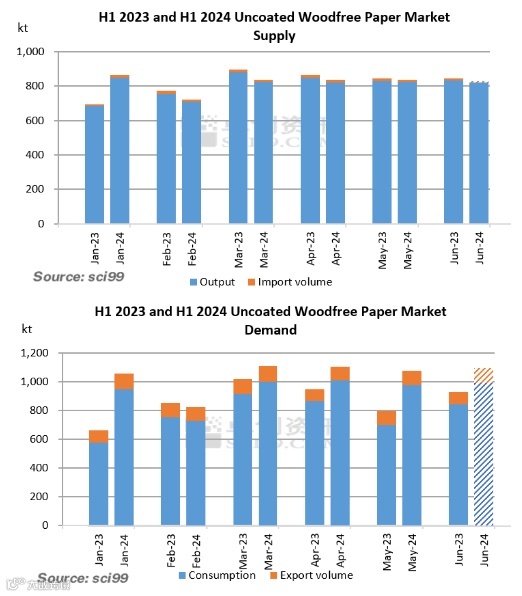
As for demand, uncoated woodfree paper is mainly used for the printing of textbooks and general publications. In 2024, due to textbook revision, publishers’ tenders appeared roughly 2 weeks later compared to usual years. So due to delays in publishers' orders and tepid demand from society buyers, the demand for uncoated woodfree paper hardly increased. During the first 5 months, the consumption volume totaled 3.90 million tons, up 2.51% Y-O-Y, and the export volume was 424.8kt, down 8.65% Y-O-Y. The decrease in export volume dragged down overall demand. In H1 of 2024, the total market demand is expected to be 5.24 million tons, up 0.77% Y-O-Y.
In general, the total uncoated woodfree paper demand growth was narrower compared to that of supply, and the market imbalance continued, restricting paper prices. Publishers’ orders were delayed due to textbook revision, and the demand from society buyers was also tepid due to slow consumption. Therefore, the supply pressure continued to have bearish influences on the market.
In H2 of the year, major market drivers will still be cost, supply and demand. The pulp price may come down under pressure, lending weaker support to the uncoated woodfree paper price. The supply pressure is expected to continue, but the market demand may improve during the traditional peak season. Under the influence of both bullish and bearish factors, the uncoated woodfree paper market may rebound slightly from the bottom.
Demand may support the market during peak season
There will be limited new capacity in H2 of the year except for an expansion at a paper mill in Central China. But the supply pressure is likely to persist, putting a bearish influence on the uncoated woodfree paper market. However, downtimes and production swings are expected in H2 of the year as paper mills struggle to market profits, which may to some extent alleviate the supply pressure from capacity expansion. On the other hand, publishers are to organize tenders from August to October for textbook printing used in the school session next spring, and some booksellers also need to replenish their stock. Therefore, the demand factor will lend bullish support to the uncoated woodfree paper market. SCI reckons that the total demand for uncoated woodfree paper will likely be 4.96 million tons in H2 of 2024, down 5.34% from that in H1. The total supply is estimated to be 6.26 million tons, down 1.88% from that in H1. On the whole, the market supply-demand imbalance may persist, and the lingering supply pressure may restrict effective price rebound in the market.
Stronger seasonal performance expected from September to November
The uncoated woodfree paper price trend demonstrates obvious seasonal patterns. From July to August, as publishing orders diminish, the demand support weakens. Despite that paper mills are still eager to hold prices firm, the market price generally lacks favorable support. Besides, some additional volume may flow from Southeast Asia into China due to weaker demand and logistics bottlenecks in the European market. This will further strengthen the supply pressure in China, dragging down the paper price. However, the stationery paper demand is to be released in September as the new school semester commences. In addition to tender orders from publishers, the demand factor will turn bullish, driving the price upward. In October, the market may still head up inertially, but the uptrend will probably decelerate. In November and December, some distributors may rush to meet sales targets and recoup cash near the end of the year. Therefore, the uncoated woodfree paper price is expected to drop due to discounts and sales promotions.
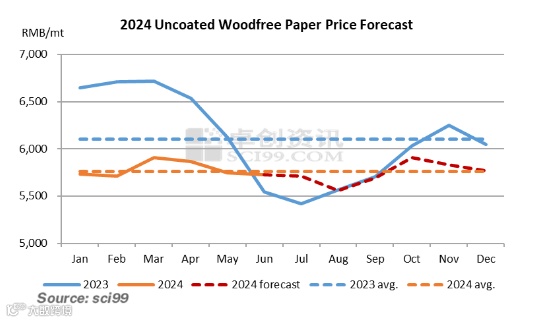
In conclusion, SCI still holds the price forecast for H2 of 2024 in the 2023-2024 China Cultural Printing Paper Market Annual Report. The uncoated woodfree paper market is likely to hover at the bottom before warming up in the upcoming peak season in September and October and finally softens and heads down near the end of the year. Affected by the bearish expectations in the pulp market, the uncoated woodfree paper average market price in H2 may be slightly lower than that in H1. The mainstream price range is expected to be RMB 5,560-5,910/mt. The highest price may appear in October, while the lowest price may appear in August.
Risk disclosure: Federal Reserve’s policy turns hawkish; below-expectation recovery in overseas economies; increase in paper imports; deceleration in domestic demand recovery; release of new capacity.
All information provided by SCI is for reference only, which shall not be reproduced without permission.
Please click "Read more" for the full article.