

Feb PBR Market Price Moves Sideways
Introduction: Since mid-January, the PBR market price has been range-bound with downstream procurement finishing and units restarting. The market price of HCBR 9000 in North China lingered at RMB 14,300-14,700/mt. In mid-to-late February, the decrement in the PBR price may be minor in the tug of war between bullish and bearish factors.
The PBR price hovered at highs in early-to-mid February.
As of February 17, the average market price of HCBR 9000 was RMB 14,450/mt, up RMB 1,150/mt or 9% from January 2, and up RMB 1,650/mt or 13% YoY.
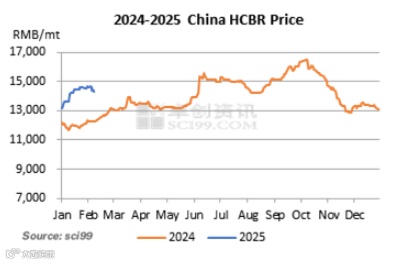
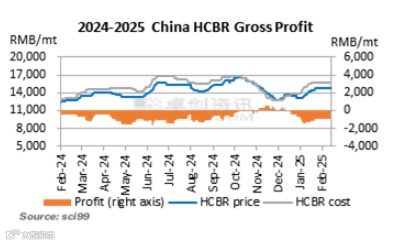
In February, the PBR market price mainly trended at highs with a narrow fluctuation. Due to high cost, the PBR industry faced high profit losses, so producers showed a weak willingness to operate. Yet, the new unit at Shandong Yulong Petrochemical went into production successfully, resulting in an ample PBR supply. As for demand, downstream enterprises suspended production for the Spring Festival holiday. After the holiday, the rigid demand recovered slowly, curbing the PBR dealings in the market. There was insufficient support from fundamentals. Yet, traders maintained high offers bolstered by cost and cut prices limitedly. Overall, dealings were hardly released. The PBR price trended sideways with the average price moving up.
The fundamentals failed to bolster the PBR market against a strong supply and a weak demand.
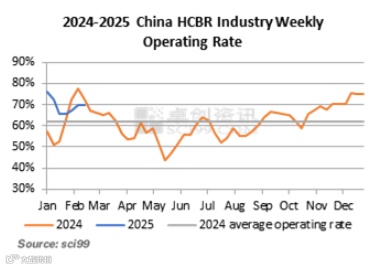
As for supply, Sinopec Qilu Company resumed normal production in February after cutting production in January. The PBR unit at Zhenhua New Materials was shut down on January 10. The PBR unit at Shandong Wintter Chemical was shut down on January 5. The unit at Hipro New Material Technology was shut down on January 23 and was restarted on February 8. At present, one production line is running. The unit at Shandong Yulong Petrochemical took a trial run at the end of December 2025 and runs normally at present. The other units were mainly under normal production. Although a few PBR units took maintenance, the new unit at Shandong Yulong Petrochemical ran normally, resulting in an ample PBR supply. In terms of demand, some tire enterprises began to cut or suspend production in mid-January in addition to the influence of the New Year’s Day holiday, heavily dragging down the operating rate of the tire industry. After the Lantern Festival, the operating rate of the all-steel tire in Shandong moved up to 62.43%. Overall, the supply stayed high, while the demand dropped notably, weighing on the PBR price.
The butadiene price remained high, underpinning the bottom of the PBR price.
Recently, China’s butadiene market price has fluctuated at highs. Up to February 17, the butadiene market price in Jiangsu-Zhejiang market was RMB 12,250/mt. The ex-works price of butadiene at Sinopec East China was RMB 12,400/mt. Most butadiene producers for outside sales faced passable sales pressure and maintained firm prices. A few producers slightly cut prices for sales, and traders operated agilely with limited willingness to sell at lows. There were few low-priced butadiene resources in the market. Without significant improvements in downstream profits, the operating rates of downstream industries recovered slowly, so downstream plants were cautious about receiving butadiene goods. Besides, the butadiene supply was expected to increase, so players mainly held wait-and-see sentiments, and some of them purchased butadiene on rigid demand when the price was low. Overall, the butadiene price trended at highs, leading to continuous profit losses in the PBR industry.
The PBR price is likely to be range-bound in the short term.
Fundamentals: In the short term, the PBR unit at Hipro New Material Technology is expected to resume normal production, and the operating rates of most PBR units are likely to be stable. The operating rate of the PBR industry will possibly edge up to around 70%. As for demand, the operating rate at tire enterprises is likely to further rise with the influence of the holiday ebbing and the tire market advancing. Yet, the high tire inventory may be consumed slowly due to the weak end demand, so the increment in the operating rate will be possibly curbed to some extent. To conclude, the rise in demand may alleviate the supply-demand pressure to some extent, and the support from fundamentals is expected to strengthen.
Cost: China’s butadiene market is expected to edge down in the short term. In terms of supply, most butadiene units may run normally. Jiutai Energy Inner Mongolia plans to restart its butene ODH unit, and the unit at Jiangsu Sailboat Petrochemical is likely to run normally. Available spot butadiene may ramp up next week. Thus, the support from supply may weaken somewhat. In terms of demand, some synthetic latex units may resume normal operation. Yet, amid weak profits, downstream enterprises may show thin appetites for purchasing high-priced resources. Besides, in the later period, the butadiene supply is anticipated to rise. Most downstream enterprises may adopt a wait-and-see stance and stock up for rigid demand. Recently, available butadiene resources have gained in the Asian market, affecting China’s players’ sentiment to some extent.
Natural Rubber: China’s natural rubber market may remain range-bound in the short term. In terms of supply and demand, the overseas tapping-suspended areas may further expand, supporting the feedstock price to remain at a high level. The cost may still prop up the natural rubber price. Meanwhile, tire and product enterprises may basically enter a full-scale resumption of work next week, and the demand for feedstock procurement is expected to pick up further. The warming trading atmosphere in the market is bullish for the natural rubber price. However, at the same time, the arrival of cargoes at ports is expected to increase successively, and port inventories may continue to accumulate, suppressing the increase of natural rubber prices. Therefore, overall, the price of natural rubber may remain range-bound in the short term.
Overall, China’s PBR market price is likely to fluctuate at highs. Despite a fall in the butadiene price, the profits of the PBR industry are expected to recover limitedly. The cost is expected to continue to underpin the bottom of the PBR price. The supply of PBR may be ample, but the recovery in the rigid demand is likely to alleviate the inventory pileup pressure. Besides, the natural rubber price may stay high, driving up the price of synthetic rubber futures. In addition, as players may hold sentiments of promoting sales, dealings may be conducted at low prices, dragging down the PBR price range next week.

All information provided by SCI is for reference only, which shall not be reproduced without permission.
Please click "Read more" for the full article.