

How will China’s PP Exports Vary amid Indonesia’s “Anti-Dumping” Investigation?
Highlights: Recently, it was heard that due to the application of a local Indonesian enterprise, the Komite Anti-dumping Indonesia (KADI) had opened a preliminary anti-dumping investigation on PP homopolymer products imported from Saudi Arabia, the Philippines, South Korea, Malaysia, Singapore, Thailand, Vietnam and China.
Background of anti-dumping by Indonesia and possible consequence
The background of Indonesia’s anti-dumping is an application initiated by PT Chandra Asri Petrochemical Tbk (hereinafter referred to as “Chandra Asri”), a local chemical company. They believe that there is price dumping of PP homopolymer products imported from China, Saudi Arabia, the Philippines, South Korea, Malaysia, Singapore, Thailand and Vietnam, which has caused losses in Indonesia’s domestic-related industries. At present, it has entered the preliminary investigation stage. The main object of the investigation is homo PP products (HS code: 39021000). The investigation subjects include manufacturers and export traders involved in the alleged countries. The relevant parties can submit a questionnaire survey within 14 days of the announcement (i.e. until December 17).
At present, the main consequences of anti-dumping include the imposition of anti-dumping duties on imported products. The amount of the tariff is determined according to the dumping margins of different export operators and shall not exceed the dumping margins determined in the final ruling. This will lead to higher trading costs and reduced international competitiveness.
Influence of possible anti-dumping by Indonesia on China PP export business
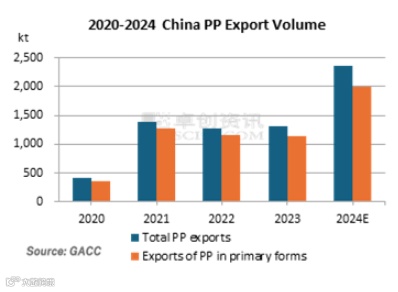
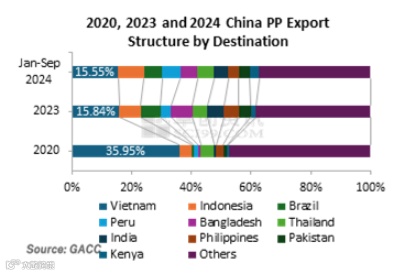
Since 2021, China’s domestic PP producers and trading enterprises have actively laid out and developed export markets, and the export volume has trended upwards in recent years. In 2024, China’s PP export market performs well, an increase of 69.47% over 2021, the year with the largest export volume in history. It is expected that in 2024, China’s PP export volume will probably reach 2,350kt, a record high, and the export of homo PP products will also reach a historical peak. From the perspective of China’s PP export trading partners, more than 30% of exports flow into Southeast Asian countries, and Vietnam accounts for the largest export share. After 2021, the demand for PP increased in Indonesia with local manufacturing industry development accelerated. In 2024, it is expected that China’s homo PP exports to Indonesia may reach around 180kt, making Indonesia the second largest export trading partner in Southeast Asia after Vietnam.
If Indonesia implements anti-dumping duties on homo PP products imported from China in the future, it will possibly have a certain negative impact on China’s export market. However, in the long run, its impact is still within controllable range. The short-term impact mainly stems from the fact that China’s homo PP exports to Indonesia account for 8.59% of the total PP exports in China. The increase in export tariff may directly enhance export costs, which may reduce China’s PP export volume in the short term. However, the countries involved in this anti-dumping investigation are still Indonesia’s main import trading partners, and PP supply in Indonesia cannot meet the demand, so there is still import demand. China is supposed to witness a global low PP price level for a long time under expectations for abundant capacity expansion in the future, so there are still certain export opportunities in the long run.
Changes in the exchange rate of USD against RMB value likely to propel the PP export business in China
In recent years, the exchange rate has also become one of the factors supporting exports in China. With the arrival of the “Trump 2.0” era, the implementation of the U.S. tariff increase policy has also caused exchange rate fluctuations to a certain extent. Since late November 2024, the exchange rate of the USD against the RMB has risen rapidly, reaching a new high since the beginning of the year, rising to the “7.19” mark, which has also given certain support to the export market. If the change in exchange rate accelerates the frequency of feedstock procurement and overseas demand gradually recovers, China’s PP export market may improve notably again.
Trade protection barriers rise, and exports face opportunities and challenges.
The results of Indonesia’s anti-dumping investigation may lead to an increase in anti-dumping duties on the export of homo PP products, which may dampen China’s export business in the near term but bring limited effects in the long term.
From the perspective of global trade, China’s PP export market has performed well in recent years, and oversupply and low price levels will continue to prevail in China’s PP industry. Hence, PP exports still have a large potential in the future. Overseas countries have also gradually paid attention to protecting their interests in related industries and have introduced trade protection policies. Whether it is Brazil’s increase in tariffs in South America, India’s additional BIS certification, or the expectation of the U.S. adjustment of tariffs, they will all become challenges for China’s PP export market. However, challenges and opportunities coexist. Chinese PP export enterprises are also making early arrangements, actively adjusting strategies, as well as strengthening cost control and market development, so as to maintain competitiveness and market diversification. In summary, China’s PP export market is still promising in the future. SCI will keep following up on this anti-dumping investigation and related measures in Indonesia and update relevant analysis timely.
All information provided by SCI is for reference only, which shall not be reproduced without permission.
Please click "Read more" for the full article.