

2024 NBR Annual Data Interpretation
Introduction: In 2024, although the NBR market showed a fluctuating upward trend driven by costs and related products, its low price was higher than that in 2023, but the highest price also failed to break through that in 2023. In 2025, the NBR market may face a conflict between the slow growth of demand and the unabated supply pressure. It is expected that the price fluctuation range of NBR in China in 2025 will still be relatively narrow, with repeated fluctuations.
2024 NBR Annual Key Indicators
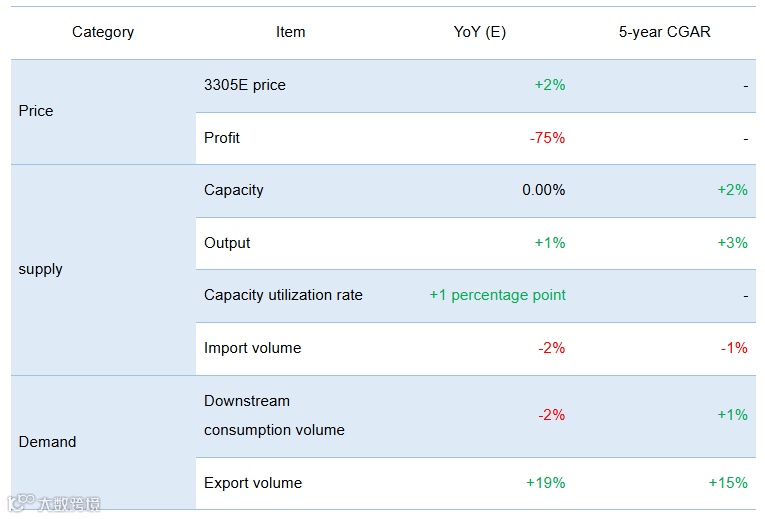
Note: Price data is due on December 19, 2024. Supply and demand data is the forecast data for the full year
Interpretation of Key Data
1. A YoY increase in the average mainstream price of NBR
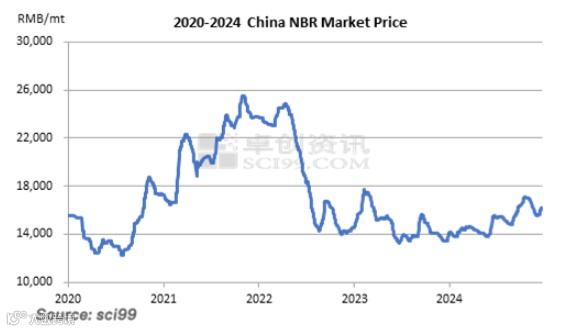
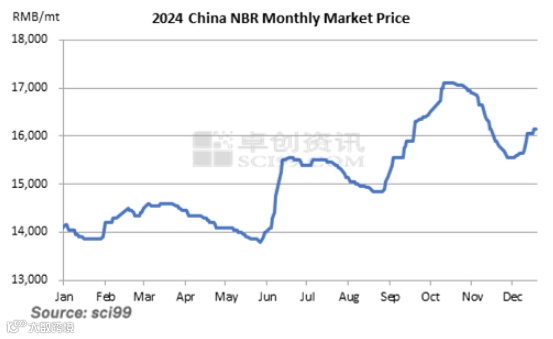
Since 2020, the NBR market has experienced a complete price cycle. From 2022 to 2023, affected by trading recession and oversupply, the market price of NBR declined from a high level and fell into low-level fluctuations. In 2024, driven by cost, macro and other factors, the NBR market price showed a fluctuating upward trend. However, due to the relatively weak supply and demand fundamentals, its price was still at a low level in recent years. Taking PetroChina Lanzhou Petrochemical 3305E in East China as an example, as of December 19, the average price from January to December was RMB 15,096/mt, a YoY increase of 1.91%; the closing price on that day increased by 14.13% compared with the beginning of the year.
From the perspective of price, for most of the year, the changes in the supply and demand pattern and expectations, combined with the fluctuations in costs and related products had an impact on the NBR market. In Q1, the market price of feedstock butadiene continued to rise, and boosted by this, the market price of NBR began to increase. However, due to the slower-than-expected recovery of downstream demand and the abundant supply of NBR, the relatively weak fundamentals restricted the increase in the NBR market price. From April to May, although the price of butadiene remained high and some NRB units underwent maintenance, it was difficult to offset the drag on the market price caused by the poor demand, and the market price of NBR declined under pressure. The subsequent increases in June, September, October, and December, as well as the decreases in July, August, and November, all replicated the previous market trends. The upward phases were supported by high prices of feedstock and related products and the phased reduction in the supply side, but the limited follow-up of demand curbed the increase in NBR prices, and the downward phases were all affected by the relatively weak demand.
2. Significant drop in production profit of the NBR industry
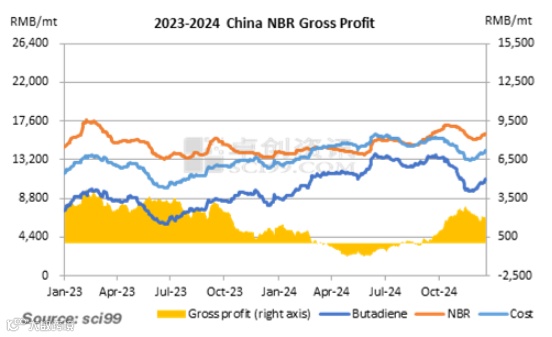
In 2024, the production profit of the NBR industry continued to decline. According to SCI, as of December 19, 2024, the average annual profit of NBR dropped by about 81% YoY. During the year, factors such as load reduction of cracking units, unexpected maintenance of domestic and foreign units, and the expansion of new butadiene capacity mostly concentrated at the end of the year led to a significant increase in the market price of butadiene. However, due to the slow recovery of downstream demand, the price increase of NBR was far less than that of feedstock, so its profit level continued to shrink, and the profits in the industrial chain were mostly concentrated in the upstream butadiene. As seen from the operation of major downstream industries, industries such as hose and belt, foaming, and sealing all faced the common problem of approaching production capacity saturation. Against the backdrop of a relatively slow overall demand recovery, it was difficult for downstream enterprises to effectively pass on the increase in feedstock costs to consumers, which further led to a further contraction of the profit of the NBR industry. Therefore, in 2024, the NBR industrial chain as a whole showed the characteristics that upstream profits were dominant while downstream profits were restricted, which reflected the imbalance between feedstock supply and demand recovery.
3. Narrow growth in output and decline in import volume
In terms of output, it is estimated that the total output of NBR in China in 2024 will increase by 1% YoY, with the annual capacity utilization rate increasing by about 1 percentage point YoY. Given the reduction in the intensity of maintenance, the output of NBR increased. However, at the same time, due to the significant increase in the price of butadiene and the contraction of the production profits of NBR, some producers reduced their operating rates in some stages or adjusted their production plans for NBR, which also led to a narrowing of the growth in the output of NBR.
In terms of import volume, it is estimated that the import volume of NBR in China in 2024 will decline by 2% YoY. The main reason lies in the reduction of nearby ocean sources. Due to the significant increase in the price of butadiene, especially the tight supply and rising prices of butadiene in the overseas market in H1 of the year, under the pressure of costs, some nearby ocean plants reduced the operating rates of NBR units. The reduction in the base of imports is one of the main reasons for the decline in the import volume of NBR in China.
4. A YoY decline in downstream consumption while an optimistic growth in export volume
In terms of domestic demand, it is estimated that the downstream consumption of NBR in China may decline by 2% YoY in 2024. Looking at the two major end industries of NBR, the data released by the China Association of Automobile Manufacturers shows that from January to November 2024, the output of new energy vehicles increased by 35% YoY, while the output of traditional fuel vehicles declined by 11% YoY. For NBR, the reduction in the output of traditional fuel vehicles is one of the realities faced by the decline in its downstream consumption. In the real estate sector, the completed area of the real estate market decreased during the year. From January to November, the completed area of national real estate projects dropped by 26.2% YoY, and the demand for NBR downstream industries such as thermal insulation and foaming materials in the rear end of the real estate sector diminished compared with last year. The reduction in demand in the two major end markets led to a decline in the downstream consumption of NBR.
In terms of exports, it is estimated that the export volume of NBR in China will increase by 19% YoY in 2024. On the one hand, some domestic producers stepped up their export efforts and actively explored foreign markets. The resilience of some rigid demand led to an increase in the proportion of exports. On the other hand, factors such as the relatively abundant supply of domestic goods and the existence of export arbitrage space also attracted some suppliers to target the international market. Meanwhile, some entrepot trades also drove the growth in the export volume of NBR. However, it should be noted that although the export volume rose, since a large part of the goods were for entrepot trade, the actual impact on the domestic market was relatively limited.
Outlook for the NBR Market in 2025:
Looking ahead to 2025, in terms of the macroeconomic cycle, starting from Q4 of 2024, the global monetary cycle has begun to shift gradually, and the process of monetary normalization has commenced. During the Federal Reserve’s interest rate cut cycle, prices of commodities are highly likely to show a downward trend. The Kondratieff cycle still poses a significant macro-demand negative factor. However, commodities generally perform well during the recession stage, and there have been two bull markets for commodities in the past decade. The real estate cycle is at the end of a cycle, which restricts the weak demand for commodities. The Juglar cycle is in an upward phase. For commodities, the intertwined influence of high supply and high demand affects commodity prices. Currently, the commodity market is in the inventory replenishment stage. The transition from active inventory replenishment to passive inventory replenishment will be completed in H1 of 2025. A new round of the inventory cycle will start from Q4 of 2026 to Q1 of 2027. Active inventory replenishment is defined as a situation where inventory is on the rise and prices are going up, which is the main stage for price increases. After inventory reaches a high level, prices turn downward during the passive inventory replenishment stage. Therefore, in terms of the trend, the transition from active inventory replenishment to passive inventory replenishment will be completed in H1 of 2025, and commodity prices will be more likely to fall than rise.
On the other hand, in terms of the industrial cycle, the pressure on the supply side remains unabated, and the growth rate on the demand side lags behind that of the supply. Since the NBR market began to expand capacity in 2022, the elasticity and room for growth on the supply side have increased. In 2025, the expansion of NBR supply will still be in progress, which determines that the price level of NBR will likely remain at a relatively low level. Therefore, even though there is usually unit maintenance in Q2 and Q4, they will not be able to provide significant impetus for the market price to rise substantially. From the demand side, as a series of policies conducive to the economy are accelerated to be implemented and combined with the steady growth of the internal driving force of the economy, China’s economic recovery and upward trend are quite firm, which is expected to boost the consumption demand of some end markets of NBR and feedback to the NBR market. The resilience of the bottom price of NBR is expected to be enhanced.
In addition, attention also needs to be paid to the impacts brought by changes on the cost side and related products. The price of butadiene may decline along with the capacity expansion, and the cost side will gradually turn bearish. However, from the perspective of related products, the fundamental positive factor that the supply of natural rubber is expected to decline will support its price to fluctuate at a relatively high level. The relatively strong performance of natural rubber will provide support for SBR, PBR, and feedstock butadiene, and then affect the NBR market to experience periodic positive changes.
Therefore, after comprehensively considering the macroeconomic cycle and the industrial cycle, SCI forecasts that China’s NBR market may exhibit repeated fluctuations within a certain range in 2025. It will be difficult to form a unilateral trend, and the overall price level may remain relatively low.

All information provided by SCI is for reference only, which shall not be reproduced without permission.
Please click "Read more" for the full article.