

2024 NBR Imports Decline While Exports Increase
Introduction: In recent years, as the Chinese market adapts to anti-dumping policies and boosts domestic self-sufficiency rates, the import dependence on NBR has shown a decrease. In the future, with the increase in domestic output and the continuous growth of demand in some developing economies, it is expected that the growth of China’s NBR imports will face pressure, while there remains room for the export volume to grow.
China’s NBR Import Volume Declined in 2024
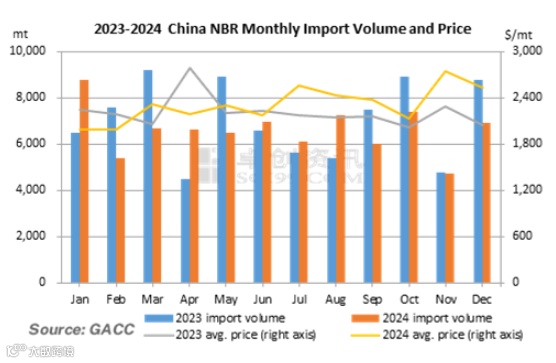
The import volume of NBR in China declined in 2024. According to the data released by GACC, the import volume of NBR in China in 2024 was 79,400mt, representing a YoY decrease of 5.82%, mainly due to the reduction in near-sea supplies. Due to the significant increase in the price of feedstock butadiene throughout the year, especially the tight supply and rising prices of butadiene in the overseas market during H1 of the year, some near-sea production units experienced reduced production load under cost pressure. The decrease in the import base is one of the main reasons for the decline in China’s NBR import volume. In addition, as the prices in some foreign markets were higher than Chinese market, the profit comparison also prompted some foreign producers to adjust their supply strategies.
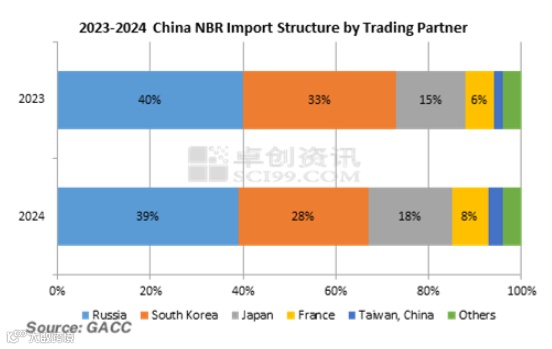
In terms of import trading partners, in 2024, there were no significant changes in the main import origins of China’s NBR, but the import volume of NBR from each trading partner did change to some extent. In 2023, Russia surpassed South Korea to become the largest import trading partner of China’s NBR, and this situation continued in 2024. Affected by geopolitical factors, a portion of Russian goods that originally flowed to Western and Central Europe changed their direction to the Chinese market in the past two years, and some of these goods were re-exported through China to Southeast Asia or South Asia. In addition, the price of NBR imported from Russia was relatively low, giving it a certain cost advantage.
By the end of 2024, China imported approximately 31,000mt of NBR from Russia, a YoY decrease of 8.8%, accounting for 39% of the total import volume, with a relatively narrow fluctuation range. China imported about 22,000mt of NBR from South Korea, a YoY decrease of 20.4%, accounting for 28% of the total import volume. The decline in import volume was mainly due to the reduction in South Korea’s supply caused by cost pressure. China imported approximately 14,000mt of NBR from Japan, a YoY increase of 9.8%, accounting for 18% of the total import volume. The increase in import volume was mainly because some Japanese producers actively targeted the Chinese market during the year. In addition, since 2018, China has imposed anti-dumping duties on NBR imported from South Korea and Japan. Moreover, in the past two years, under the pressure of the economic environment, end factories have been seeking lower cost control. As a result, some downstream factories in the Chinese market have already replaced NBR imported from South Korea and Japan. Therefore, the changes in the import volume of NBR from South Korea and Japan during the year did not have a significant guiding effect on the Chinese market.
China’s NBR Export Volume Increased in 2024
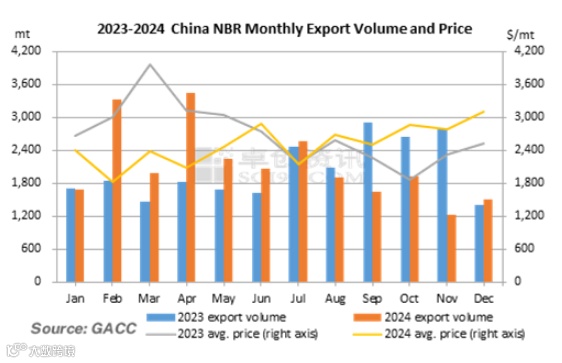
The export volume of NBR in China increased in 2024. According to the data released by GACC, the export volume of NBR in China in 2024 was 25,500mt, a YoY increase of 4.45%. On the one hand, some domestic producers expanded their export efforts and actively explored overseas markets. The existence of some rigid demand led to an increase in the proportion of exports. On the other hand, factors such as the relatively abundant supply of domestic goods and the existence of export arbitrage space also attracted some suppliers to target the international market. At the same time, some entrepot trade also contributed to the growth of the export volume of NBR. However, it was worth noting that although the export volume increased, since a large proportion of the goods were for re-export, the actual impact on the domestic market was relatively limited.
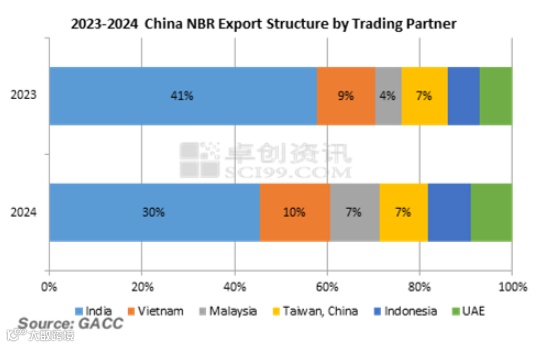
In terms of export trading partners, in 2024, there were no significant changes in the main export destinations of China’s NBR, mainly flowing to India and Southeast Asia. Specifically, in 2024, the export volume of NBR from China to India was 7,500mt, a YoY decrease of 25.6%, accounting for 30% of the total export volume. In recent years, the Indian economy has shown a continuous growth trend. The growth of the economic level has led to an increase in the local demand for rubber feedstock. Therefore, India has always been among the top export trading partners of China’s NBR. The main reason for the decline in the export volume of NBR from China to India in 2024 was the reduction in entrepot trade. In the past two years, some goods from a certain European country were transshipped to India through China. The decline in the arrival quantity of goods from a certain European country also affected the growth of China’s exports of NBR to India.
Different from India, in 2024, the export volume of NBR from China to some Southeast Asian countries increased YoY. Among them, the quantities of NBR exported to Vietnam, Malaysia, Indonesia, and Thailand increased by 23.5%, 96.9%, 20.8%, and 41.0% respectively compared with the previous year. The Southeast Asian region is rich in labor resources and has relatively low labor costs. In recent years, some industries have been transferred to the Southeast Asian region. However, due to the limited local supply capacity, it is difficult to meet the market demand, thus providing a market space for the export of China’s NBR. Secondly, the geographical advantages and relatively low sea freight costs have also increased the enthusiasm of Chinese enterprises to export to the Southeast Asian region.
It is expected that the growth of China’s NBR imports will face pressure in 2025, while there is still room for growth in export volume.
In terms of imports, firstly, overseas newly added capacity is limited. With the continuous recovery of capacity in major overseas manufacturing countries, the scope of supply outflow from the world’s major NBR exporting countries and regions may still expand. In addition, the increase in China’s output will further enhance the domestic self-sufficiency rate of NBR. Moreover, as the product quality continues to stabilize and improve, it may also restrain the growth of import volume to a certain extent.
In terms of exports, firstly, the quality of domestic NBR is gradually stabilizing, and domestic supply continues to increase. Against the backdrop of oversupply, exports are undoubtedly still one of the effective ways to expand the consumption channels of China’s NBR. In addition, the economic growth of emerging markets and developing economies will maintain the resilience of rigid demand within the region, which will also drive the growth of China's NBR export volume.
Overall, the growth of NBR export volume will help to alleviate the pressure of oversupply in China’s market and thus provide a certain support for NBR prices. Therefore, for the NBR industry, seizing export opportunities and optimizing export strategies will be one of the important ways to achieve sustainable development in the next five years.

All information provided by SCI is for reference only, which shall not be reproduced without permission.
Please click "Read more" for the full article.