

2020-2024 China Methanol Capacity Development Analysis
In recent years, China’s methanol capacity growth has slowed down, influenced by national energy consumption control policies, environmental protection inspectors and high investment costs of coal chemical projects, etc. In 2024, China’s methanol capacity increased by 3.80 million mt/a to 111.81 million mt/a, up 3.52% YoY. However, the average growth rate of capacity in the recent five years further shrank to 4.81%, down 0.76 percentage points from the previous five years. It is predicted that China will see another 5.4 million mt/a newly added capacity in 2025 when the total capacity may reach 117.27 million mt/a, up 4.8% YoY. In the future several years, the growth rate of methanol capacity is expected to remain stable at about 3%-5%.
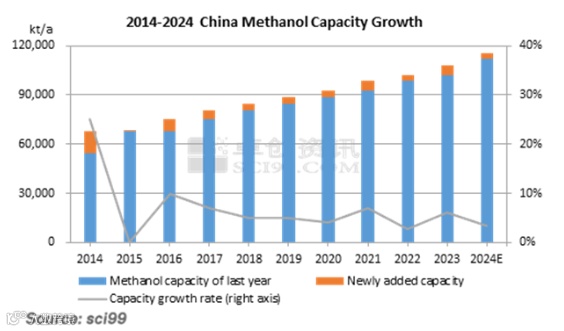
Stable feedstock supply contributes to the growth of methanol capacity.
The steady supply of feedstock and the optimization of production costs are important reasons for the continuous expansion of methanol capacity. Taking the theoretical cost of coal-based methanol as an example, it overall showed an M-shape movement from 2020 to 2024. In 2020, the cost stayed at a relatively low level of RMB 1,500/mt, boosting the methanol capacity growth. In 2021, due to coal price rises, the cost of methanol climbed to RMB 2,318/mt, up 54.33% YoY. In 2022, the average cost remained high at RMB 2,616/mt, hitting a five-year high, as coal prices kept firm on grounds of supply restrictions and global inflation, etc. Heavy cost pressures dampened players’ willingness to invest and start methanol projects. From 2023 to 2024, coal prices stabilized in line with national macro regulations. The average cost of methanol hovered around RMB 2,200/mt, with its capacity growth tending to be stable.
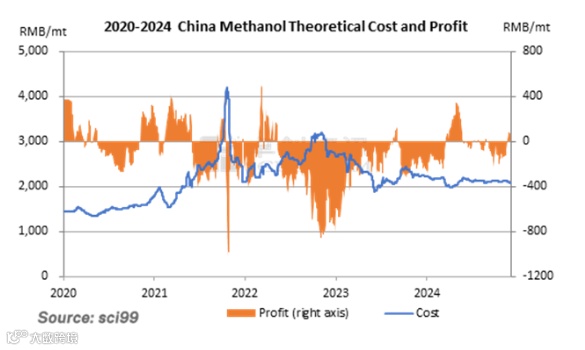
Methanol capacity growth is positively correlated with its profitability.
There is also a close and complex relationship between methanol capacity growth and profitability. In recent years, the profit data of the methanol industry has fluctuated significantly. In 2020, the theoretical profit from producing coal-based methanol was RMB 18/mt, but it turned negative in the following years. The theoretical profit loss was RMB 63/mt in 2021 and then expanded to RMB 303/mt in 2022. Afterwards, the profitability improved gradually, but the profit remained negative at RMB -210/mt in 2023. In 2024, the profit loss narrowed to RMB 22/mt. As for capacity growth, the growth rate of methanol capacity was 7.09% in 2021, 2.83% in 2022 and 3.52% in 2024, which was basically in accordance with the methanol profit variation trend. For one thing, poor profitability of methanol will lead to limited liquidity of enterprises, and enterprises will suspend or cancel new project plans. For another, changes in profitability will also affect investors’ confidence and expectations in the methanol industry, and the increased difficulty in financing will further limit the capacity expansion.
Methanol capacity develops in the direction of large-scale and intensification.
In the past, China’s methanol industry development showed characteristics of large enterprise number, small capacity, and scattered capacity distribution. With the startup of large-scale CTO/MTO projects and the withdrawal of some small capacity in recent years, the domestic methanol capacity has presented a trend of large-scale and intensive development. The proportion of large methanol units has increased by a large margin. In 2024, the proportion of methanol units with capacity of 1,000kt/a or above was 47.17%, up 0.38 percentage points YoY. The proportion of methanol units with capacity of 400kt/a or above was 76.90%, up 0.07 percentage points YoY.
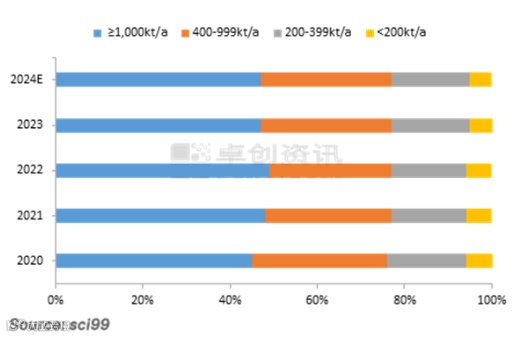
These changes reflect the promotion of domestic and foreign macroeconomic policies and environmental protection requirements. The operation of large-scale methanol projects has not only improved the efficiency of capacity utilization, but also promoted the effective integration of resources, making the industrial chain more complete. At the same time, with the progress of chemical technologies and the improvement of environmental protection standards, those small-scale, high energy consumption, and small units that are difficult to meet environmental protection standards have been gradually eliminated, which has promoted the overall industry improvement.
Overall, China’s methanol capacity continued to grow in 2024, with a slowdown in growth, large-scale and intensification remaining the main characteristics.

All information provided by SCI is for reference only, which shall not be reproduced without permission.
Please click "Read more" for the full article.