

Benzene’s Role in Aromatics Value Chain
Benzene, the simplest aromatic hydrocarbon, serves as a foundational feedstock in petrochemicals, widely used in synthetic fibers, plastics, rubber, pharmaceuticals, and pesticides. Recently, the Dalian Commodity Exchange (DCE) released a notice soliciting public feedback on benzene futures and options contracts. The development of benzene futures and options will complement existing styrene futures and options, offering comprehensive risk management tools and pricing benchmarks for industrial enterprises, thereby enhancing supply chain stability in the aromatic hydrocarbon sector.
Introduction of the Benzene Industry
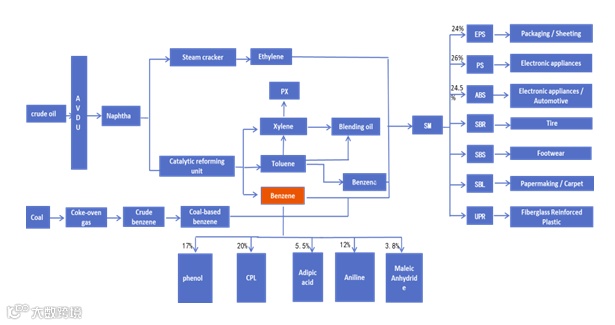
Benzene is categorized into oil-based benzene and coal-based benzene, with the industry defaulting to oil-based benzene as the standard. Positioned upstream in the industrial chain alongside toluene and xylene, benzene’s direct upstream feedstock is naphtha. Toluene and xylene have relatively streamlined downstream applications: toluene is primarily used for gasoline blending to boost octane ratings, while xylene mainly feeds PX production, with PX’s share in xylene consumption rising in recent years. In contrast, benzene acts as a versatile chemical intermediate, with key downstream products including styrene, phenol, aniline, and CPL. Its extended industrial chains link to various end-use sectors. For example, the benzene-styrene-GPPS/HIPS/ABS chain connects to packaging, automotive, consumer goods, and construction; the benzene-CPL-PA6 chain primarily serves synthetic fibers and plastics, with PA6 accounting for 99% of CPL consumption; the benzene-phenol-bisphenol A/phenolic resin chain supplies coatings, electronics, and automotive components. PC’s key end-users include auto parts, buckets, optical discs, etc.
Chart 1 Benzene Industrial Chian
Source: SCI
BTX Production Process
For BTX (benzene, toluene, xylene) production process, catalytic reforming dominates, where naphtha undergoes Pt/Re catalyst reforming to generate BTX mixtures. Benzene is then separated via extraction or distillation. Another key method is ethylene cracking, where byproduct pyrolysis gasoline (containing 20-30% benzene) from ethylene units undergoes hydrodesulfurization followed by benzene extraction.
Both processes primarily use naphtha - a colorless/yellowish petroleum-derived liquid with a distinct odor, categorized as chemical light oil. Depending on distillation range and composition, naphtha serves as feedstock for ethylene steam cracking, catalytic reforming, aromatics complexes, solvent oils, aromatization, and light naphtha isomerization units.
Naphtha supply remains largely self-consumed or traded within corporate groups, particularly within China’s three state-owned oil giants, resulting in limited market liquidity. Shandong’s refinery-to-chemicals transition has further reduced external sales. After 2019, demand surged as mega integrated refining projects drove PX unit expansions, with PX and catalytic reforming now accounting for 60% of naphtha consumption. Under refinery-to-chemicals policies, ethylene demand is rebounding after aromatics reforming capacity saturation. Currently, naphtha consumption splits evenly between ethylene steam cracking and aromatics reforming.
In addition, coking byproduct crude benzene (containing around 50-70% benzene) can be refined into benzene through hydrogenation. Hydrotreated benzene units use crude benzene – a coal-derived compound mainly composed of benzene, recovered from de-ammoniated coke oven gas during coal pyrolysis. Environmental policies and crude steel output controls have reduced production of pig iron, crude steel, coal, and coke, tightening supply of crude benzene for hydrotreating.
Benzene Imports and Exports
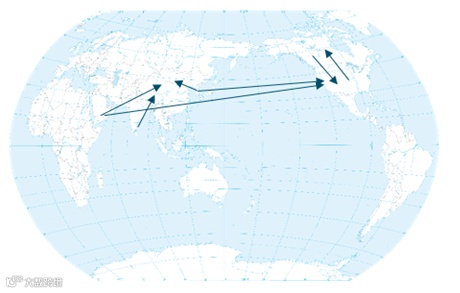
Globally, China is the largest benzene importer, followed by the U.S., while South Korea ranks as the top exporter. Korean-origin benzene accounts for the largest share of China’s imports.
Chart 2 Benzene Global Supply Flow
Source: SCI
Over the past five years, China’s benzene imports have been dominated by Asian suppliers, with South Korea contributing 46-50% of total imports. As the world’s key benzene supply hub, South Korea primarily exports to China and Europe/US.
In 2024, South Korea supplied 50.01% of China’s benzene imports, up 3.87 percentage points from 2023. This increase stemmed from weakened European/US demand and persistently closed Asia-US arbitrage windows, diverting more Korean cargoes to China. By 2025, with sluggish US demand and delayed gasoline blending needs, South Korea’s benzene exports to the US dropped to zero, while its share in China surged to 95.15%.
As the flagship aromatic product with national standards, benzene holds large-scale upstream/downstream and trading volume in the chemical sector. Booming downstream demand has steadily raised China’s import reliance and global influence. With Dalian Commodity Exchange soliciting public feedback on benzene futures/options contracts, its futures launch is imminent. Following styrene futures (listed in 2019), benzene futures will complete a benzene-styrene hedging "closed loop", helping enterprises manage price risks, lock production margins amid capacity expansions, and enhance the chemical industry’s risk resilience.
All information provided by SCI is for reference only, which shall not be reproduced without permission.
Please click "Read more" for the full article.