

Impacts of Tariff Fluctuations on China Ethanol Industry
Introduction: The joint statement of the China-U.S. Geneva economic and trade talks announced that the preliminary results were that both sides canceled 91% of the additional tariffs and suspended the implementation of 24% tariffs. This tariff reduction had a slight impact on the ethanol feedstock corn market but had little impact on ethanol import and export trade.
According to SCI, China’s ethanol output in 2024 was 10,410kt, of which 78% was grain-based ethanol output. Corn is the most important feedstock for ethanol production, and it usually accounts for 85%-90% of ethanol production costs. Cost is the core factor in ethanol pricing. Therefore, the impact of this tariff adjustment on the ethanol industry is first to affect the production cost of ethanol through corn, but the impact on China’s ethanol import and export trade is small due to the low import and export volume of ethanol.
The U.S. corn market has little impact on China’s corn market due to the low dependence on corn imports.
In the announcement of the State Council Tariff Commission on imposing additional tariffs on some imported goods originating from the U.S., the tariffs in the agricultural field involved in Announcements No. 1-2 in 2025 will continue to exist. Among them, the 15% tariff on imports of chicken, wheat, corn, and cotton in Announcement No. 2 will still be implemented. In 2024, China’s corn output was close to 260 million mt, and the import volume was only 13.6356 million mt, of which only 2.0725 million mt of U.S.-origin corn accounted for only 15% of the total imports. The import time of corn from the U.S. to China is 45 days to 2 months, which has little impact on the effective supplement of China’s short-term corn supply. In addition, from the price point of view, there may be few arbitrage opportunities for corn from the U.S. to China, which will also affect the import volume of U.S.-origin corn to China. However, tariff fluctuations will affect the global corn trade pattern. China currently mainly imports corn from Brazil and Ukraine, but the U.S., Brazil, and Ukraine are also major exporters of corn in the world. Therefore, after the tariff fluctuations, attention should be paid to whether it will affect the corn exports of Brazil and Ukraine to other countries in the world.
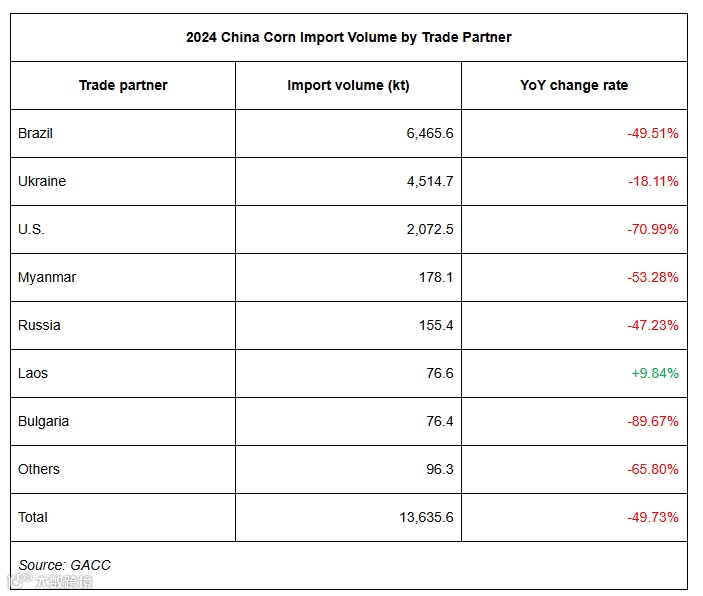
Changes in the output and price of China-origin corn are more important to China’s ethanol industry.
China’s ethanol producers rarely purchase imported corn and mainly rely on China-origin corn to maintain production. China’s grain-based ethanol production is mainly concentrated in the Northeast China and Henan. According to SCI, 36% of China’s edible and industrial ethanol output and 70% of fuel ethanol output were concentrated in Jilin and Heilongjiang in 2024. Henan’s edible and industrial ethanol output accounted for nearly 20% in 2024, and fuel ethanol output accounted for 4%. The feedstock for ethanol production in the above regions mainly came from Northeast China. At present, Northeast China’s corn prices are still strong. The inventory is mainly held by traders, and most traders insist on profit-driven sales, causing slow corn purchases of ethanol producers. In the short term, although foreign price fluctuations and changes in China’s corn and substitute imports will affect China-origin corn prices and the costs of China’s ethanol producers, the current probability of a sharp drop in China’s corn market prices is small. Corn-based ethanol production in Jilin has been loss-making for five consecutive months, and in the past two months, China’s ethanol prices have risen relatively significantly. Since April, the price of 95% general-grade ethanol in Jilin has risen by RMB 300/mt, an increase of 6%, mainly supported by costs.
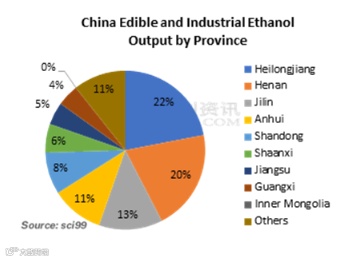
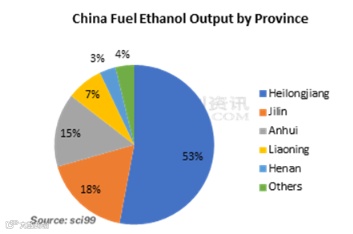
Tariff fluctuations have little impact on China’s ethanol market because China’s ethanol import and export volume is small.
According to GACC, China’s ethanol imports from January to March 2025 were 106.3mt. China rarely imports ethanol from the U.S. Before April 2025, China’s imports of denatured ethanol from the U.S. were subject to a special agreement tariff of 45%. Based on the current U.S. ethanol price, even without considering the additional 10% tariff, the tax-paid price is higher than the current market price in China.
From January to March 2025, China’s ethanol export volume was close to 16kt, mainly to Saudi Arabia, the Philippines, South Korea, Vietnam and other countries and regions. The exports to the above four countries accounted for 87% of the total export volume. Compared with previous years, China’s ethanol exports in 2025 increased slightly. Compared with the U.S., the U.S., as the world’s largest ethanol exporter, mainly produces fuel ethanol. In 2024, the U.S. exported about 5,750kt of fuel ethanol, of which the exports to Canada, India, the U.K. and the Netherlands accounted for 65% of the total export volume. China rarely exports ethanol to these countries. In 2024, the U.S. exported about 210kt of ethanol to the Philippines, and the export volume to Saudi Arabia, South Korea, Vietnam, Taiwan of China and other places was relatively small.
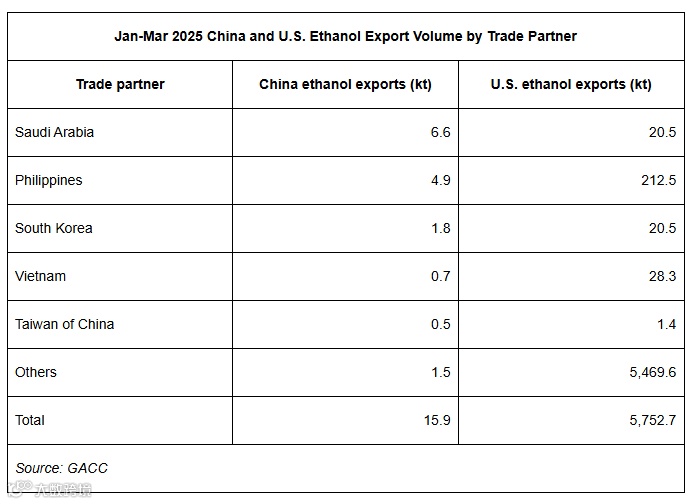
Tariff fluctuations have little impact on China-U.S. ethanol trade, but future trade flows between China and Brazil need to be kept under scrutiny.
Because the ethanol arbitrage window between China and the U.S. is closed and China’s ethanol output is sufficient, this tariff adjustment has little impact on China’s ethanol market. It is expected that in the short term, China’s ethanol industry supply will still be dominated by China-origin ethanol, and exports may increase moderately, but the prices of ethanol feedstock in the U.S. and Brazil are lower, although China’s fermented ethanol exports will increase in the short term due to the temporary opening of the arbitrage window, it will be difficult to form price competitiveness in the long term. In addition, China and Brazil have cooperated closely recently. Compared with the fluctuations in China-U.S. tariffs, the industry should pay more attention to the possibility of fluctuations in the import and export trade of corn, DDGS, and ethanol between China and Brazil in the future.
All information provided by SCI is for reference only, which shall not be reproduced without permission.
Please click "Read more" for the full article.