

Q2 All-Steel Tire Production & Sales to Move Down After Stable Rise in Q1
Introduction: In Q1, China’s all-steel tire production and sales grew steadily. The Spring Festival holiday was in late January and early February. The tire capacity was released weakly before the holiday, while it was released strongly after the holiday. The demand continuously shrank before the holiday, and trading slowed down until it was suspended. After the holiday, the demand showed a trend of recovery. Looking to Q2, the tire market may fail to further rise, with supply and demand both to fall.
All-steel tire production and sales grew steadily in Q1.
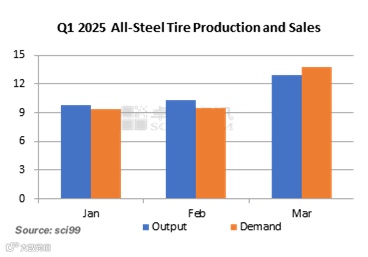
In Q1, China’s all-steel tire production and sales mainly grew steadily. The Spring Festival holiday was in late January and early February. Tire enterprises generally began to suspend production for the holiday in late January, leading to low output in January. After the holiday in February, the tire market gradually recovered with production and sales rebounding. In March, the production and sales rose to the normal level. According to SCI, the total all-steel tire output is estimated at 33.1 million pieces in Q1, up around 2.90% YoY. The total demand is estimated at 32.5 million pieces in Q1, up around 1.5% YoY.
The monthly operating rate rose steadily, driving up the tire output.
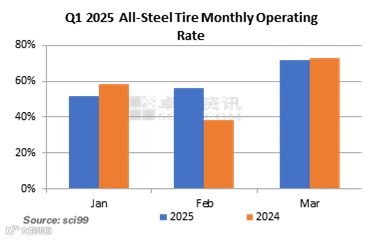
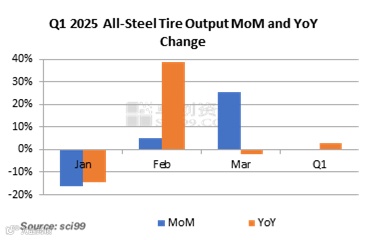
According to SCI, the monthly operating rate ramped up month on month in Q1. The Spring Festival holiday was in Q1. After the holiday, the tire capacity was strongly released. In March, the operating rate rose to around 72%. The main drivers for the rise in the operating rate of the tire industry were as follows. First, with the holiday finishing, tire enterprises resumed normal operation, and the capacity was released continuously. The stability and continuity of enterprise operation helped to increase the operating rate. Second, the domestic and overseas demand was released intensively after the holiday. To meet the demand, most tire enterprises maintained high operating rates. Third, the high prices of feedstock increased the tire costs. The bullish sentiments promoted the consumption of the tire inventory, further bolstering the operating rate. Overall, the all-steel tire output in Q1 moved up by 2.91% YoY.
The demand in different markets performed differently. The demand support in the markets of OE tires and exports was relatively strong.
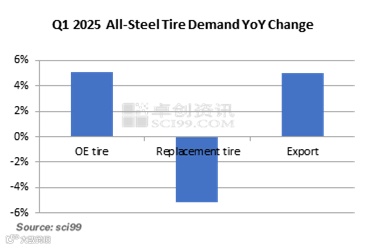
In terms of demand, China’s commercial vehicle market registered a positive trend in Q1, driving up the demand for OE all-steel tires. The exports further increased based on the high volume of 2024. In contrast, the market of replacement tires was relatively weak, and replacement volume was lower YoY. According to SCI, in Q1, the total demand for OE all-steel tires grew by around 5.05%, the total export volume increased by around 5.00%, and the total replacement volume dropped by around 5.13%. The total demand increased by around 1.50% YoY.
Specifically, the traditional sales peak season of the commercial vehicle market usually appears in Q1. According to SCI’s data, the total output of commercial vehicles in Q1 grew by 5.1% YoY, and the total sales increased by 1.8% YoY. Therein, the light truck market grew by 7.03% YoY, hitting a 4-year high. The positive trend effectively promoted the capacity release at commercial vehicle enterprises, so as to meet the market demand. Therefore, driven by the rise in commercial vehicle output, the demand for OE tires also trended up. For China’s tire enterprises, the overseas market remained a guarantee of profits. On the one hand, the export growth rate to emerging markets such as Africa and the Middle East exceeded 30%, among which the contribution of the Belt and Road countries was significant. On the other hand, export and re-export trade continued to increase, among which exports to Mexico increased by nearly 50%. Meanwhile, Chinese-made tires continued to fill the gap in the European market on their cost-performance advantage. Thus, China’s tire exports continued to climb YoY. Yet, the performance of the replacement tire market was relatively soft. The fundamentals of China’s economy are gradually recovering, but the strength of the recovery was less than expected. Meanwhile, the real estate market was operating weakly, and the investment in infrastructure projects was insufficient, failing to strongly drive up the consumption of the huge tire inventory. The replacement volume in Q1 declined YoY.
All-steel tire production and sales are expected to mainly go downwards in Q2.
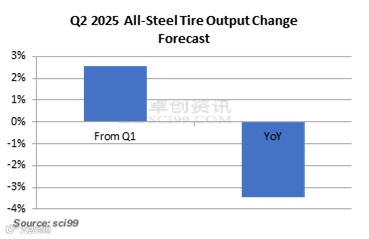
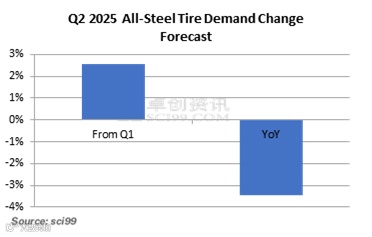
SCI reckons that China’s all-steel tire production and sales in Q2 are predicted to drop from highs. Considering the holiday influence in Q1, the total all-steel tire output in Q2 is predicted to grow by 2.60% from Q1 but decline by 3.40% YoY. The total demand in Q2 may rise by around 2.40% from Q1 but slide YoY. Specifically, there is likely to be strong support from the demand in the OE tire market, but the support from the demand in the replacement tire market and exports may weaken somewhat.
Main factors weighing on the all-steel tire production and sales in Q2:
1. Seasonal factors: Q2 is the traditional slack season for the tire market. Without clear support, the output in Q2 is expected to trend down.
2. Capacity adjustment: With the gradual consumption of existing domestic and export orders and weak newly added orders, coupled with the influence of the Labor Day holiday, the tire capacity release is expected to weaken somewhat. At the same time, under the pressure of the domestic demand slowing down, the tire inventory is likely to pile up, curbing the capacity release.
3. Market competition intensification: Against a weak end market, some tire enterprises are expected to cut prices for sales promotion to enhance the market share. The fall in profits will likely weigh on the stable capacity release.
4. The export growth deceleration: Considering the influence of the global economic situation, trade frictions, and tariffs, the tire export growth is expected to decelerate, curbing the increment in the tire output.
On the whole, the tire industry's prosperity heated up in Q1. However, with various factors including the soft domestic demand and weakened capacity release, China’s all-steel tire production and sales are predicted to trend down in Q2.
All information provided by SCI is for reference only, which shall not be reproduced without permission.
Please click "Read more" for the full article.