

SBR Supply to Stay Stable After Spring Festival Holiday Against High Operating Rate
Introduction: Up to January 2025, there were 11 ESBR producers in China with a total capacity of 1,460kt/a. This research covered all of China’s SBR producers. Therein, there were 2 SBR producers in North China with a total capacity of 350kt/a, 4 in East China with 470kt/a, 2 in South China with 150kt/a, 2 in Northeast China with 340kt/a, and 1 in Northwest China with 150kt/a.
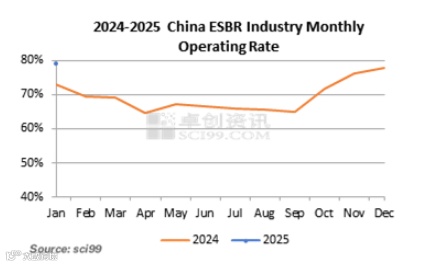
In January, the operating rate of the ESBR industry rose MoM.
In January, the operating rate of the ESBR industry was 78.88%, up 1.22 percentage points MoM. The SBR unit at Huizhou LCY Elastomers ran at a full load after restarting on January 2. The relocated 220kt/a SBR unit at Shen Hua Chemical Industrial went into production. The operating rates of the other units saw no obvious change.
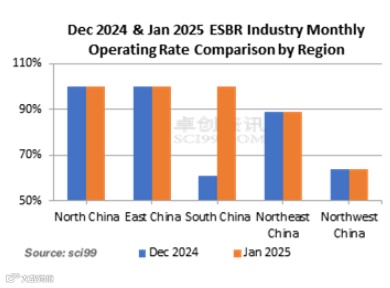
According to SCI, in January 2025, the operating rates of the ESBR industry in various regions of China were different. Therein, the operating rates in North China, East China, Northeast China, and Northwest China were stable. The operating rates at Sinopec Qilu Company, Nanjing Yangzi Petrochemical and Rubber, Shen Hua Chemical Industrial, PetroChina Jilin Petrochemical, PetroChina Fushun Petrochemical, and PetroChina Lanzhou Petrochemical were all maximized, mainly due to the fairish profits of the SBR industry. The operating rate in South China moved up by 39 percentage points mainly because the unit at Huizhou LCY Elastomers was restarted and tended to run at a full load.
The changes in the operating rates in various regions resulted in slight adjustments in the SBR resource flow in different regions. The overall circulation volume of SBR resources increased, failing to bolster the SBR price effectively. The SBR unit at Huizhou LCY Elastomers took maintenance on December 19. It was restarted in early January and tended to run at a full load. Overall, the operating rate of the SBR industry rose MoM.
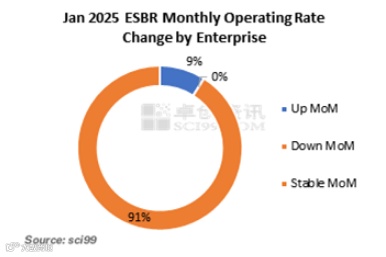
The monthly average prices of feedstock butadiene and SBR both perked up, but the increment in the SBR price was smaller than that in feedstock prices. Thus, the gross profits of the SBR industry shrank but remained at over RMB 700/mt. The operating rates at SBR producers that sourced feedstock butadiene from the market were maximized. Also, the operating rates of the SBR units sourcing feedstock butadiene from refining-chemical integration units were maximized. Overall, 1 SBR producer saw MoM growth in the operating rate in January, no one saw a decline, and the remaining units maintained stable operating rates. The units at Fujian Fuxiang Chemical and Tianjin Lugang Petroleum Rubber remained offline.
According to SCI, China’s SBR units are scheduled to run at full loads in February, although the Spring Festival holiday was in February. The operating rate of the SBR industry in China may rise to around 79.56% in February, up around 0.68 percentage points MoM. The relocated 220kt/a ESBR unit at Shen Hua Chemical Industrial was fed into feedstock on January 2, and the existing 170kt/a ESBR unit operated at the same time. In February, the existing 170kt/a ESBR unit at Shen Hua Chemical Industrial is expected to run at a full load, and the relocated 220kt/a unit may maintain one-line operation. In the next three months, only PetroChina Lanzhou Petrochemical has a plan for unit maintenance, but the time has not been determined. The overall SBR resources circulating in the market are predicted to stay ample in the next three months, failing to drive up the SBR price. The operating rate forecast above may be adjusted based on the actual running status of the SBR units.

All information provided by SCI is for reference only, which shall not be reproduced without permission.
Please click "Read more" for the full article.