

PP Prices Stabilize with Sino-U.S. Tariff Friction Eased
Highlights: On the afternoon of May 12, China and the U.S. released the Sino-U.S. Geneva Joint Statement on Economic and Trade Talks, in which both sides agreed to mutually reduce tariffs. The alleviation of trade relations exceeded market expectations, leading to an improved atmosphere in commodity markets. PP prices halted declines and rebounded slightly, and the trading activity also revived notably. However, from a long-term perspective, fundamental pressure in the PP market is likely to remain, reflecting that PP prices may lack enough upward momentum.
Outcome of the China-U.S. Peace Talks Beyond Expectations
Since the inauguration of Trump’s “2.0” term, U.S.-China tariff dynamics experienced significant volatility in 2025. The tariff standoff between the two nations peaked in April, with multiple rounds of steep increases pushing the combined tariff rates (including base tariffs) on certain goods to 245%. This escalation forced a suspension of some import and export trade activities.
China and the U.S. have released the Sino-U.S. Geneva Joint Statement on Economic and Trade Talks, with both parties committing to implement the following measures by May 14, 2025:
On May 12, China and the U.S. jointly released the Sino-US Geneva Joint Statement on Economic and Trade Talks, achieving substantive progress on tariff issues.
First, the U.S. will amend the ad valorem tariffs imposed on Chinese goods (including those from Hong Kong of China and Macao of China) under Executive Order 14257 of April 2, 2025, by suspending 24% of the tariffs for an initial 90-day period while retaining the authority to impose the remaining 10% as stipulated in the order. Second, the U.S. will revoke the additional tariffs on these goods imposed under Executive Orders 14259 on April 8, 2025 and 14266 on April 9, 2025.
Correspondingly, China will adjust the ad valorem tariffs on U.S. goods outlined in Customs Tariff Commission Announcement No. 4 of 2025, by suspending 24% of the tariffs for an initial 90-day period, retaining the authority to impose the remaining 10%, and canceling the additional tariffs imposed under Announcements No. 5 and No. 6 of 2025. In addition, China will adopt necessary measures to suspend or revoke non-tariff countermeasures against the U.S. implemented from April 2, 2025.
The latest high-level Sino-U.S. economic and trade talks have achieved substantive progress, significantly reducing bilateral tariff levels. The U.S. has canceled 91% of its imposed additional tariffs, while China correspondingly removed 91% of its retaliatory tariffs. The U.S. also suspended 24% of its “reciprocal tariffs”, with China reciprocally pausing 24% of its counter-tariffs. In the two days following the tariff announcement, commodity market sentiment has broadly improved, with PP prices stabilizing modestly.
PP Market Sees Strong Trading Activity and Price Stabilization
Since April, PP prices have been on a downward trajectory, hitting new lows in May. However, the consensus reached during the May 12 Sino-U.S. trade talks boosted overall market sentiment. Coupled with strong fluctuations in futures markets, PP trading activity remained robust, with some sellers raising prices tentatively. Regarding the closing price on May 13, mainstream prices of PP raffia in East China reached RMB 7,210/mt, up RMB 35/mt from May 11. After the talk, bearish market expectations have eased, driving downstream factories to replenish inventory more actively. Traders also cover short positions, leading to a notable improvement in PP demand over the past two days. Market participants have shifted from passive destocking to proactive inventory reduction, providing temporary support for PP prices.
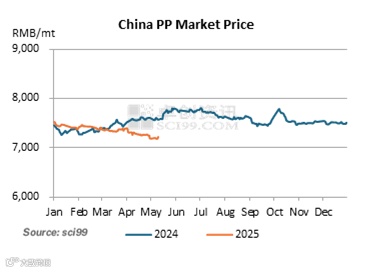
Currently, PP market players’ bearish sentiment has significantly eased. However, market participants remain cautious about future trends, primarily due to uncertainties in the supply-demand dynamics of PP.
Demand: Strong Short-Term Sentiment, Improving Overseas Demand and Seasonal Demand Weakness in China
According to SCI, recent demand improvements stem from two factors, namely bargain-hunting after the resolution of U.S.-China trade tensions and short-covering by mid- and downstream players. However, the sustainability of restocking driven by export orders remains unclear. Some enterprises that halted production due to high tariffs have resumed operations and initiated active inventory replenishment. But for some enterprises that experienced order cancellations to the U.S., they lack bulk orders currently, and it needs time for orders to rebound, restricting some demand improvement.
In the medium run, tariff reductions may gradually revive exports in PP-intensive downstream fields such as small appliances, power tools, toys & stationery sheets, medical devices and furniture. The 90-day exemption period may trigger the export business promotion by downstream processors, buoying an optimistic outlook for export orders from June to July. In the long run, Chinese exporters may continue diversifying markets with concerns about an unsteady international trade environment, and their orders from Europe, Southeast Asia and Africa have improved recently.
In terms of domestic demand, PP downstream markets may enter the traditional demand slack season in Q2 2025. Plastic woven enterprises may face reduced orders, and BOPP film enterprises will probably cut back operating rates. Injection molding (e.g., pallets, containers) and compounding manufacturers may similarly see subdued activity. This has aroused cautious sentiment in the market. Generally, the PP market may face diverging forces:
Supportive factors: Expected recovery in export orders for downstream products (e.g., tariff-driven cost relief);
Downside risks: Seasonal weakening of domestic demand in China, particularly in construction, packaging and durable goods.
Supply: Maintenance Peak Season and New Capacity Fuel Market Concerns
From a supply perspective, the PP industry remains in the peak maintenance period of the first half of 2025, with production cuts continuing to provide key support to the market. According to SCI, PP unit shutdown rates in China range between 17%-20% currently. Maintenance-related output losses in May are projected to stay near annual highs at approximately 680kt. The concentration of unit maintenance is expected to significantly alleviate PP supply pressure in the near term.
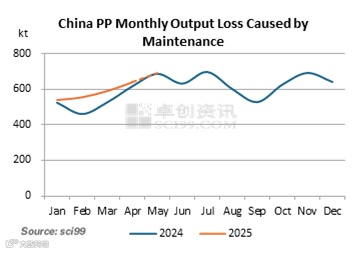
However, newly added PP units may produce qualified products, and there will still be capacity expansion plans from June to August, which may drive up PP supply pressure in China.
The inventory level in the PP industrial chain is not high now, which may ease the supply pressure in the near term. In the long term, PP supply may continue to climb on the back of continuous capacity release. Besides, crude oil-based PP unit operating rates may be enhanced as profits revive. Moreover, the alleviation of trade friction between China and the U.S., the previous expectations that some PDH-based PP producers may reduce operating rates or arrange unit maintenance are likely to ratchet down.
SCI reckons that PP market prices may stabilize and warm up gradually in the short run due to the snug supply and brightening exports. However, prices may still face downward risks in the long run with multiple factors mixed, such as brightened overseas demand, weak domestic demand and continuous capacity expansions in China. Meanwhile, following the substantive progress in the Sino-U.S. economic and trade talks, further room for improvement in macroeconomic expectations may be limited. In summary, the PP spot market price stabilizes and may go up in the short term, but the upward momentum for prices in the medium-to-long term may be insufficient.
All information provided by SCI is for reference only, which shall not be reproduced without permission.
Please click "Read more" for the full article.