

China Methanol: H1 Prices Shift from High to Low, H2 Range-Bound Volatility Expected
Introduction: H1 2025 witnessed sharp volatility in China’s methanol market saw with significant regional price spread changes. Taking the coastal methanol market as an example, influenced by factors such as import volume fluctuations, changes in MTO plant operations, geopolitical tensions, and trade frictions, methanol prices exhibited a downward-then-upward trend. Looking ahead to the second half of the year, domestic methanol supply and demand balance may improve, with mainstream coastal methanol prices expected to rise, fluctuating in the range of RMB 2,400-2,600/mt.
Coastal and inland market prices moved somewhat in sync, but were driven by slightly different factors.
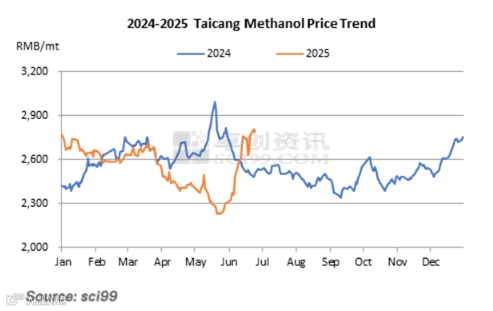
In H1 2025, China’s coastal methanol market presented a V-shape movement on the whole. The methanol price in the Taicang market averaged RMB 2,550/mt, down 2.83% compared with that in H1 2024. The price peak occurred at the end of June, reaching RMB 2,810/mt, which was RMB 200/mt or 6.65% lower than the H1 2024 peak of RMB 3,010/mt. The price bottomed out at RMB 2,230/mt at the end of May, down RMB 127/mt or 5.39% from the H1 2024 low of RMB 2,357/mt.
From January to April, methanol imports were lower compared with the same period in previous years. However, persistent price inversion between domestic and import markets, coupled with rotational unit shutdowns at key coastal MTO plants, led to weak trading sentiment among traders. Although mid-March saw a temporary price rebound supported by low coastal inventory and rigid demand-driven restocking, market fundamentals remained weak.
The situation worsened when all methanol units in a certain Middle Eastern country resumed operations in March, followed by escalated trade tensions in April, which significantly reduced the operating rates at coastal MTO plants. As a result, supply-demand fundamentals continued weakening, driving prices down to a yearly low of RMB 2,230/mt by late May. Subsequently, influenced by vessel age restrictions on imports and escalating tensions in the Middle East, supply was expected to tighten considerably. Meanwhile, demand from traders and downstream users recovered, leading to a sharp price rebound in June.
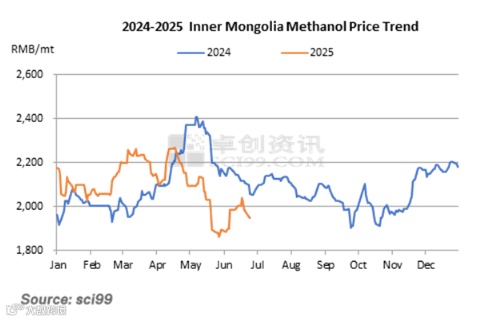
In H1 2025, China’s inland methanol market staged an N-shape movement on the whole. The methanol price in the Inner Mongolia market averaged RMB 2,099/mt, down 0.47% compared with that in H1 2024. The price peak occurred in mid-April at RMB 2,267.5/mt, which was RMB 142.5/mt or 6.28% lower than the H1 2024 peak of RMB 2,410/mt. The price trough of RMB 1,860/mt was recorded in early June, down RMB 55/mt or 2.87% from the H1 2024 bottom of RMB 1,915/mt.
The commissioning of Inner Mongolia Baofeng New Material’s MTO units led to sustained methanol consumption within the region, bringing steady demand. Meanwhile, falling coal prices improved the profitability of CTO production, strengthening olefin producers’ willingness to purchase methanol at lower prices. This helped establish a solid price floor of RMB 2,000/mt in Inner Mongolia during Q1. Later, as spring maintenance (March-April) reduced supply, regional methanol prices briefly approached RMB 2,300/mt. However, weak profitability in traditional downstream industries and resistance to high prices prevented a breakthrough above this key resistance level.
By May, sluggish demand in key consumption markets like Shandong, combined with ample supply across neighboring regions, promoted competitive discounting among producers. As a result, Inner Mongolia’s methanol prices gradually declined to RMB 1,860/mt, the lowest level in H1 2025. The market rebounded in June, driven by recovering downstream profits and increased speculative buying, marking a bottoming-out recovery for Inner Mongolia’s methanol prices.
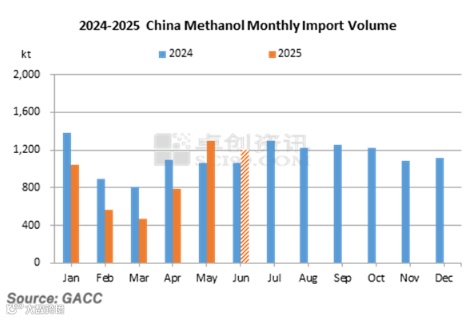
China's methanol market in H1 saw declining imports alongside rising domestic output year-on-year.
In H1 2025, China’s total methanol imports are estimated at 5,362.1kt, down 940.4kt or 14.92% YoY. During the first quarter, overseas methanol units underwent intensive maintenance, and extended shutdowns at a major Middle Eastern producer due to natural gas supply restrictions led to a significant reduction in methanol shipments to China. Concurrently, China’s domestic methanol prices remained at the lowest level globally, prompting international suppliers to voluntarily reduce their contractual supply volumes to the Chinese market. As a result, China’s monthly methanol import volume stayed low from January to April.
The import situation began to improve in April as multiple overseas methanol units gradually resumed operations, leading to a steady recovery in monthly import volumes during May and June. Overall, methanol imports from both a certain Middle Eastern country and other non-Iranian sources in H1 2025 were below the levels seen in H1 2024.
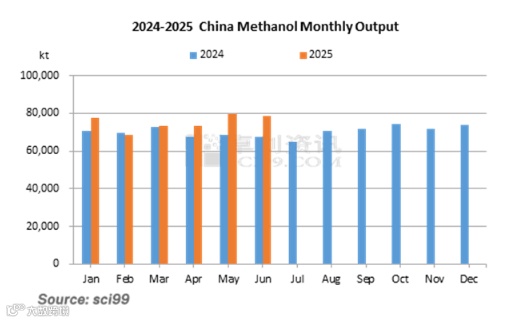
China’s methanol output reached 45,033kt in H1 2025, up 8.14% YoY. This growth was primarily driven by a significant decline in coal prices during the period. The average price of Inner Mongolia Q5500 thermal coal fell to RMB 482/mt, down 26.75% YoY, which substantially improved the production enthusiasm of methanol producers. From the perspective of maintenance schedules at China’s merchant methanol producers, the total capacity undergoing maintenance in H1 2025 was 5,000kt/a less than that during the corresponding period in 2024.
Improved economics in the core downstream industry boosted methanol demand and prices.
The improved profitability of CTO production in H1 2025 contributed to stronger methanol consumption during the period. As coal prices slid, production costs for CTO declined, leading to a recovery in corporate earnings. Quarterly reports from listed companies such as Baofeng Energy and Levima showed improved profitability in Q1 2025. The restored profits of CTO producers enhanced their competitiveness and purchasing power for feedstock methanol, which in turn provided support for methanol prices in the inland market.
H1 2024 & H1 2025 Methanol Downstream Product Profit Comparison
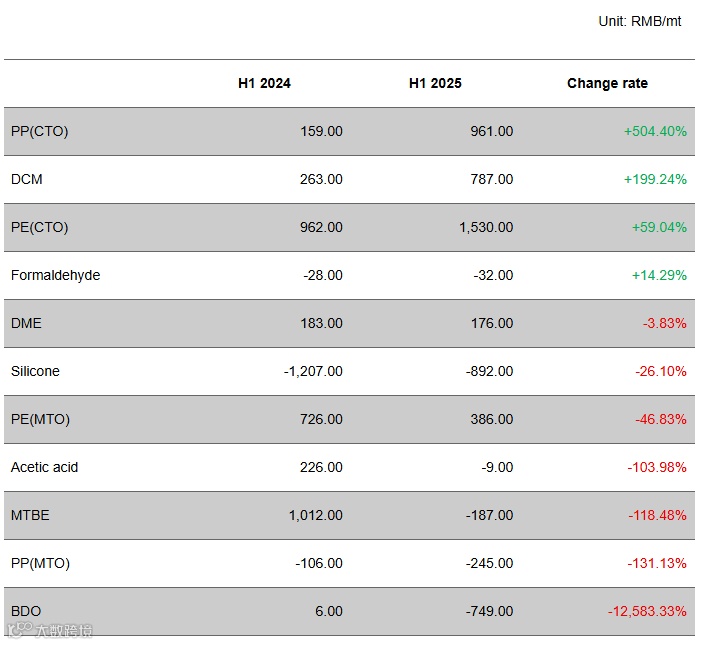
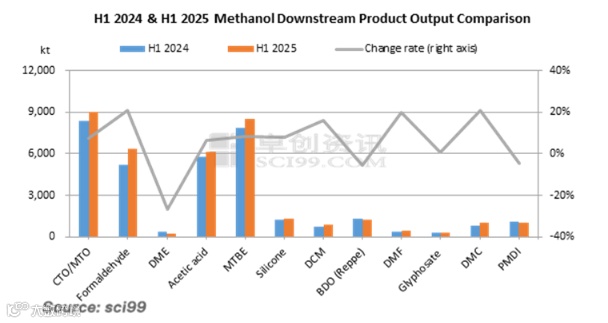
The profitability showed divergence across other downstream industries in H1 2025. Products such as PP (CTO route), PE (CTO route), and dichloromethane demonstrated margin expansion during this period. In contrast, PE (MTO route), acetic acid, MTBE, PP (MTO route), and BDO either saw reduced profits or widening losses. This variance in financial performance led to differentiated production patterns across downstream industries. For example, output growth was particularly notable for formaldehyde and chloromethanes, which experienced margin recovery, while output increases for acetic acid and MTBE fell below expectations.
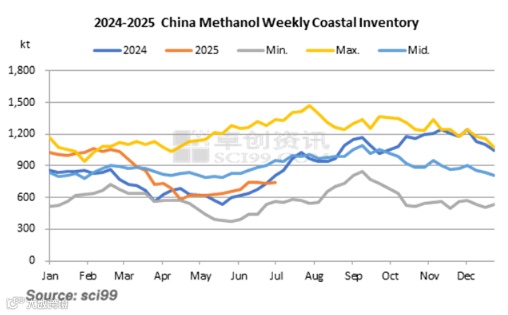
Methanol inventories gradually drew down, approaching historical lows during certain periods.
In H1 2025, the coastal methanol inventory generally followed a “decline-then-rise” pattern. From January to mid-April, the inventory fluctuated downward, primarily driven by multiple factors including reduced imports, steady procurement from coastal olefin plants, and increased export shipments. By May, imports grew significantly while exports shrank, and the market gradually displayed characteristics of supply growth outpacing demand. This shift led to a slow rebound in the coastal inventory by the end of June. Overall, the coastal methanol inventory failed to accumulate substantially throughout the first half of 2025.
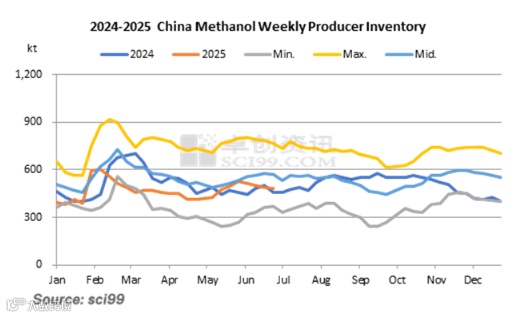
In H1 2025, China’s inland methanol inventory exhibited a “rise-then-fall” pattern. In January and February, the overall inventory increased, as reduced transportation efficiency during the Spring Festival holiday led to passive stock accumulation at methanol producers. The situation reversed from March to April as improved downstream demand coincided with unit maintenance at some methanol producers, resulting in gradual inventory drawdowns. While May and June saw minor inventory builds because of the delayed implementation of maintenance at some producers, the overall inventory level remained below the historical median for the period.
Looking ahead to the second half of 2025, methanol prices are predicted to keep fluctuating under the influence of multiple factors such as supply-demand fundamentals, macroeconomy, mentality, cost, etc. The methanol market is expected to maintain a tight supply-demand balance. Geopolitical developments and their resulting impact on market sentiment, coupled with energy price volatility, may emerge as key drivers influencing price movements.
From a macroeconomic perspective, although tensions in the Middle East have eased, multiple challenges continue to dampen overall market sentiment. External uncertainties persist alongside weak domestic demand fundamentals, while structural overcapacity in production sectors and persistent deflationary pressures further compound market concerns. The prevailing climate of unstable expectations continues to weigh heavily on business confidence, sustaining an overall cautious macroeconomic outlook. These interwoven factors collectively maintain a subdued macro sentiment.
On the supply side, China’s methanol market is expected to maintain its growth trajectory in terms of supply in H2 2025. Domestic methanol output is projected to reach 46.5 million mt, driven primarily by two key factors: Firstly, newly commissioned methanol projects in the first half of the year, such as Zhongtai Chemical’s 1 million mt/a methanol unit in Xinjiang, have gradually achieved stable operation, effectively expanding domestic capacity. Secondly, coal prices remain relatively low compared to the same period last year, providing strong production incentives for coal-to-methanol enterprises, with industry operating rates likely to stay at elevated levels.
In addition, China's methanol imports are anticipated to gradually recover in H2 2025, with the total volume reaching 7.55 million mt. This outlook is based on the normalization of international supply chains and the stable operation of some newly added overseas units. The dual effect of sustained growth in domestic output and recovering imports is predicted to ensure an overall ample supply in the methanol market during this period.
On the demand side, methanol consumption in some downstream sectors weakened in H1 2025 due to relatively poor profitability. However, methanol demand is expected to pick up in the second half of the year with several new downstream units, including acetic acid, MTO, MTBE and formaldehyde units, scheduled to come online. This expansion, combined with the anticipated seasonal demand boost during the traditional "Golden September and Silver October" peak period, should drive growth in China's methanol consumption. Nevertheless, the narrow profit margins in certain methanol downstream industries may provide limited support for methanol prices. Market participants should monitor the actual operating rates of newly added units.
From a cost perspective, domestic coal output increased in H1 2025, leading to lower coal prices. With coal output expected to continue growing in the second half of the year, coal prices are likely to remain relatively low, which should help sustain high operating rates at domestic coal-based methanol producers. As for imported cargoes, China’s methanol imports are projected to stay at a high level in H2 2025, while import costs may remain relatively low due to the depreciation of the US dollar.
Overall, China’s methanol market supply-demand balance may improve in H2 2025. The coastal market is likely to trend higher, with prices fluctuating in the range of RMB 2,400-2,600/mt, and the prices in the Inner Mongolia market may move sideways in the range of RMB 1,850-2,150/mt.
All information provided by SCI is for reference only, which shall not be reproduced without permission.
Please click "Read more" for the full article.