

U.S. Tariff Escalation to Have Influence on Global Tire Trade
Introduction: Due to the long-term anti-dumping and countervailing duties imposed by the U.S. on Chinese tires, China’s domestic tire enterprises have basically withdrawn from the U.S. market. Thus, the trade friction may have a limited impact on China’s domestic tire enterprises. However, in the early stage, China’s tire enterprises concentrated on building plants overseas. The high reciprocal tariffs imposed by the U.S. on more than 50 countries or regions around the world, especially Southeast Asian countries, may put pressure on the tire exports of China’s overseas plants, thereby affecting global rubber demand expectations.
The tariff escalation has a limited impact on China’s domestic tire production as the proportion of China’s tire exports to the U.S. has dropped to a low level.
Since 2014, the U.S. has conducted multiple “anti-dumping and countervailing duty” investigations on China’s tire exports to the U.S. Combined with the “301 investigation” during Trump’s last term, China’s tire exports to the U.S. have already experienced a significant decline. According to GACC, in 2014, China’s all-steel tire exports to the U.S. accounted for 20.81%, and the semi-steel tire exports to the U.S. accounted for 29.18%. By 2024, the proportion of all-steel tire exports to the U.S. fell to 3.17% and that of semi-steel tire exports to the U.S. fell to 0.95%. Therefore, the direct impact of the U.S. reciprocal tariff on China’s tire exports to the U.S. is relatively limited.
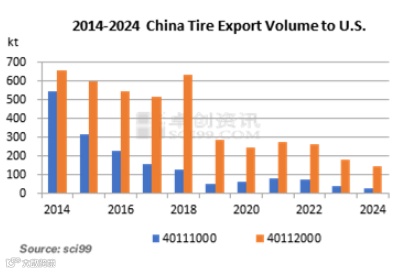
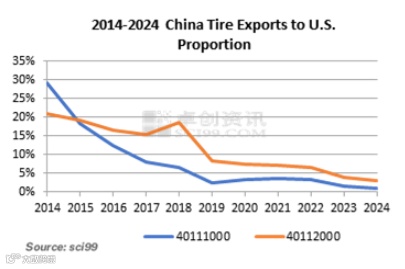
To circumvent trade barriers, China’s tire enterprises built plants overseas intensively.
From the location selection of China’s tire enterprises for overseas plants, it can be seen that Southeast Asia has become the first choice for China’s tire industry to go global with its unique raw material resources and geographical advantages. It has formed a scale effect in overseas capacity investment and construction, gathering about 90% of the capacity of China’s tire enterprises’ overseas plants, mainly concentrated in Thailand, Vietnam, Cambodia, Indonesia, and Malaysia. As one of the main demand markets for tires in the world, Europe has more advantages in the transfer of demand nearby and has also become a new place to explore for overseas plants in the past two years. Although the current capacity accounts for less than 8%, there is still great potential in the future global investment and construction expectations.
The total designed capacity of China’s overseas tire plants exceeds 300 million pieces, and the capacity under production exceeds 200 million pieces.
According to SCI, the total designed capacity of all-steel tires built by China’s overseas plants has reached 42.55 million pieces, and the capacity under production has reached 36.5 million pieces. The total designed capacity of semi-steel tires has reached 264.5 million pieces, and the capacity under production has reached 174.5 million pieces. The main purpose of building plants overseas is, on the one hand, to circumvent international trade barriers, break through global market restrictions, and enter the tire market of developed countries such as the U.S.; on the other hand, it is to take advantage of the raw material cost advantages, tariff preferential policies, and logistics radiation of the selected area to improve profitability and strengthen global competitiveness. At the same time, the layout of capacity in multiple overseas locations can effectively reduce dependence on a single region.
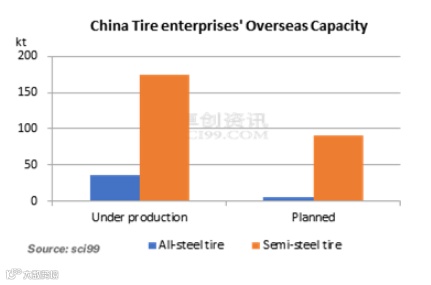
Southeast Asia and Mexico become the main tire import trading partners of the U.S.
In recent years, with the concentrated construction of plants by China’s tire enterprises in Southeast Asia, coupled with the tariff exemption advantage of USMCA, the source of U.S. tire imports has changed significantly. Data from 2024 shows that Mexico, Thailand, Vietnam, and Canada were the main sources of U.S. tire imports. Among them, truck and bus tires mainly came from Thailand, Vietnam, Canada, Cambodia, etc., with import proportions of 27%, 15%, 9%, and 8% respectively; passenger car and light truck tires mainly came from Thailand, Mexico, Vietnam, Indonesia, etc., with import proportions of 25%, 14%, 9%, and 8% respectively. It can be seen from this that the U.S. reciprocal tariffs may have a certain impact on Southeast Asian exports. While pushing up export tariffs, it is not ruled out that it may affect the progress of China’s tire enterprises’ capacity layout in Southeast Asia.
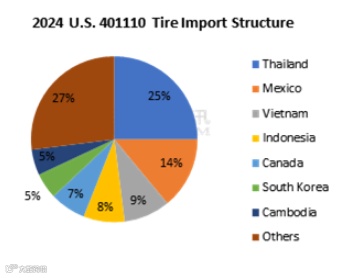
Source: CBP
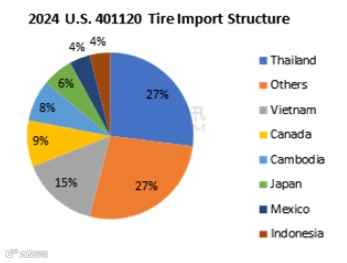
Source: CBP
The impact of the U.S. “reciprocal tariff” is concentrated on China’s overseas tire plants.
In summary, since the proportion of China’s tire exports to the U.S. has dropped to less than 3.5%, the impact of the “reciprocal tariff” on China’s tire exports may be relatively limited. However, China’s tire enterprises have already deployed their capacity around the world, and they are mainly concentrated in Southeast Asia, Europe, North America, and other regions. These regional countries are the main source countries for the U.S. tire imports. Therefore, this reciprocal tariff will likely have a certain impact on tire exports from these regions.
According to the recent survey conducted by SCI, some countries in Southeast Asia are looking forward to negotiating with the U.S. to reduce or exempt tariffs. If the negotiation is effective, it may benefit exports. On the contrary, Southeast Asian tire exports may face high tariffs, increase export costs, weaken their price competitiveness, and the number of orders for tires exported to the U.S. will likely show a significant downward trend. Thus, the market’s expectation of a decline in tire demand is expected to be further amplified in the short term.
Secondly, the U.S. has imposed high tariffs on many countries in Southeast Asia, weakening the re-export trade channel, and accelerating the adjustment of trade flows of China’s tire enterprises. Markets in Europe, the Middle East, Africa, Latin America, and other places are likely to become the main destinations, intensifying competition in the international market.
Furthermore, the overseas capacity layout process of China’s tire enterprises may also be affected. The profit margin of orders for the capacity under production is likely to be squeezed, and the capacity may be even transferred. For tire enterprises with newly added or scheduled capacity, the possibility of suspending or postponing projects cannot be ruled out.
Finally, in the context of oversupply in China, export obstruction may cause tire enterprises to turn to domestic sales, and intensify domestic market competition. Thus, both tire prices and profitability are likely to be impacted.
Therefore, under this background, the international tire market reconstruction will likely accelerate. The demand pressure may affect the global demand for raw materials, which is expected to drag down raw material prices. In short, although the U.S. tariff policy on China may cause significant fluctuations in the commodity market in the short term, it is expected to accelerate China’s economic transformation and the reshaping of the global trade pattern in the long run.
All information provided by SCI is for reference only, which shall not be reproduced without permission.
Please click "Read more" for the full article.