

EPDM Prices Drop amid Fiercer Competition
Keywords: EPDM, Imported resources increased YoY, Price decreased
Introduction: Imported arrivals of EPDM increased greatly YoY, leading to ample market supply. Meanwhile, the EPDM demand was mediocre, remaining regular volume. Due to the bearish impact of supply-demand fundamentals, the EPDM market price decreased slightly.
Weak demand and ample supply weighed on EPDM market price
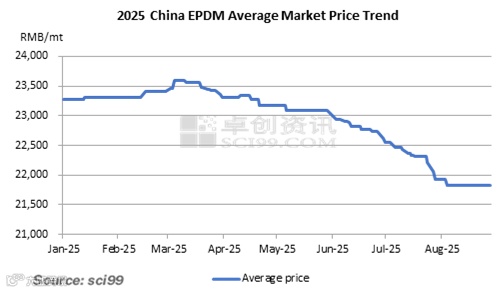
In H1 2025, the domestic EPDM market showed relatively stable performance, and the market price remained in downward fluctuation after inching up in March. This was directly related to the gradual easing of tight supply in the market and the relatively weak performance on the demand side. Due to the high-temperature weather and external factors, EPDM demand showed weaker performance from July to August. The production reductions and suspensions intensified for small and medium-sized downstream enterprises, and the operating rate of related industries of tires decreased. The EPDM market price decreased significantly amid the noticeable demand slack season. As of August 29, 2025, the domestic average price of EPDM was RMB 21,825/mt, down 2.78% YoY. What will the future trend be like? For the specific situation, please refer to the following analysis.
Greatly increased EPDM supply weighed on market price
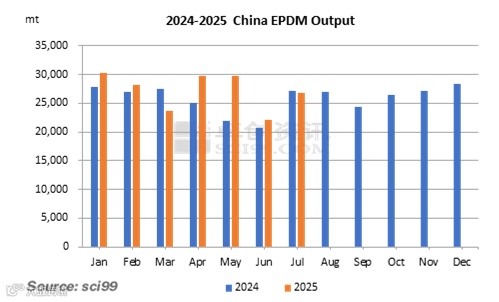
On the supply side, domestic capacity of EPDM increased to 435kt/a in 2025, and the new 40kt/a unit at PetroChina Jilin Petrochemical fully operated in July. From January to July, the total supply increased by 13% YoY. The total supply of the EPDM industry was significantly increased as domestic output rose YoY and imported resources surged, which led to ample market supply.
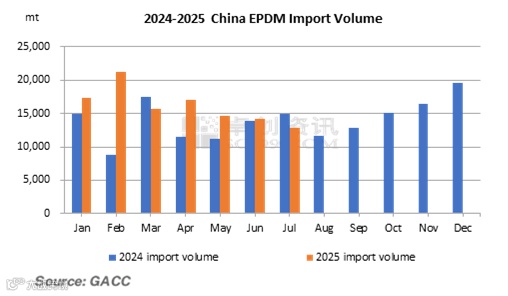
The domestic output of EPDM increased by 8% YoY from January to July. The five major producers in China increased their operating rates, and the commissioning of the new unit also improved the domestic supply level. Therefore, the domestic self-sufficiency rate of EPDM increased, while the import dependence decreased. On the import side, from January to July, China totally imported 112.9kt of EPDM, up 21.78% YoY. It was impacted by multiple factors. Firstly, the export volume from South Korea and Saudi Arabia to Europe in the previous period decreased due to the tepid demand in Europe. Therefore, they turned to export their resources to the Chinese market. Secondly, although demand in Southeast Asia remained relatively stable, under the influence of the US tariff policy, market players showed resistance to the EPDM prices, which in turn reduced support for the prices of overseas EPDM resources. In consequence, the export volume to Southeast Asia decreased. Thirdly, the overall demand in the Chinese market remained large, coupled with increasing demand in the automotive industry, which increased the exports from Europe to China. In that context, the total domestic imports increased significantly, intensifying the sales pressure on the supply side, which weighed on the EPDM prices.
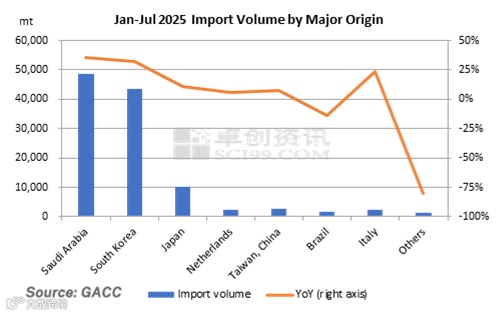
From the perspective of year-on-year arrival levels of major trading partners, the resources from Saudi Arabia increased significantly, up 35.91% YoY from January to July. Due to the low prices, the Saudi Arabian resources mainly circulated to the domestic low-end market, and the substantial increase in arrivals exerted significant downward pressure on the market prices. The resources from South Korea increased by 32.23% YoY, mainly sourced from Kumho and Versalis. The growth in exports to China was largely due to weak demand in Europe, prompting suppliers in South Korea to increase their exports to the Chinese market to maintain their overall sales volume. The Italian supply mainly consisted of EPM, which had a certain price advantage. As a result, the import volume increased significantly YoY, reaching as high as 24.06%.
Demand remained flat YoY, leading to a gradual decline in prices
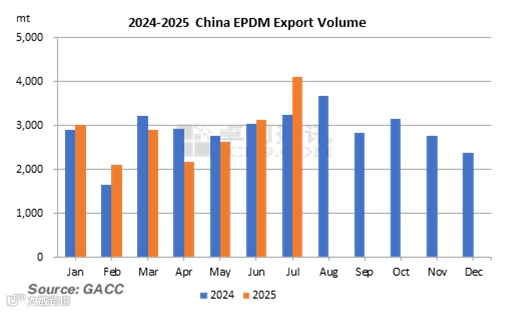
On the demand side, the total demand increased by 0.3% from January to July. Domestic downstream demand increased by 0.4% YoY. In terms of exports, the total export volume from January to July was 20 kt, up 1.51% YoY. The overall volume of the demand remained basically stable YoY, while demand performance varied by downstream industry. Demand in the automotive industry was buoyant, supporting the overall demand, and demand in the wire and cable industry remained normal. However, demand in the construction industry persistently fell YoY, as the new construction area and completed housing area declined YoY, which in turn led to a reduction in the demand for EPDM. Meanwhile, demand in the plastic track industry was tepid, with a sluggish peak season being the main manifestation of this year.
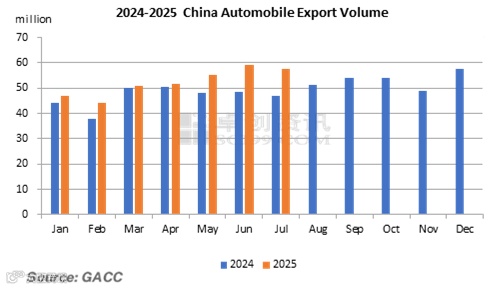
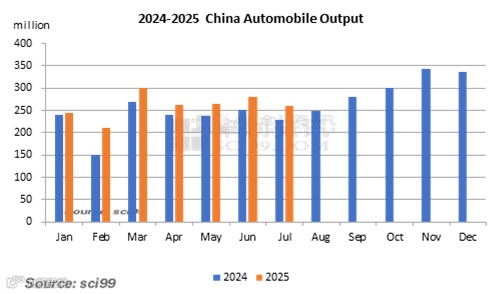
From the perspective of the automotive industry, the largest downstream sector for EPDM, from January to July, automobile production and sales reached 18.235 million and 18.269 million units, respectively, up 12.7% and 12% YoY. The growth rates for production and sales increased by 0.2 and 0.6 percentage points compared to the January-June period. During the same period, new energy vehicle production and sales reached 8.232 million and 8.22 million units, respectively, up 39.2% and 38.5% YoY. New energy vehicle sales accounted for 45% of total new automobile sales. From January to July, automobile exports reached 3.68 million units, up 12.8% YoY. In terms of export destinations, Mexico, the UAE, and Russia were the top three markets for exports. The top three markets for new energy vehicle exports were Mexico, the UAE, and Brazil. The overall increase in automobile production has led to higher demand for EPDM. However, the extended payment cycles in end-use industries and declining profits among downstream producers have a more significant impact on the acceptance of EPDM prices.
Overall, the total demand for EPDM remained largely flat YoY, while supply remained ample, providing relatively limited support from demand-side positives. In the long term, downstream sectors’ acceptance of EPDM prices may continue to be constrained by the dual pressures of high costs and declining finished product prices, which may consequently impact the long-term price trend of EPDM.
Supply-demand changes remain key drivers for future market trends
In August, domestic market prices continued to decline gradually, with high temperatures persistently impacting the operating rates of downstream industries. It was reported that, due to external factors, productions frequently reduced and shut down in the Beijing-Tianjin-Hebei region in late August, leading to weaker demand. From September to December, expectations for a significant adjustment in the overall supply-demand dynamics of the industry remain low. With most domestic and international units operating without maintenance shutdowns, pressure in sales is mounting. While there is some anticipation of a rebound in demand, ongoing cost pressures and declining profits continue to dampen downstream acceptance of feedstock prices. Consequently, amid the persistent supply-demand imbalance, it is expected that in the short term, domestic EPDM market prices may remain in a downward trend.
All information provided by SCI is for reference only, which shall not be reproduced without permission.
Please click "Read more" for the full article.