

Crude-to-PP Unit OR to Dip amid Limited Demand and Profit Improvement
In H1 2025, crude oil-based PP unit operating rates (ORs) showed YOY growth most of the time and remained above 78%, mainly due to improved profits and favorable expectations for demand. However, the actual demand was softer than expected. Entering H2 2025, operating rates dropped and reached 74.79% as of August 21, which fell by 1.84% YOY. Market players held a more cautious stance. Crude oil values spiraled within a narrow range, and crude oil-based PP production profit losses were aggravated. Besides, PP downstream demand was below average, restricting the industry operating rate.
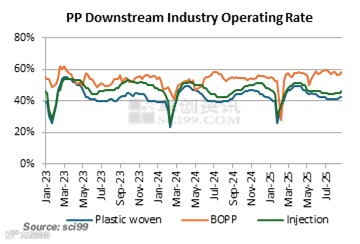
In terms of demand, it grew at a slower rate, while PP demand from various fields performed differently. Traditional fields were still prominent PP consumption parts, but their consumption growth slowed down notably. For example, demand from plastic woven, injection and film industries has reached the highest level or even shrunk. According to SCI, the average operating rates at plastic woven, BOPP and injection product enterprises were 44%, 55% and 46% respectively in H1 2025. They rose by 2 percentage points, 3 percentage points and remained flat YOY separately.
The growth rate of PP demand was lower than that of capacity due to intensive capacity release, although there was a demand improvement in new emerging fields such as automobile and home appliance. New units at ExxonMobil Chemical, CNOOC Ningbo Daxie Petrochemical and Shandong Yulong Petrochemical are operated steadily currently. The imbalance between supply and demand is supposed to be more noticeable in H2 2025. In addition, market players may hold a more cautious stance about stockpiling in H2 2025. Limited downstream purchases will probably constrain operating rates at crude oil-based PP producers.
In H2 2025, factors such as geopolitical risk premiums and OPEC+ production increases are creating a complex interplay of market influences, leading to fluctuating oil prices. Currently, crude oil prices have been rising consecutively for several days, but the upward range is limited without further impetus. As a result, cost support for oil-derived PP remains limited, which may, to some extent, prevent a more significant decline in operating rates among oil-based PP producers.
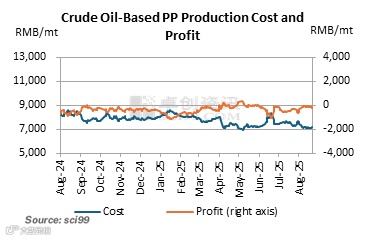
Generally, crude oil prices are expected to remain range-bound in H2 2025, constraining profit improvement at crude oil-based PP producers. The growth in PP downstream demand may still face certain resistance. As for supply, there may still be newly added capacity at producers such as CNOOC Ningbo Daxie Petrochemical and Shandong Jincheng Petrochemical. Crude oil-based PP supply will probably climb, while its unit operating rates may inch down.
All information provided by SCI is for reference only, which shall not be reproduced without permission.
Please click "Read more" for the full article.