

PVC: India's Final Anti-Dumping Ruling Exceeds Expectations
Introduction: On August 14, India’s Ministry of Commerce and Industry released the final ruling on the anti-dumping investigation into PVC resources originating from China, Indonesia, Japan, South Korea, Taiwan of China, Thailand, and the United States. The anti-dumping duty imposed on China has increased significantly, which will reduce China’s export opportunities to India. In the short term, attention should be paid to the possibility of a last-minute rush to export; in the long run, PVC enterprises urgently need to lay out in other overseas regions to seize opportunities amid the changing global supply flow patterns.
On August 14, India’s Ministry of Commerce and Industry announced the final ruling on anti-dumping measures against PVC resources originating from China, Indonesia, Japan, South Korea, Taiwan of China, Thailand, and the United States. From the final ruling, the anti-dumping duty imposed on China has significantly exceeded expectations, greatly reducing the possibility of Chinese supplies being exported to India. The implementation of India’s anti-dumping duty will completely change the overall pattern of China’s export flow.
India PVC Anti-Dumping Duties on Major PVC Producers
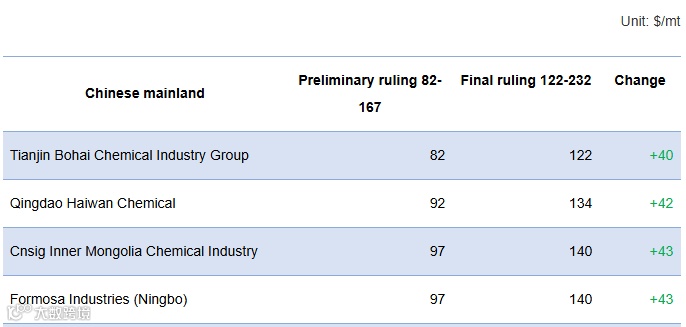
Compared with the preliminary anti-dumping ruling announced at the end of October last year, the final ruling on India’s PVC anti-dumping duty has shown obvious changes: the anti-dumping duty on China has increased significantly, while that on the United States has decreased significantly. The anti-dumping duties imposed on Japan, South Korea, Taiwan of China, and Indonesia are relatively low. In the future, the export volume of these four regions/countries to India will continue to increase, while China’s PVC exports to India will drop sharply.
As India’s PVC resin anti-dumping duty is gradually implemented, China’s PVC exports to India will decrease significantly. In the long run, this will completely change the overall pattern of China’s PVC export flow.
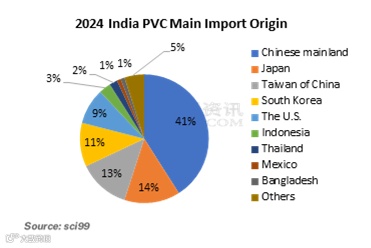
In the past few years, China has been the largest trading partner for India’s PVC imports. Among India’s main import sources in 2024, the top five were China, Japan, Taiwan of China, South Korea, and the United States, accounting for 87.66% of the total imports. The Chinese mainland’s main competitors in exporting PVC to India are Taiwan of China, Japan, South Korea, and the United States, and the final anti-dumping duties for these four regions/countries are all lower than that for the Chinese mainland.
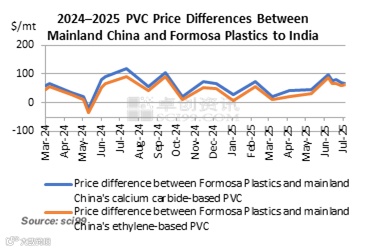
Due to the obvious gap in anti-dumping duties, China’s price advantage in exporting PVC to India will disappear, which will significantly affect the volume of China’s PVC exports to India. Formosa Plastics (Taiwan of China) is Asia’s largest PVC exporter and a weather vane in the Asian PVC market. According to India’s final anti-dumping ruling, the anti-dumping duty on Formosa Plastics is $47/mt, while that on major Chinese exporters of calcium carbide-based PVC is $140-177/mt, with a gap of $93-130/mt. From the price difference comparison between Chinese calcium carbide-based PVC and Formosa Plastics’ products in India from 2024 to 2025, the difference exceeded $93/mt only occasionally. For China’s ethylene-based PVC, India’s anti-dumping duty is $122-140/mt, which is $75-93/mt higher than that on Formosa Plastics. Similarly, from the price difference comparison between Chinese ethylene-based PVC and Formosa Plastics’ products in India from 2024 to 2025, the difference exceeding $75/mt was also very limited. Therefore, from the perspective of price comparison with competitors, after India’s anti-dumping duty is implemented, China will lose its price advantage, leading to a significant reduction in China’s PVC exports to India.
Short-term focus: possibility of a last-minute rush to export
Although India has announced the final ruling on PVC anti-dumping duty, the specific implementation time has not yet been announced and is subject to the release by India’s Ministry of Finance. Market players generally expect it to be announced within 20-30 days, while some participants believe there may be a buffer period of about 45 days. Attention should be paid to the subsequent implementation time and Indian buyers’ purchasing intentions. If there is a certain buffer period after the policy is implemented, the market will usher in a golden window for a last-minute rush to export.
Long-term: China’s PVC export flow pattern will change
In recent years, India has been China’s largest export destination, with China’s PVC exports to India accounting for about 50% in the past two years. China’s PVC exports are highly dependent on the Indian market. However, with the implementation of India’s anti-dumping policy, China’s exports to India may decline significantly. Under the circumstance that the global PVC supply and demand fundamentals have not changed significantly for the time being, the global PVC supply flow will likely undergo obvious adjustments: the volume of supplies from Taiwan of China, Japan, and South Korea to India will increase significantly, while Chinese supplies will fill the markets vacated by these regions. It is estimated that this change in market flow will take at least a few months to explore and adapt.
Moreover, India has plans to put 3,000kt/a PVC units into operation from 2025 to 2028. If the plan is implemented as scheduled, India’s PVC import volume may decrease, and the international PVC flow pattern will undergo new changes.
Central Asia, with limited local PVC capacity and few new project plans, is gradually becoming a new focus of international trade flows under the Belt and Road Initiative. The African region has great development potential. With the deepening of regional economic cooperation, export opportunities for PVC in Central Asia and Africa will increase significantly.
On the whole, new unit commissions in the future and regional policy adjustments will have a certain impact on global trade flows. China’s PVC enterprises urgently need to expand into other overseas markets to cope with challenges and seize opportunities amid the changing regional flow of supplies.

All information provided by SCI is for reference only, which shall not be reproduced without permission.
Please click "Read more" for the full article.