

H1 IIR Price Fell After Rally on Supply-Demand Imbalance
Introduction: China’s IIR market experienced accumulating supply-demand contradictions in the first half of 2025, with prices rallying before correcting. Looking ahead to H2, domestic IIR units are expected to maintain normal operations, ensuring stable spot supply. However, demand from downstream enterprises is unlikely to improve significantly, suggesting persistent supply-demand imbalances may keep prices weak in the second half of 2025.
H1 2025: IIR Prices Under Pressure
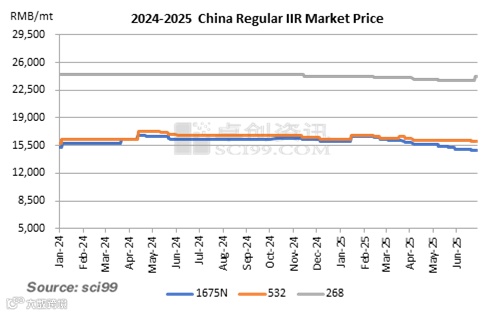
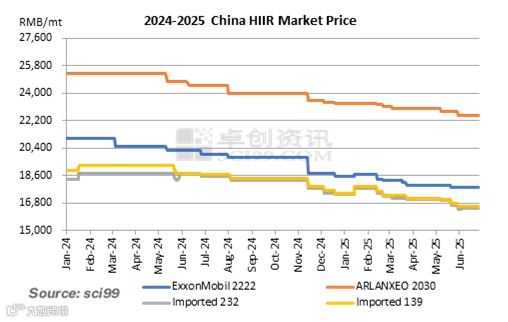
January saw modest price increases driven by rising feedstock MTBE prices and pre-holiday stockpiling of downstream enterprises. However, the Spring Festival holiday disrupted demand continuity, capping price gains. During February-March, slow post-holiday demand recovery coupled with high social inventory triggered a gradual price correction. Meanwhile, weakening MTBE prices further eroded cost support, further dragging down IIR market prices.
In Q2, the IIR market prices maintained a weak oscillating trend due to sustained supply-demand imbalance. Although some unit maintenance temporarily tightened supply, persistently soft demand—especially from the tire sector where operating rates stayed low—limited IIR price upside. As of June 27, prices for grade 1675N in East China stood at RMB 14,900/mt, down RMB 750/mt from the yearly peak, while grade 232 traded at RMB 16,450/mt, down RMB 1,300/mt from the yearly high.
Accumulating Supply-Demand Imbalances in H1
Supply: In H1 of 2025, domestic IIR units operated normally, with some maintenance units resuming production by early June. Additionally, steady import arrivals and elevated social inventory ensured ample supply.
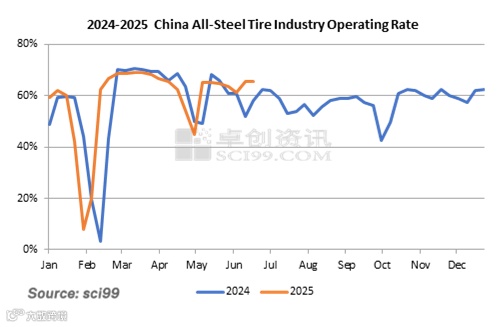
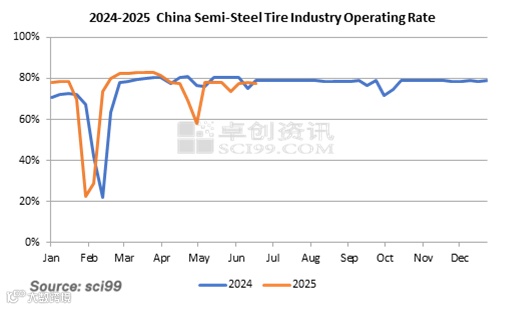
Demand: Overall demand underperformed in H1 of 2025. Downstream tire enterprises’ operating rates showed only sporadic improvements, with overall H1 demand growth remaining sluggish. On the one hand, the slow global economic recovery and insufficient end-market demand kept the tire industry operating rates subdued. On the other hand, U.S.-China tariff tensions constrained export orders, further curbing demand for IIR. Besides, downstream buyers adopted conservative procurement strategies with primary essential purchases, limiting acceptance of higher prices.
Feedstock MTBE Price Rose and Then Fell
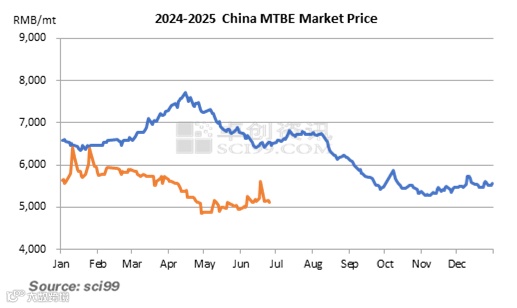
In H1 of 2025, the price of MTBE experienced a process of first rising and then falling, forming a phased support for the price of IIR. Especially during January, the increase in the price of MTBE promoted the upward adjustment of the EXW price of IIR, and then drove the IIR market price higher. But starting from February, the price of MTBE gradually declined and mostly maintained a low-level adjustment trend, weakening the cost support for the IIR market.
H2 2025 Outlook: Lower Mainstream Price Expected
The IIR market price is projected to remain weak in H2, with a modest rebound possible in September-October. Key factors:
Supply: Stable domestic output and continued imports will sustain abundant market supply.
Demand: Downstream tire sector operating rates may have limited upside. Meanwhile, considering that the current market demand has not fully recovered, the growth in demand is expected to be limited.
Costs: MTBE oversupply may persist, keeping prices depressed and further reducing IIR cost support.
All information provided by SCI is for reference only, which shall not be reproduced without permission.
Please click "Read more" for the full article.