

Commissioning of PVC Units Intensifies Market Competition
Introduction: In recent years, the commissioning of ethylene-based PVC units has accelerated, with the proportion of ethylene-based PVC capacity gradually increasing. Recently, some ethylene-based PVC units have successively started trial runs. It is expected that competition in the market supply will likely intensify, which may exert certain pressure on the calcium carbide-based PVC market.
Ethylene-based PVC: Its capacity proportion has gradually increased in recent years.
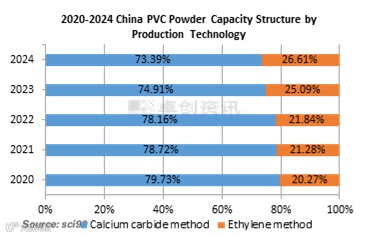
In recent years, as the approval of new calcium carbide-based PVC projects has been tightened, there have been fewer newly commissioned calcium carbide-based PVC units, while more enterprises have expanded ethylene-based capacity, leading to a yearly increase in the proportion of ethylene-based PVC capacity. According to SCI, as of the end of 2024, calcium carbide-based PVC capacity accounted for 73.39%, and ethylene-based capacity accounted for 26.61%. In contrast, all overseas production adopts the ethylene-based process. After the 500kt/a PVC units at SP Chemical were commissioned in Q1 2025, the proportion of ethylene-based PVC capacity has reached 27.72%. It is expected that by the end of 2025, the proportion of the ethylene-based PVC capacity may reach around 30%.
Ethylene-based PVC enterprises: Prices and stability of feedstock have certain impacts on units’ operation.
Currently, there are 21 domestic ethylene-based PVC enterprises with a total capacity of 7,920kt, and their feedstock sources are diverse. Among them, the proportion of enterprises relying on purchased ethylene is relatively large. The ethylene sources for these enterprises are mainly divided into domestic procurement and imports (some from parent companies), with the self-produced ethylene capacity reaching 1,460kt.
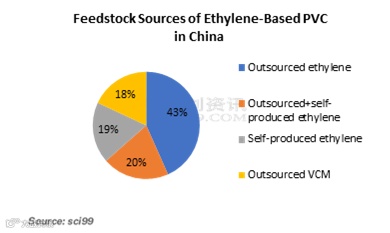
For PVC enterprises that purchase ethylene externally, their ethylene sources are mainly domestic purchases and imports, with imports accounting for a relatively larger proportion. China’s ethylene imports are mainly from Japan and South Korea, so the operating rates at these import-dependent enterprises will be affected by the USD-denominated ethylene prices and import supply.
For enterprises with self-produced ethylene, the feedstock for ethylene production mainly includes naphtha, ethane, methane, and methanol (either purchased externally or self-produced). Therefore, the prices and supply of ethylene feedstock will also affect the operating rates of ethylene units, which may impact the operating rates of PVC units. Specifically, among domestic PVC enterprises, only one enterprise uses ethane as the main feedstock for ethylene production, while most others use mixed feedstock. Thus, ethane import conditions will have a limited impact on some PVC units.
Entering July, with the elimination of U.S. ethane export restrictions, coupled with the load reduction and scheduled maintenance plans of some downstream ethylene plants, the spot supply of ethylene in the market has increased. RMB-denominated ethylene prices first entered a downward trajectory, and USD-denominated prices also retreated from high levels. As a result, the cost pressure on domestic ethylene-based PVC enterprises has eased, and the stability of feedstock supply has been ensured.
Ethylene-based PVC Market: As new units are successively commissioned, market competition may intensify.
In mid-July, the 400kt/a PVC units at Tianjin Bohua Development and the 500kt/a units at Wanhua Chemical (Fujian) successively started trial runs and are still in the commissioning phase, with the release of capacity expected to begin in August. In addition, the 200kt/a unit at Qingdao Haiwan and the 300kt/a unit at Zhejiang Jiahua Energy Chemical are also planned for commissioning. With the successive commissioning of ethylene-based units, competition for ethylene-based PVC supplies in the South China and East China markets will likely further intensify. The price gap between ethylene-based and calcium carbide-based supplies in these regions will likely narrow, and calcium carbide-based supplies will face pressure. Therefore, for calcium carbide-based PVC enterprises, only by utilizing futures tools, monitoring regional price differences, and flexibly adjusting pricing strategies can they maintain certain advantages in the competition.

All information provided by SCI is for reference only, which shall not be reproduced without permission.
Please click "Read more" for the full article.