



Analysis of Asian Special Synthetic Rubber Trade Flows in H1 2025
Data Review: Analysis of Asian Special Synthetic Rubber Trade Flows in H1 2025
Introduction: Asia is not only the largest supply area of special synthetic rubber in the world, but also the largest consumption area. In H1 2025, amid a rather severe global trade environment, trade flows of Asian supplies saw only marginal changes, with some changes in trade volume. Against the backdrop of global economic transformation and industrial upgrading, the global trade network of special synthetic rubber has remained complex and full of opportunities in H2 2025.
Global Capacity Distribution of Special Synthetic Rubber
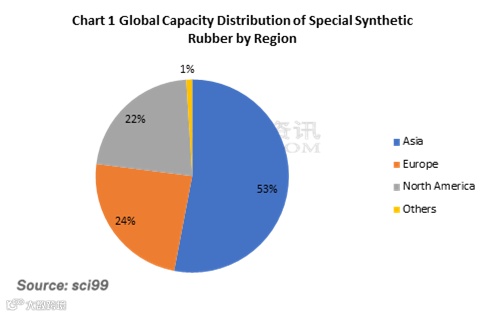
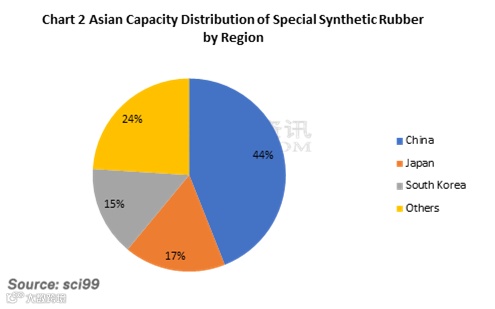
In terms of the regional distribution of global capacity, Asian capacity of special synthetic rubber ranks the top one in the world, accounting for 53%. In addition, the capacity in Asia increased in H1 2025. The main regions in terms of global special synthetic rubber capacity are China, Japan, and South Korea. With the strong manufacturing capacity, China is the largest consumer of special synthetic rubber both in Asia and globally. However, Japan and South Korea are major exporters of special synthetic rubber on a global scale. Apart from the Chinese market, supplies from Asia including China, Japan, and South Korea mainly flow to South Asia, Southeast Asia and other regions. Therefore, the trade flows of special synthetic rubber in Asia can be observed through the import and export data of China, Japan, South Korea, Southeast Asia and South Asia.
In H1 2025, China’s Special Synthetic Rubber Import Volume Increased While Export Volume Decreased
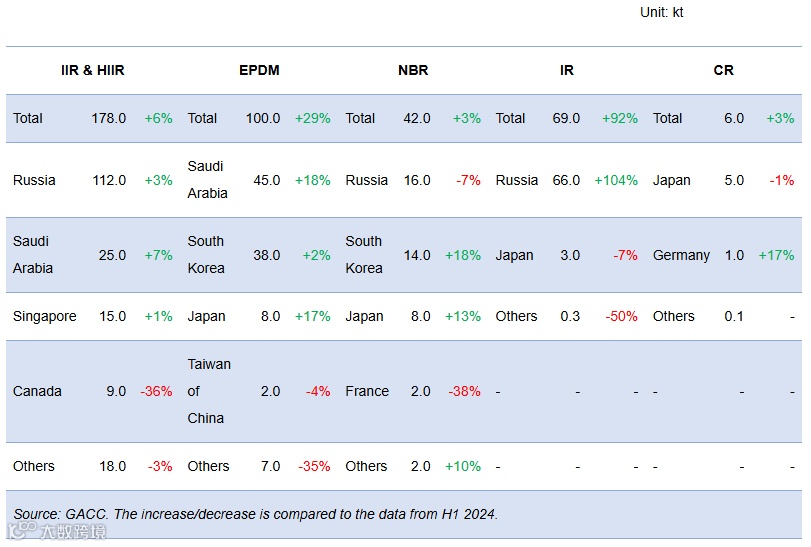
According to the data released by GACC, in H1 2025, China’s cumulative import of special synthetic rubber reached 395kt, up 21% YoY. In terms of rubber types, EPDM import volume increased by more than 20%, while IR import volume increased by more than 90% YoY. The growth of EPDM was driven by Saudi Arabian resources. Saudi Arabian EPDM units saw reduced maintenance YoY in H1 2025, coupled with the concentrated arrival of promotional resources in late 2024, both contributing to the increase in Saudi Arabian imports. The growth of IR still driven by supply from a European country.
Table 1 H1 2025 China Special Synthetic Rubber Import Data
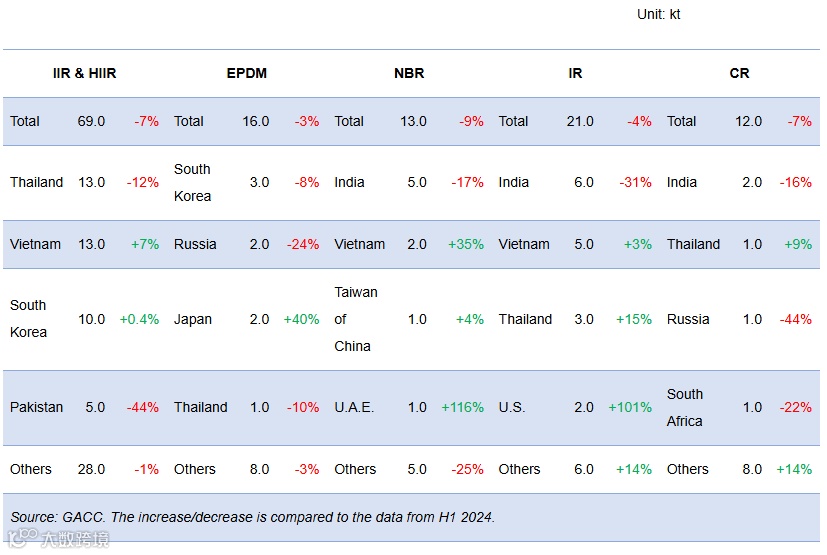
According to the data released by GACC, in H1 2025, China’s cumulative export of special synthetic rubber reached 131.3kt, down 6.35%YoY, with falls in all rubber types to varying degrees. In H1 2025, due to the implementation of U.S. reciprocal tariffs, the downstream operating rate decreased, and the economic activity weakened in some of China’s trade partners. In this context, as their rubber demand weakened, China’s export and re-export volume of special synthetic rubber consequently decreased.
Table 2 H1 2025 China Special Synthetic Rubber Export Data
In H1 2025, Japan’s Export Volume of Special Synthetic Rubber Decreased Slightly.
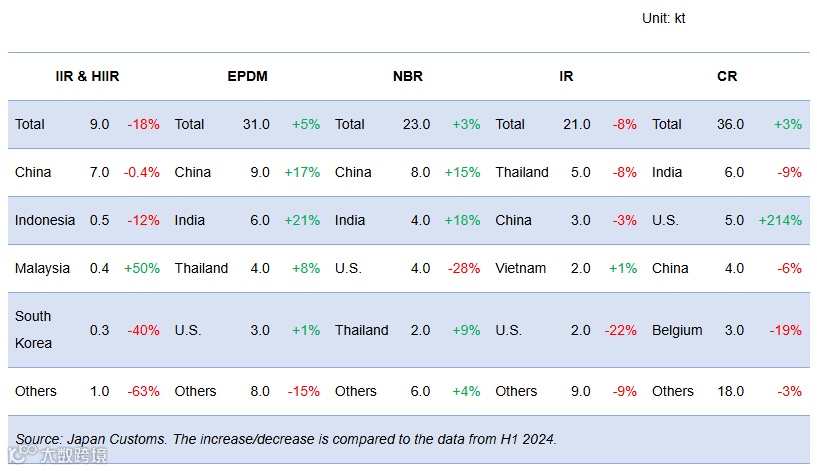
According to the data released by the Japanese Customs, in H1 2025, Japan’s cumulative export of special synthetic rubber reached 120.1kt, down 0.7% YoY. In terms of different rubber types, the export volume of IIR&HIIR and IR decreased significantly, while other types increased to varying degrees. On the one hand, the operation rate in Singapore’s IIR industry increased, replacing some IIR resources in the Asian region. On the other hand, due to the implementation of U.S. reciprocal tariffs, the rubber demand in some economies was reduced.
Table 3 H1 2025 Japan Special Synthetic Rubber Export Data
In H1 2025, South Korea’s EPDM and NBR Export Volume Increased.
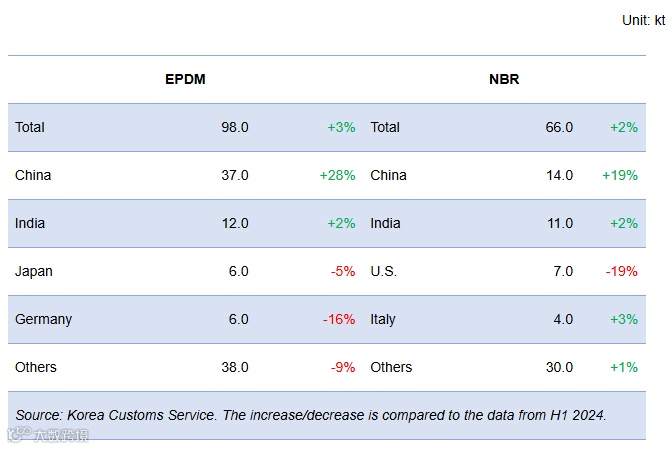
South Korea’s special synthetic rubber only includes EPDM and NBR. According to the data released by South Korea’s customs, South Korea’s cumulative EPDM export reached 98.1kt, up 3.11% YoY. The cumulative NBR export reached 65.9kt, up 1.85% YoY. In terms of EPDM, the commission of the new 70kt/a unit at Kumho played a key role in improving the overall export volume of EPDM. However, the overall export volume of NBR fluctuated within a narrow range, with the quantity exported to the U.S. decreasing by 18.52% YoY, relatively impacted by the U.S. reciprocal tariffs.
Table 4 H1 2025 South Korea EPDM and NBR Export Data
From January to May 2025, the Indian Import Volume of Special Synthetic Rubber Increased Slightly.
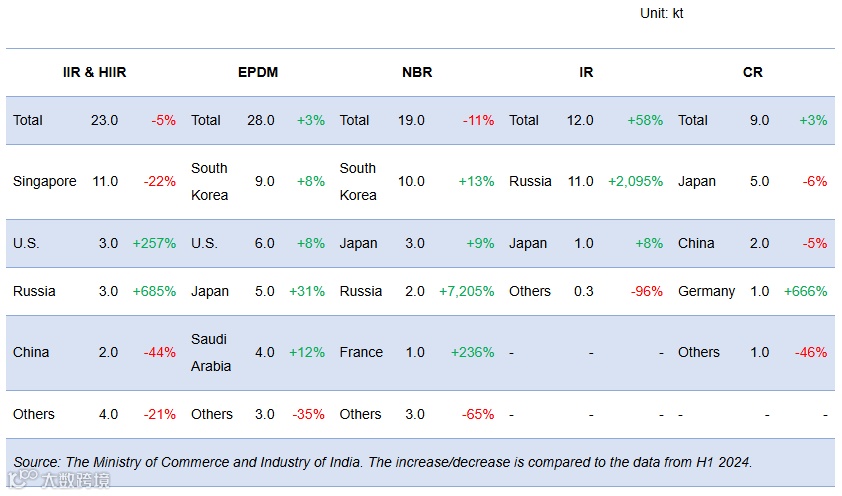
According to the data released by the Ministry of Commerce and Industry of India, from January to May 2025, India’s cumulative special synthetic rubber imports reached 90.8kt, up 2.6% YoY. In terms of trade partners, the import volume of some type of rubber from Russia increased significantly, while the volume of the resources that are transshipped via China decreased. (As of the time of publication, the data from the Ministry of Commerce and Industry of India was updated to May 2025.)
Table 5 Indian Special Synthetic Rubber Import Data (Jan-May 2025)
In H1 2025, Thailand’s Import Volume of Special Synthetic Rubber Decreased Slightly.
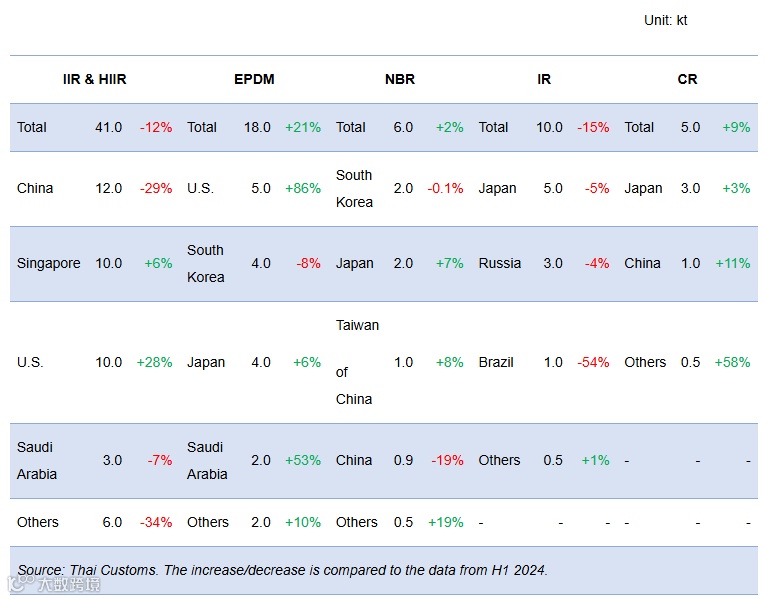
According to the data released by the Thai Customs, Thailand’s cumulative special synthetic rubber imports reached 78.9kt, down 4.56% YoY. In terms of different rubber types, the import volume of IIR&HIIR and IR decreased significantly. The tire demand in Southeast Asia was relatively impacted by the U.S. reciprocal tariffs, further reducing the feedstock consumption of some special synthetic rubber.
Table 6 H1 2025 Thailand’s Special Synthetic Rubber Import Data
Impact of Tariffs Remains Severe in H2 2025, Global Trade Landscape Faces Reshaping
According to an announcement released by the White House on July 31 (US Eastern Time), an executive order was signed under laws including the International Emergency Economic Powers Act, specifying tariff rates applicable to imports from 69 trading partners into the US market. The goods from these trading partners will be subject to so-called “reciprocal tariffs” ranging from 10% to 41% upon entering the US market. Among them, 40 countries or regions will face a 15% tariff rate, while 10 will be subject to rates of 19% or 20%. The new tariff rates will take effect seven days after the executive order is issued. Additionally, on August 3, US Trade Representative Greer stated that the new round of tariffs is largely finalized and will not be adjusted in current negotiations, including a 35% tariff on imports from Canada and a 50% tariff on those from Brazil.
For some main producers of special synthetic rubber, while the implementation of tariff policies has eliminated uncertainties in the U.S. export market, their trade partners remain relatively diversified. The U.S. tariff may also impact the downstream export demand of key importing countries for special synthetic rubber. According to the IMF’s latest global economic forecast in July, global economic growth is expected to slow down, with trade-related changes weakening the apparent resilience. In 2025 and 2026, the projected global economic growth rates are 3.0% and 3.1% respectively, lower than the 3.3% growth in 2024 and the pre-pandemic historical average of 3.7%. Commodity markets exhibit weaker expectations for economic growth and demand, which may affect global special synthetic rubber trade volumes in H2 2025. Close attention should be paid to subsequent international macroeconomic developments.

All information provided by SCI is for reference only, which shall not be reproduced without permission.
Please click "Read more" for the full article.
