


点击蓝字
关注我们


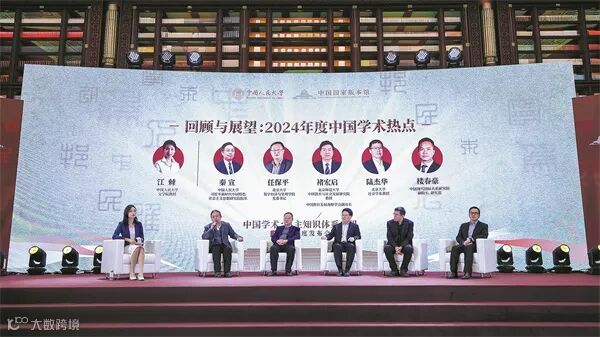
Scholars discuss the top 10 academic topics in Chinese philosophy and social sciences for 2024 at the China National Archives of Publications and Culture in Beijing on Monday. The list was jointly released by Renmin University of China and the Shanghai Federation of Social Science Associations.[Photo provided to China Daily]
The Renmin University of China in Beijing and the Shanghai Federation of Social Science Associations jointly released the top 10 academic topics in Chinese philosophy and social sciences for 2024 on Monday.
The list includes theoretical studies on Xi Jinping Thought on Culture, further deepening reform to advance Chinese-style modernization, new quality productive forces, contemporary interpretations on traditional Chinese ethical thoughts, and research on the construction of an education power.
It also involves China's demographic structural changes and high-quality development of the population, the country's history of unification, world China studies, as well as the Global South and the evolution of the international order.
Besides, the academic community attaches great importance to artificial intelligence value alignment, which deals with ensuring that AI systems act in accordance with shared human values and ethical principles.
The list was announced during an event held at the China National Archives of Publications and Culture in Beijing on Monday, where a series of academic achievements to accelerate the establishment of an independent knowledge system for Chinese philosophy and social sciences was made public.
Zhang Donggang, RUC's Party secretary, says that the university will work together with all parties to continuously produce quality academic works and strengthen the academic creativity and global influence of Chinese philosophy and social sciences, Zhang says.
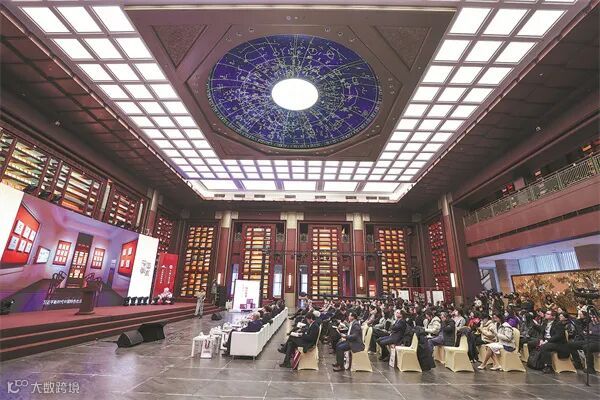
A series of academic achievements to accelerate the establishment of an independent knowledge system for Chinese philosophy and social sciences was made public at the China National Archives of Publications and Culture in Beijing on Monday.[Photo provided to China Daily]
Wang Weisong, vice-president of the Shanghai Federation of Social Science Associations, says that since its launch in 2003, the annual selection of the top 10 academic topics in Chinese philosophy and social sciences has been carried out for 22 consecutive years.
The selection aims at cutting-edge, forward-looking academic topics that have been intensively discussed throughout the year and attracted a certain level of public attention, he adds.
In 2024, studies around AI value alignment focused mainly on its technical paths, ethical norms and the establishment of governance frameworks, apart from balancing the rapid technological development with social values.
According to Chen Changfeng, professor at the School of Journalism and Communication, Tsinghua University, these academic efforts emphasized realizing human values through technical approaches like machine learning and data-based governance and reconciling value conflicts ethically; dealing with the bias, misinformation and unclear accountability arising from the content generated by large language models; as well as promoting AI value alignment via ethical standards, legal policies and international collaborations.
She stresses the need to pay attention to the cultural and ethical differences between countries, which will be reflected in their generative artificial intelligence products and lead to the necessity of coordination.
Zhang Xiping, editor-in-chief of academic journal International Sinology, says that world China studies involve not only China studies by overseas scholars, but also Chinese scholars' research into overseas China studies themselves.
Over the past year, Chinese scholars have increasingly investigated the spread of Chinese culture abroad, compiling bibliographies for overseas Chinese texts, reprinting and publishing these texts, and translating important Sinological works, which all provide new materials for domestic Chinese cultural studies.
Zhang Xiping says that, in the future, Chinese scholars should deepen the research into the history of Sinology in various countries and translate fundamental literature, while paying more attention to and supporting Global South countries in conducting independent, critical China studies.
During the event, the Renmin University of China announced the updates of its construction of digital platform Academic Arena, comprising sub-platforms for classic literature and preprints in philosophy and social sciences.
The classic literature sub-platform features more than 20,000 quality papers — which account for 0.5 percent out of more than 4 million papers published in China from 2013 to 2022 — recommended by 1,300 experts in the field.
On the preprint sub-platform, researchers can voluntarily share their research findings that have not yet been formally published free of charge and with open access. The sub-platform connects authors, readers and academic journals, facilitating academic review, recommendation and selection of articles, as well as further dissemination of research findings.
According to the university, eight months after its launch in late April, Academic Arena now has more than 28,000 registered users. The preprint sub-platform has signed memorandums of understanding with more than 400 collaborative journals and published over 13,000 articles, whereas more than 8,000 scholars have authorized some 11,000 articles for the classic literature sub-platform.
It was also on Monday that Beijing-based Renmin University of China and Chinese Academy of Social Sciences, as well as Shanghai-based Fudan University and East China Normal University, jointly released some of their major recent academic achievements in finance, literature, philosophy and history.
Among them is a complete compilation of poetry created during the Tang Dynasty (618-907) and Five Dynasties and Ten Kingdoms (907-960).
The 50-volume anthology by Chen Shangjun, professor at the Department of Chinese Language and Literature of Fudan University, collects all the extant poetry of the period, which includes over 55,000 pieces by more than 4,200 poets, with a total word count exceeding 18 million Chinese characters.
Chen Shangjun, who spent 40 years compiling the anthology, said during a recent public event in Shanghai that it has been the dream of generations of scholars to conduct a complete collation of all existing Tang poetry.
"During compilation, I've tried my best to examine available literature and select the best editions of the poetry, while addressing the complexities of the poetry's transmission — such as issues relating to their authenticity and authorship — with the aim of handling these difficulties with objectivity and prudence," he adds.
Tang poetry, with those household pieces by poets such as Li Bai and Du Fu, constitutes a splendid segment of traditional culture. Previously, Quan Tang Shi, a Tang poetry anthology created during the 18th century, was widely referenced. Yet, compiled by 10 scholars within only a year, it was inevitably not thorough enough.
Chen Shangjun's work will hopefully provide the academic community with a more accurate, reliable and well-documented reference for Tang poetry.
Article data : CHINA DAILY
If there isinfringement, please contact the background editor to delete
★
关于我们
中科国滨作为一家国际服务型的国有控股企业,以全球视野,多元融合,引才聚智为使命。致力于共创发展。以党建聚合科技,创新引领未来为愿景。以政企协同,人才强国为核心价值观。助推政企数字智能化转型,赋能企业高质量发展,加速企业技术创新,产业升级和模式变革。为此,公司形成了以“智慧产业孵化+人才引进+科技赋能+创新协同+政企服务”为核心的全产业链布局,并逐步实现企业服务全方位,全领域,全覆盖,并不断的优化和完善。推动政企融合产业的创新和发展,助力国家经济的繁荣。
跨越国界聚人才 科创发展领未来
中科国滨 关山可越
关注中科国滨,探索全球未来科技,共享优质资讯,掌握最新国际人才动态,了解相关政策最新变化,建议您定期查看公众号,以免错过重要信息,感谢您的关注与支持!

|
电话:400-182-9881 地址:北京市朝阳门外大街甲6号万通中心C座 |