

近日,阿斯利康与第一三共在ESMO 2025大会上公布了达卓优(通用名:德达博妥单抗)一线治疗三阴性乳腺癌(TNBC)的III期TROPION-Breast02研究的详细数据(摘要编号#LBA21)。在该患者人群中,德达博妥单抗是首个且唯一较化疗显著改善总生存期(OS)的治疗药物。
研究结果提示,与研究者选择的化疗相比,德达博妥单抗在不适合免疫治疗的局部复发性不可切除或转移性TNBC患者中,在OS和无进展生存期(PFS)这两个双重主要终点上均取得了具有统计学显著性和临床意义的改善。
具体而言,德达博妥单抗组的中位OS较化疗组延长了5.0个月(23.7个月 vs 18.7个月,HR=0.79,p=0.0291)。经盲态独立中心评估(BICR),德达博妥单抗较化疗可降低43%疾病进展或死亡风险(HR=0.57,p<0.0001),中位PFS分别为10.8个月和5.6个月。
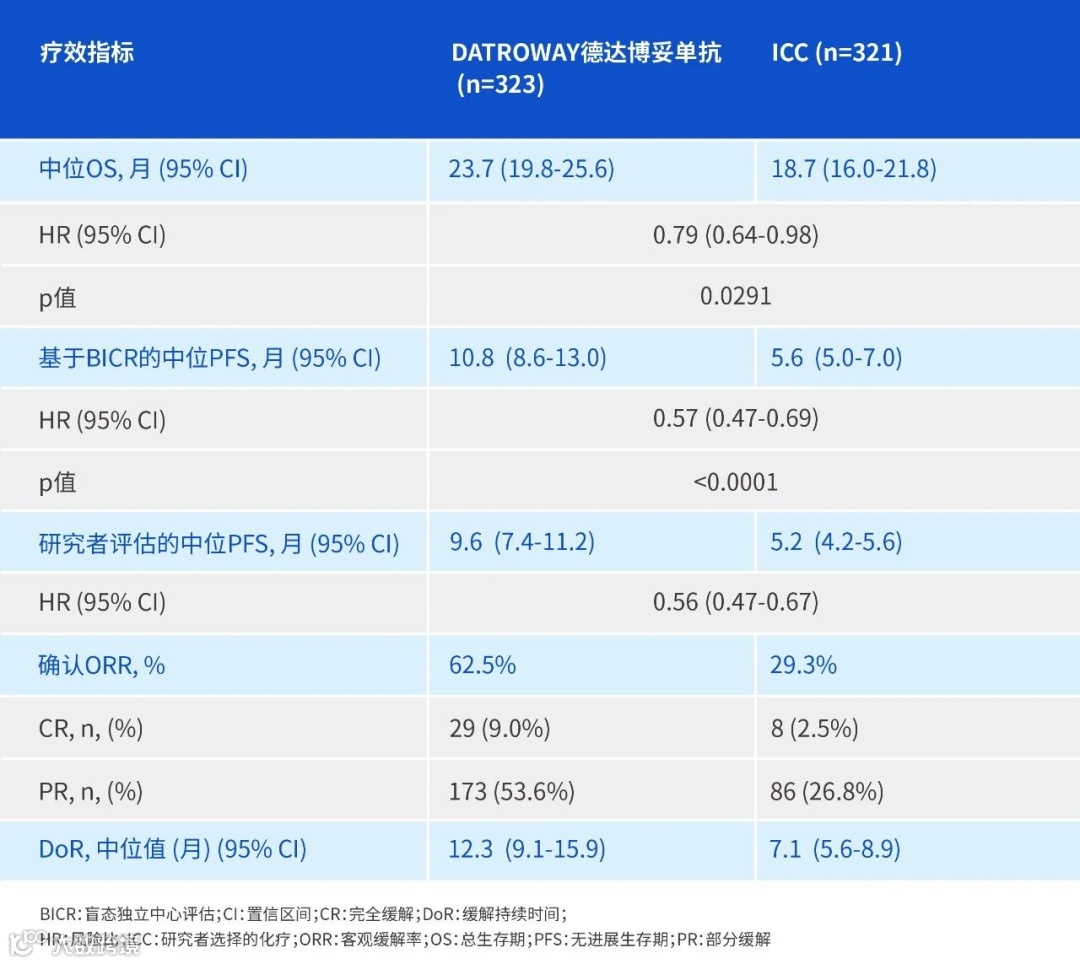
截至2025年8月25日,数据截止时,仍有45名患者(14%)接受德达博妥单抗治疗,8名患者(3%)接受化疗。除入组PD-L1阴性的患者外,TROPION-Breast02研究还纳入了因其他原因无法接受免疫治疗的PD-L1阳性患者。
德达博妥单抗是一款采用独有技术开发的靶向TROP2抗体偶联药物 (ADC),由第一三共研制并由阿斯利康和第一三共合作开发和商业化。
接受德达博妥单抗治疗的患者治疗持续时间是化疗患者的两倍以上(中位治疗持续时间分别为8.5个月与4.1个月),且因治疗相关不良事件(TRAEs)导致停药的比例更低(4%对比7%)。德达博妥单抗组和化疗组分别有33%和29%的患者出现3级及以上治疗相关不良事件。最常见的3级及以上治疗相关不良事件包括:中性粒细胞减少症(3%,13%)、口腔炎(8%,0%)、白细胞减少症(<1%,4%)、疲劳(3%,3%)、呕吐(1%,<1%)、贫血(2%,3%)、 脱发(0%,<1%)、周围神经病变(0%,2%)、干眼症(1%,0%)、恶心(<1%,<1%)、食欲减退(<1%,<1%)及便秘(<1%,0%)。德达博妥单抗组出现1例5级间质性肺病(ILD)事件,经独立委员会判定与药物相关。该事件被确认为3级肺炎,治疗调查员认定死亡原因为疾病进展所致。
阿斯利康与第一三共正在另外三项III期临床研究中评估德达博妥单抗在三阴性乳腺癌的不同分期及治疗场景中的应用。TROPION-Breast03试验评估德达博妥单抗联合或不联合度伐利尤单抗治疗新辅助治疗后存在残留浸润病灶的I-III期三阴性乳腺癌患者。TROPION-Breast04研究评估德达博妥单抗联合度伐利尤单抗作为新辅助治疗,用于II-III期三阴性或激素受体(HR)低表达、HER2低表达或阴性乳腺癌患者。TROPION-Breast05研究评估德达博妥单抗联合或不联合度伐利尤单抗作为一线治疗,用于PD-L1阳性的转移性三阴性乳腺癌患者。
###
声明:本文涉及尚未在中国大陆获批的产品或者适应症,阿斯利康不推荐任何未被批准的药品使⽤。
参考文献
1. O’Reilly D, et al. Overview of Recent Advances in Metastatic Triple Negative Breast Cancer. World J Clin Oncol. 2021;12(3):164-182.
2. World Health Organization. Breast Cancer. Available at: https://www.who.int/news-room/fact-sheets/detail/breast-cancer Accessed October 2025.
3. American Cancer Society. Triple-Negative Breast Cancer. Available at: https://www.cancer.org/cancer/types/breast-cancer/about/types-of-breast-cancer/triple-negative.html. Accessed October 2025.
4. Martinez et al. Contribution of Clinical and Socioeconomic Factors to Differences in Breast Cancer Subtype and Mortality Between Hispanic and Non-Hispanic White Women. Breast Cancer Res Treat. 2017; 166(1):185-193
5. Vargas et al. Risk Factors for Triple-Negative Breast Cancer Among Latina Women. Cancer Epidemiol Biomarkers Prev (2019) 28 (11): 1771–1783.
6. National Cancer Institute. SEER Cancer Stat Facts: Female Breast Cancer Subtypes. Available at: https://seer.cancer.gov/statfacts/html/breast-subtypes.html. Accessed October 2025.
7. Huppert, et al. Emerging Treatment Strategies for Metastatic Triple-Negative Breast Cancer. Ther Adv Med Oncol. 2022;14:1-25.
8. Cortes J, et al. Pembrolizumab Plus Chemotherapy in Advanced Triple-Negative Breast Cancer. N Engl J Med. 2022;387:217-226.
9. Geurts V, et al. Immunotherapy for Metastatic Triple Negative Breast Cancer: Current Paradigm and Future Approaches. Curr Treat Options Oncol. 2023; 24:628-643.
10. Punie, et al. Unmet Need for Previously Untreated Metastatic Triple-Negative Breast Cancer: a Real-World Study of Patients Diagnosed from 2011 to 2022 in the United States. The Oncologist. 2025; 30(3): oyaf034.
11. National Comprehensive Cancer Network. Breast Cancer. (Version 3.2025). https://www.nccn.org/login?ReturnURL=https://www.nccn.org/professionals/physician_gls/pdf/breast.pdf Accessed October 2025.
12. Rossi V, et al. Sacituzumab Govitecan in Triple-Negative Breast Cancer: from Bench to Bedside, and Back Front Immunol. 2024 Aug;15: 1447280.
13. Lin H, et al. Significantly upregulated TACSTD2 and Cyclin D1 Correlate with Poor Prognosis of Invasive Ductal Breast Cancer. Exp Mol Pathol. 2013:94(1): 73-78.
14. Goldenberg D, et al. The Emergence of Trophoblast Cell-Surface Antigen 2 (TROP-2) as a Novel Cancer Target. Oncotarget. 2018;9(48): 28989-29006.
Copyright © 2025 PHARMCUBE. All Rights Reserved. 免责申明:本微信文章中的信息仅供一般参考之用,不可直接作为决策内容,医药魔方不对任何主体因使用本文内容而导致的任何损失承担责任。