
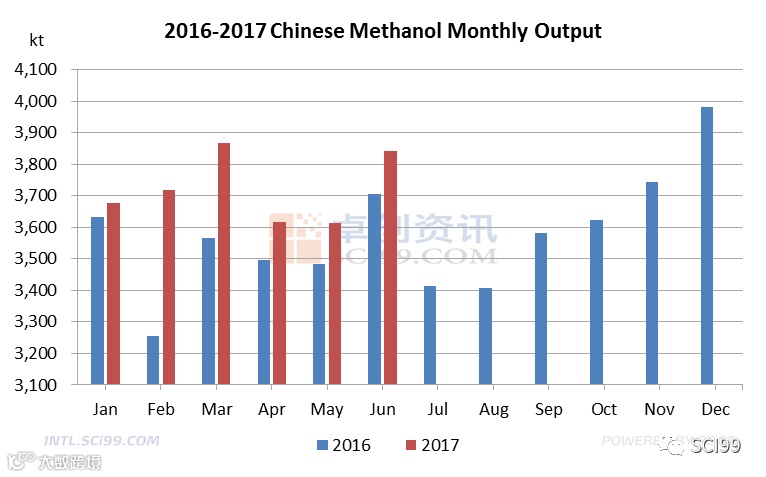
In H1, 2017, there was barely net newly-added capacity released in the Chinese methanol industry. However, the CTO projects put into operation in Q4, 2016 gradually came into normal running, and the overall operating rate of the methanol industry kept rising. Consequently, the monthly methanol output increased notably.
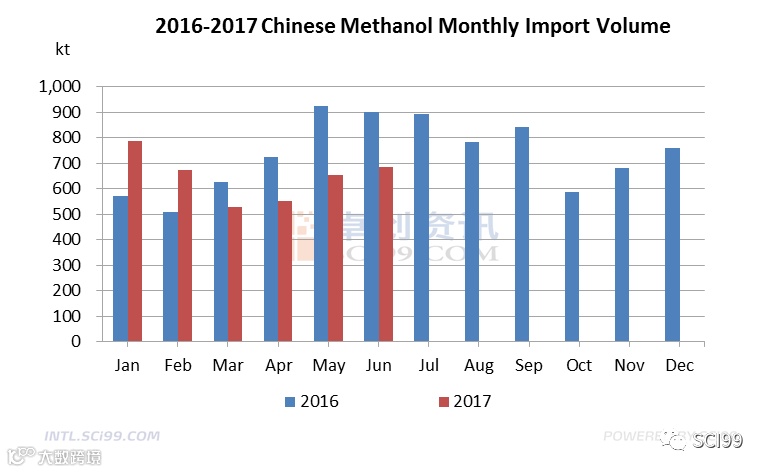
Influenced by the high methanol prices in the coastal areas in Q4, 2016, China’s methanol import volume still remained at the peak level around the Spring Festival of 2017. However, some MTO units in the coastal areas were shut down afterwards, and local methanol prices also fellback. As a result, the methanol import volume gradually declined in Q2, 2017.
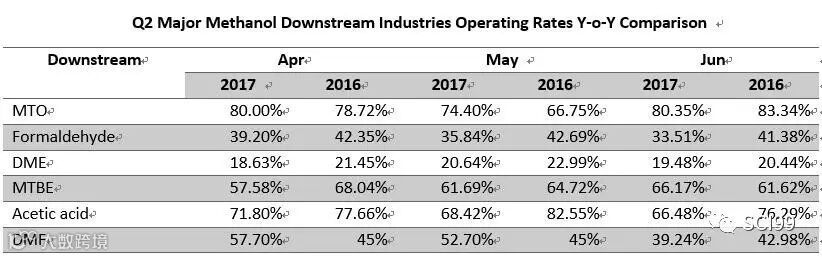
After the Spring Festival holiday,environmental protection and safety inspection was carried out successively indifferent regions, which dampened the methanol demand, especially in the traditional downstream industries. The above data showed that in Q2, the demand peak season, the operating rates of most traditional downstream industries, such as formaldehyde and DME, were lower than those in the same period of last year.
According to the related data H1, 2017, the supply-demand fundamentals are still weak in the Chinese methanol market, as the impact from the environmental protection and safety inspection is obvious, and this influence may last for a long time. For H2, 2017, there is no newly-added demand in the MTO industry. Although there will be some new capacity in the traditional downstream industries, such as MTBE, but the support to the methanol market is limited. As for supply, only in Shandong there will be nearly 3,000kt/a newly-added methanol capacity planned to be put into operation in H2, 2017. SCI considers that if all the methanol capacity is released as scheduled, the Chinese methanol market will continue facing supply-demand imbalance in H2, 2017, and the methanol prices may keep fluctuating downwards.
For more information please contact us at
overseas.sales@sci99.com
+86-533-6296499