China and Major Pulp Exporters' Mutual Dependency Will Enhance
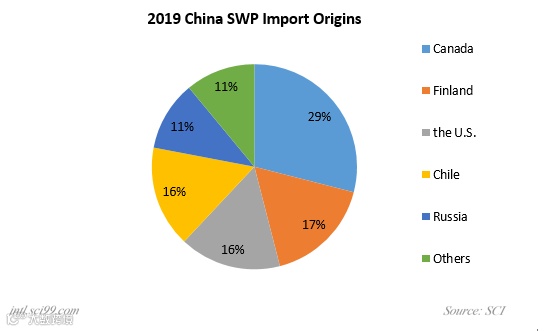
China’s main SWP import origins include Canada, the U.S., Chile, Finland and Russia. Affected by the Sino-U.S. trade dispute, the ranking of Finland and the U.S. had changed since 2019. Therein, the SWP import proportion from Finland continued to grow, while that from the U.S. declined. Due to limited demand growth in China under economic downward pressure as well as unexpected unit turnaround and upgrades at pulp mills in Canada, Chile and Russia, the proportions of other import origins had slipped. The top 5 import origins accounted for 88% of China’s SWP import.
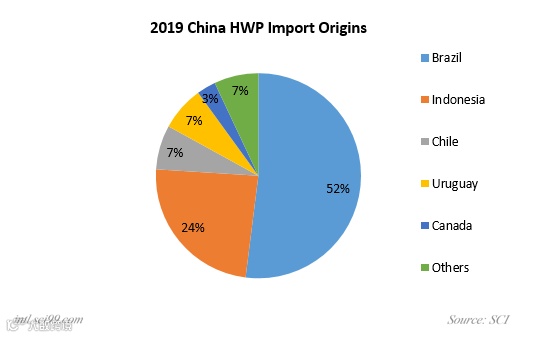
The major HWP import origins were Brazil, Indonesia, Chile, Uruguay and Canada. In 2019, the import volume from Brazil was 6.13 million mt, accounting for 52.02% of China’s total HWP import. The top 5 import origins accounted for 92% of China’s total HWP import.
 Based on SCI’s research, the pulp export volume of Finland was 4.15 million mt in 2019, up 12% Y-O-Y, but the export value went down by 10.2% Y-O-Y. Asia and Europe were the major export destinations of Finland. Therein, China accounted for 42% of Finland’s pulp export. Brazil exported 14.73 million mt of pulp in 2019, flat Y-O-Y, but the export value went down by 10.6%. Therein, China accounted for 43% of Brazil’s pulp export. In 2019, Russia exported 2.05 million mt, and 77% of that was exported to China. According to the aforementioned data, although China is highly dependent on imported pulp resources, major pulp exporters also consider China as an important export destination. China and pulp exporters are mutually dependent.
Limited changes are seen in global pulp supply
According to the data from UN Food and Agriculture Organization, Asia is by far the largest pulp consumption region, accounting for 36% of the world’s total, while the Americas produced 51% of the pulp in the world.
Based on the pandemic updates on March 22, Europe was severely affected by the COVID-19 outbreak. Therein, Italy, Spain, Germany and France had the most confirmed cases (over 10,000). The situation in South America, the largest HWP producing region, was less pressing for the time being. The confirmed case number in Brazil was 1,110. It was heard that Suzano, CMPC, Ence and Klabin had carried out precautious measures such as enclosed production at pulp mills and teleworking for office staff.
The pulp price will remain range-bound in the short term under the influence of multiple factors
Up until now, major pulp producing countries and pulp mills have not released any news regarding operation disruptions due to the outbreak. The pulp supply will remain uncertain in the short term, and some of the Europe-bound pulp may be redirected to Asian Markets. Also, because of the complex situations in the stock and crude markets, the pulp market is not likely to remain in isolation, but it will certainly have its unique performance. According to SCI data, the wood pulp prices in China mainly fluctuated sideways after the Spring Festival holiday. The SWP price ranged between RMB 4,400-4,650/mt, and the HWP price ranged between RMB 3,700-3,750/mt.
In the future, the main reasons affecting the pulp prices will be as follows. First, the average shipment freight time may be extended due to the pandemic control and quarantine measures carried out by the customs of countries. Risks from the cost factor may increase due to the slowing down container turnover rate at ports. The domestic logistics in China, on the other hand, is recovering steadily.
Second, the scheduled, unexpected turnarounds and shutdowns due to force majeure factors may increase, mainly affecting the SWP supply in the future. The HWP price is determined by the operation of Brazilian pulp producers. Based on its pulp export, in February 2020, Brazil exported 450kt of pulp to China, down 43% M-O-M, and it was lower than that in 2019. However, 450kt was an average number as seen in the past few years. Therefore, the HWP shipment arrivals at China’s ports are not expected to increase obviously in April. According to feedbacks from ports, the pulp arrival at Changshu is estimated to be 350-360kt, and that at Qingdao is estimated to be 300kt.
Third, domestic demand in China is recovering slowly. Because many paper mills are still consuming pulp inventory from the pre-holiday procurement, the port inventory only drops slowly. In mid-march, the combined port inventory at Qingdao, Changshu, Baoding and Gaolan only went down by 2.82% compared with that in early March. The operating rate recovery at cultural paper mills was limited, and orders from publishers were delayed due to teleworking and deferred school semesters. Most tissue paper mills had resumed operational, but the operating rate was below the normal level. The production at ivory board producers was fairish, benefited from its substitution for duplex board.
Fourth, downstream cultural paper prices loosened slightly, and the ivory board price saw minor changes. The tissue paper price went up because of the inelastic demand, and the profit of tissue producers rose over that of other paper producers. Although the overall market sentiment remains bearish at present, the prices are not likely to decline any further restricted by the cost factor. Thus, the pulp and paper prices are expected to remain range-bound in the short term.
More uncertainties are observed in the pulp and paper market under the context of the global pandemic situation, and the turning point has not yet appeared. Also, uncertainties from the pulp industry fundamental factors still remain, and participants are cautiously sitting on the sidelines.
However, the mutual dependency between China and major pulp producers in the world is enhancing due to the general economic downturn, and the importance of the Chinese market is growing. Participants are advised to pay attention to updates of the global pandemic as well as the moves undertaken by overseas pulp mills, especially Brazilian pulp mills. The commissioning dates of some newly added capacity may be delayed.
Please click "Read more" for more information
For more information please contact us at
Based on SCI’s research, the pulp export volume of Finland was 4.15 million mt in 2019, up 12% Y-O-Y, but the export value went down by 10.2% Y-O-Y. Asia and Europe were the major export destinations of Finland. Therein, China accounted for 42% of Finland’s pulp export. Brazil exported 14.73 million mt of pulp in 2019, flat Y-O-Y, but the export value went down by 10.6%. Therein, China accounted for 43% of Brazil’s pulp export. In 2019, Russia exported 2.05 million mt, and 77% of that was exported to China. According to the aforementioned data, although China is highly dependent on imported pulp resources, major pulp exporters also consider China as an important export destination. China and pulp exporters are mutually dependent.
Limited changes are seen in global pulp supply
According to the data from UN Food and Agriculture Organization, Asia is by far the largest pulp consumption region, accounting for 36% of the world’s total, while the Americas produced 51% of the pulp in the world.
Based on the pandemic updates on March 22, Europe was severely affected by the COVID-19 outbreak. Therein, Italy, Spain, Germany and France had the most confirmed cases (over 10,000). The situation in South America, the largest HWP producing region, was less pressing for the time being. The confirmed case number in Brazil was 1,110. It was heard that Suzano, CMPC, Ence and Klabin had carried out precautious measures such as enclosed production at pulp mills and teleworking for office staff.
The pulp price will remain range-bound in the short term under the influence of multiple factors
Up until now, major pulp producing countries and pulp mills have not released any news regarding operation disruptions due to the outbreak. The pulp supply will remain uncertain in the short term, and some of the Europe-bound pulp may be redirected to Asian Markets. Also, because of the complex situations in the stock and crude markets, the pulp market is not likely to remain in isolation, but it will certainly have its unique performance. According to SCI data, the wood pulp prices in China mainly fluctuated sideways after the Spring Festival holiday. The SWP price ranged between RMB 4,400-4,650/mt, and the HWP price ranged between RMB 3,700-3,750/mt.
In the future, the main reasons affecting the pulp prices will be as follows. First, the average shipment freight time may be extended due to the pandemic control and quarantine measures carried out by the customs of countries. Risks from the cost factor may increase due to the slowing down container turnover rate at ports. The domestic logistics in China, on the other hand, is recovering steadily.
Second, the scheduled, unexpected turnarounds and shutdowns due to force majeure factors may increase, mainly affecting the SWP supply in the future. The HWP price is determined by the operation of Brazilian pulp producers. Based on its pulp export, in February 2020, Brazil exported 450kt of pulp to China, down 43% M-O-M, and it was lower than that in 2019. However, 450kt was an average number as seen in the past few years. Therefore, the HWP shipment arrivals at China’s ports are not expected to increase obviously in April. According to feedbacks from ports, the pulp arrival at Changshu is estimated to be 350-360kt, and that at Qingdao is estimated to be 300kt.
Third, domestic demand in China is recovering slowly. Because many paper mills are still consuming pulp inventory from the pre-holiday procurement, the port inventory only drops slowly. In mid-march, the combined port inventory at Qingdao, Changshu, Baoding and Gaolan only went down by 2.82% compared with that in early March. The operating rate recovery at cultural paper mills was limited, and orders from publishers were delayed due to teleworking and deferred school semesters. Most tissue paper mills had resumed operational, but the operating rate was below the normal level. The production at ivory board producers was fairish, benefited from its substitution for duplex board.
Fourth, downstream cultural paper prices loosened slightly, and the ivory board price saw minor changes. The tissue paper price went up because of the inelastic demand, and the profit of tissue producers rose over that of other paper producers. Although the overall market sentiment remains bearish at present, the prices are not likely to decline any further restricted by the cost factor. Thus, the pulp and paper prices are expected to remain range-bound in the short term.
More uncertainties are observed in the pulp and paper market under the context of the global pandemic situation, and the turning point has not yet appeared. Also, uncertainties from the pulp industry fundamental factors still remain, and participants are cautiously sitting on the sidelines.
However, the mutual dependency between China and major pulp producers in the world is enhancing due to the general economic downturn, and the importance of the Chinese market is growing. Participants are advised to pay attention to updates of the global pandemic as well as the moves undertaken by overseas pulp mills, especially Brazilian pulp mills. The commissioning dates of some newly added capacity may be delayed.
Please click "Read more" for more information
For more information please contact us at