The recovery of market trading in China’s pulp market has been slow since early February, and the logistic system was still ineffective. Downstream paper mills also encountered obstacles in their resumption attempts. Transactions were seen occasionally in the pulp market on a benchmark price in accordance with the futures market, and the pulp inventory started to accumulate at major ports and regions.
Pulp inventory rose steadily but was yet to break the historic high.
Cumulating pulp inventory was commonly seen at major ports and regions during the Spring Festival periods. Although the inventory was on the rise, it had not broken the historic high in August 2019.
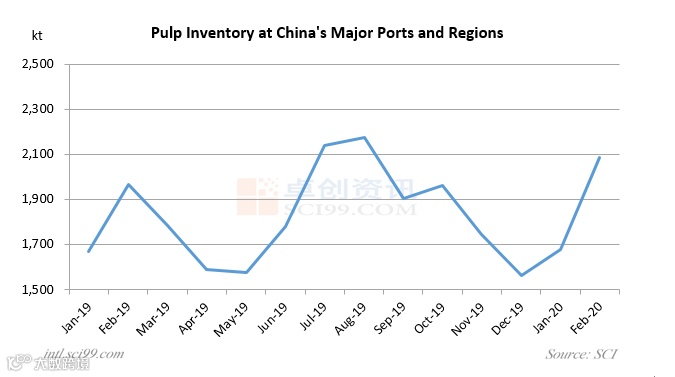
Remark: the chart only includes inventory data at Qingdao, Changshu and Baoding.
As seen from the chart above, in Q4 2019, the port inventory had entered a de-stocking stage. Meanwhile, affected by unexpected incidents at overseas producers and changing sentiment amongst participants, the pulp prices were showing signs of rebounding. According to SCI data, the monthly average price of imported SWP was RMB 4,492/mt in January, up 0.23% M-O-M, and that of HWP was RMB 3,744/mt, up 0.35% M-O-M. The monthly average prices of imported CMP and UKP also rose by 1.18% and 0.65% respectively M-O-M.
However, the pulp inventory level was on the rise due to restrictions on production and logistics. According to SCI, the pulp inventory (Qingdao, Changshu, Baoding and Gaolan) in early February was 2,050kt, up 15% from late January. By mid-February, the inventory has reached 2,230kt, up 9% from early February. Therein, the pulp inventory in Qingdao increased by 6% in the past two weeks, that in Changshu increased by 4%, and that in Baoding surged by 39%.
Despite the normal operation at domestic pulp mills, long-distance sales were restricted by the logistics.
The operating status at domestic pulp mills was relatively stable, and some units which had been shut during the holiday were coming back online. Therefore, the most pressing matters are the sales pressure due to restrictions on long-distance transportation and the low availability of pulping chemicals.
The Ministry of Transport has lifted the tolls for highway transportation, aiming to reduce the general logistic cost of the industrial sector. However, with many of the migrant workers who work in the logistic system being grounded in their hometowns, the availability of truck transportation was limited in the market. Therefore, the recovery of the logistic system still faces certain obstacles. In the short term, transportation has become one of the direct influencing factors in the pulp market.
Downstream paper mills acted slowly in resumption, affecting pulp sales.
During the first week after the holiday, most paper mills planned to restart after February 10. But based on the latest updates, some have postponed to after February 20, and some even estimated the resumption would occur in early March. As a result, the pulp market sales were curbed by the frequent resumption postponements at downstream paper mills.
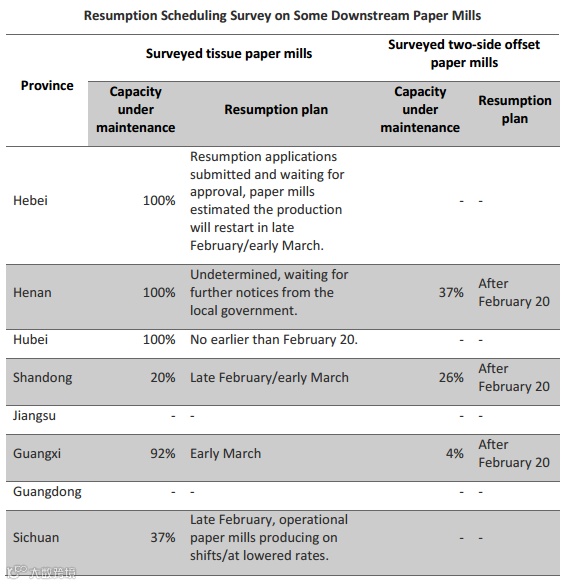
If the surveyed paper mills could restart as normal after the holiday and operated at a rate of 70-75%, the pulp consumption volume would be 230kt. However, because most large-sized paper mills had prepared sufficient pulp stock, the paper inventory might have started to accumulate.
Price discovery function of the BSK futures
The market trading has not resumed normal because of several obstacles such as ineffective transportation and delayed resumption. During the past two weeks, most pulp sellers offered at the dominant BSK contact price minus RMB 40-50/mt, and the price discovery function played an important role in supporting pulp spot trading.
1. Although the impact of the trade war on the SWP market is marginalizing, the easing relationship between China and the U.S. will undoubtedly benefit the orderly development of the paper industry. According to the latest exemption list published by the Customs Tariff Commission of the State Council, the tariff on imported SWP from the U.S. is lifted, and it will ease the cost pressure of domestic paper producers.
2. Q4 reports of several listed enterprises indicate that their profit rates have slipped from the first three quarters and some Canadian enterprises suffered operating losses. Therefore, overseas pulp mills may reluctant to sell at low prices.
3. Uncertainties such as the strike in Finland, the bushfire in Australia, the sulfur content restriction policy by IMO will continue to tight up pulp supply and provide support to the future pulp prices.
5. The policy regulations on imported waste paper and the use of plastic will benefit the demand for wood pulp in the future.
6. The RMB to USD exchange rate edged down recently, but as the current force majeure event ends, the exchange rate will climb, alleviating import cost pressure.
SCI reckons the restrictions will only hinder the pulp price in the short term. The tightening supply and rising import offers will support the pulp price in the future. As seen from the shipment status of major pulp exporters, in January, the pulp export from Brazil to China rose by 43.74% M-O-M, and that from Chile rose by 26.92% M-O-M. Therefore, the supply pressure may be released in March. Participants are advised to pay attention to the impacts of the uncertainties and the pulp de-stocking rate at major ports and regions.
Please click "Read more" for more information
For more information please contact us at