

China Exported 380CST Bonded Bunker Futures to Singapore
On August 10, Freepoint Commodities (Shanghai) obtained 16,010mt of bonded 380CST futures warehouse receipts through standard warehouse receipt transfer and delivery and exported the cargoes to Singapore for the bonded bunkering market. This shows that China’s LSFO started to supply overseas bunkering market. In history, China’s bonded bunker sales was 9-12 million mt per year. The low bonded bunker sales didn’t match China’s large cargo throughput at ports. Among the global top ten ports in terms of port throughput, there are eight of them in China, such as Ningbo-Zhoushan, Shanghai, Shenzhen, Guangzhou, Hong Kong and Qingdao. And in particular, Ningbo-Zhoushan Port ranked first in the globe for several consecutive years. Chinese coastal ports’ cargo throughput is around six times of the Singaporean ports’ throughput. But China’s bonded bunker sales is only one fourth of Singapore’s bonded bunker sales. In the past years, the bonded bunker prices at Chinese ports were much higher than the prices in Singapore, because most of China’s bonded bunker was imported from Singapore. Meanwhile, Chinese ports’ bunkering service efficiency was lower. Therefore, it was hard for China’s bonded bunker sales to increase a lot in the past years.
But Zhoushan Port is building itself into a bunkering hub in Northeast Asia with IMO 2020. On April 22, the Ministry of Commerce issued the first batch of LSFO export quotas for 2020. Sinopec, PetroChina, CNOOC, Sinopec and ZPC were awarded 4.29 million mt, 2.95 million mt, 0.86 million mt, 0.90 million mt and 1 million mt, repectively. On June 22, LSFO futures were officially launched on Shanghai International Energy Exchange (INE). The listed contracts include LU2101, LU2102, LU2103, LU2104, LU2105 and LU2106, and the listed base price is RMB 2,368/mt. The largest difference between the LSFO futures launched on INE and the fuel oil futures listed on Shanghai Futures Exchange (SHFE) is that the former one refers to the fuel oil with the sulphur content no more than 0.5%, while the latter one refers to 380 CST fuel oil whose sulphur content is 3.5%. Due to the requirements of IMO 2020, China boosted its transition from high-sulphur fuel oil to low-sulphur fuel oil from 2019. Therefore, in 2020, the supply of high-sulphur 380CST in China dropped, and its co-movement with the market weakened. Accordingly, China decided to launch LSFO futures.
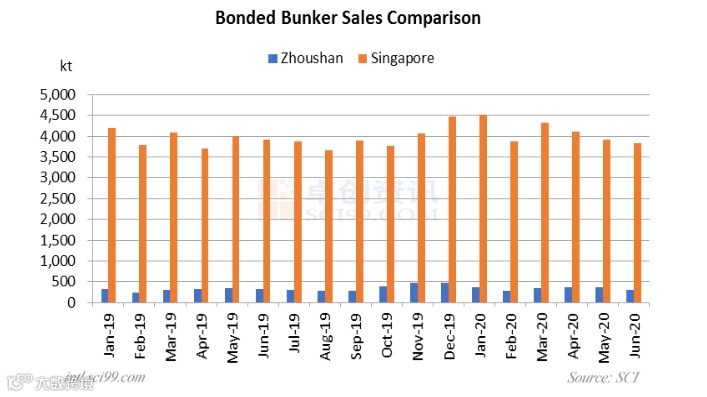
Among the global top ten ports in terms of port throughput, there are eight of them in China, such as Ningbo-Zhoushan, Shanghai, Shenzhen, Guangzhou, Hong Kong and Qingdao. And in particular, Ningbo-Zhoushan Port ranked first in the globe for several consecutive years. Chinese coastal ports’ cargo throughput is around six times of the Singaporean ports’ throughput. But Zhoushan’s bonded bunker sales is less than 10% of Singapore’s bonded bunker sales. In the past years, the bonded bunker prices at Chinese ports were much higher than the prices in Singapore, because most of China’s bonded bunker was imported from Singapore.