

Profitability of CREP in NE, North & East China
On July 28, the south section of China-Russia East Pipeline (CREP) was kicked off in Nantong, Jiangsu, which is expected to greatly improve the supply guarantee capability in the Yangtze River Delta. At present, the north section of CREP (Heihe to Changling) was put into operation in December 2019; the middle section of CREP (Changling to Yongqing) is under construction and is scheduled to be put into service by the end of 2020; the south section of CREP is expected to be put into operation in 2023. Currently, CREP is the world’s largest cross-border natural gas pipeline project in terms of single pipeline transmission capacity, and its China part can achieve interconnection with the existing pipelines in the surrounding areas and boost the natural gas supply.
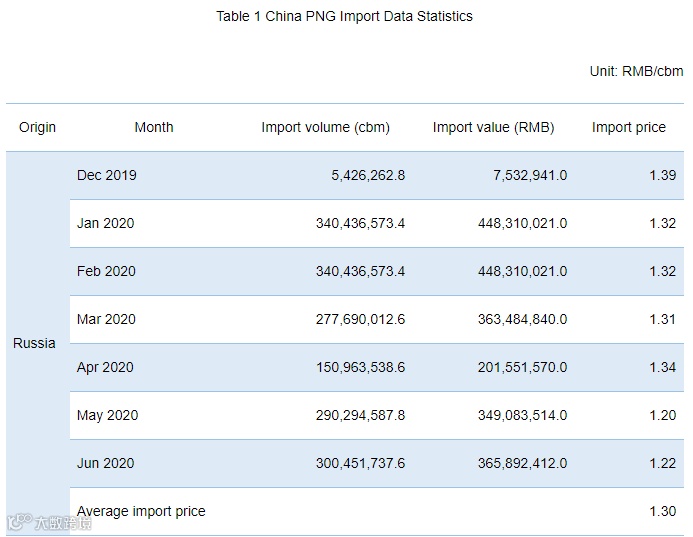
According to SCI, since the north section of the CREP was put into operation, the PNG price imported from Russia averaged RMB 1.3/cbm. At present, the transmission price for the north section of CREP is RMB 0.1825 /thousand cbm*km (9% VAT included). Assuming that the middle and south sections are both based on this transmission price, the price comparison between Russian PNG delivered price and provincial hub price are calculated according to the distance from Heihe to each region.
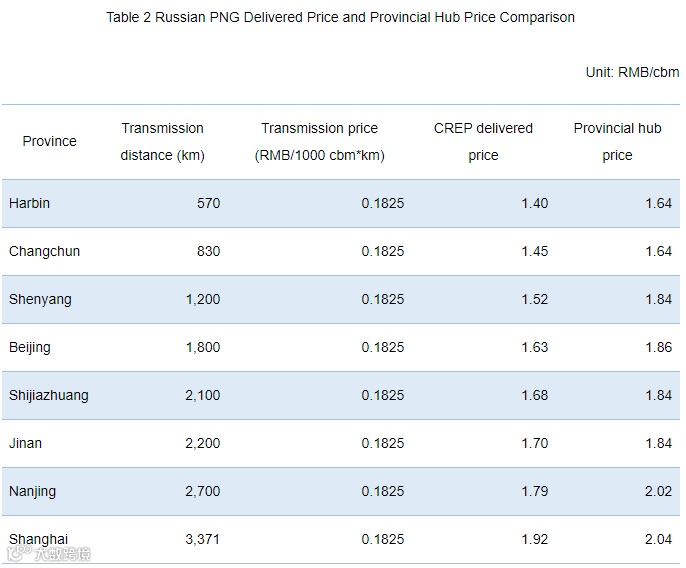
Assuming that the transmission price of CREP is RMB 0.1825/thousand cbm*km, the Russian PNG delivered prices are all lower than the provincial hub prices. Thus, Russian PNG has a significant price advantage in Northeast China, North China and East China.
2 Russian PNG and other PNG Price Comparison
From the perspective of gas supply, North China currently mainly relies on the PNG supply from Shaanxi-Beijing Trunk Line and Yu-Ji Trunk Line as well as the LNG regas from LNG receiving terminals in the eastern coastal areas supplemented to the natural gas output from regional gas fields. The gas supply sources in the Yangtze River Delta include the West-to-East Trunk Line I and Sichuan-East Trunk Line from the west, the LNG receiving terminals in Rudong, Shanghai and Ningbo from the east, West-to-East Trunk Line II from the south and Qing-Ning Trunk Line from the north, forming a multi-directional gas supply structure. The main gas source of West-to-East Trunk Line II is Central Asia Pipeline; that of Shaanxi-Beijing Trunk Line is Yulin and Jingbian gas fields; that of Sichuan-East Trunk Line is Puguang gas field.