

Jun China PBR Import and Export Analysis
Introduction: In June 2022, China’s PBR import volume edged down, while China’s PBR export volume hit a new high.
China’s PBR import volume in June showed a slight M-O-M decrease.
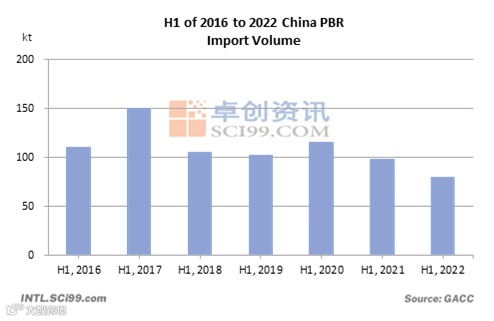
GACC’s data showed that in June 2022, China’s PBR import volume was 11.9kt, down 5.18% M-O-M and down 22.62% Y-O-Y. From January to June 2022, China’s PBR import volume totaled 80.3kt, down 18.35% Y-O-Y, notching a record low.
China’s PBR import volume in June dwindled, and the total import volume from January to June hit a record low. The decrease in PBR import volume in recent years was mainly due to the increasing degree of self-sufficiency. The decrease in June import volume was mainly as China’s demand underperformed. As seen from the major downstream application field – the tire industry, China’s all-steel tire output from January to June 2022 was 58.3545 pieces, down 14.14% Y-O-Y. China’s semi-steel tire output from January to June 2022 was 23.63846 pieces, down 4.49% Y-O-Y. Tire enterprises’ demand for PBR was limited under inventory pressure and due to limited impetus from domestic demand.
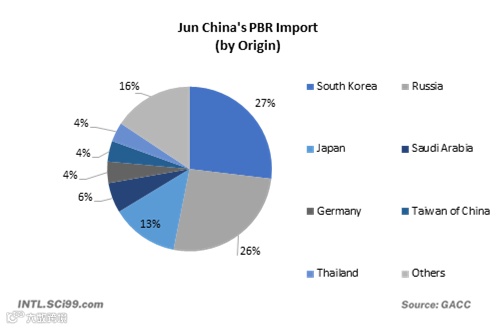
South Korea remained to be China’s largest PBR import trade partner in June. China’s PBR import volume from South Korea was 3.2kt in June, taking up 27% of China’s total PBR import volume.
China’s PBR export volume in June hit a fresh high.
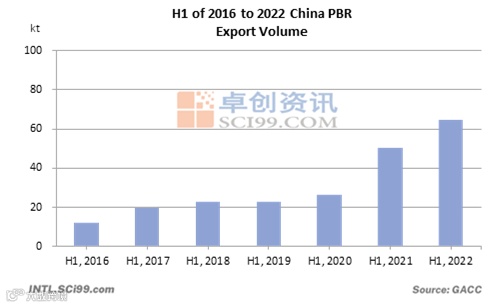
GACC’s data showed that in June, China’s PBR export volume was 17.2kt, up 6.25% M-O-M and up 181.06% Y-O-Y. From January to June 2022, China’s PBR export volume totaled 64.5kt, up 28.14% Y-O-Y.
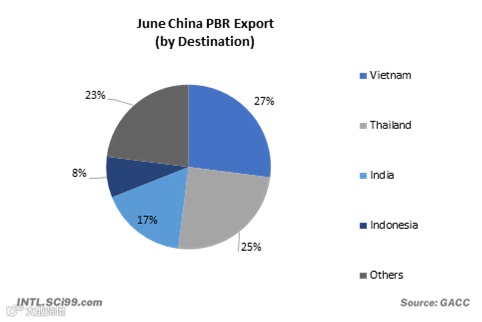
Among China’s export trade partners, the export to India changed noticeably. GACC’s data showed that China exported 2.9kt of PBR to India in June, up 953.4% M-O-M and up 2,346,040% Y-O-Y. For the import proliferation, first, India only had 120kt/a PBR capacity, and some resources still relied on imports. According to SCI, India’s main import trade partners were South Korea, Saudi Arabia and a country in Europe. GACC’s data showed that South Korea’s PBR export volume to India declined by about 30% in June. Due to changes in the international situation, the export of synthetic rubber in a European country changed to some extent. The changes in India’s main import trade partners conduced to China’s PBR imports.
The prices of China’s PBR resources exported to India were higher than China’s domestic market prices, and yuan depreciated against the U.S. dollar. Export profits contributed to the high arbitrage enthusiasm. GACC’s data showed that the monthly average export price of China’s PBR exported to India was $2,100/mt or so in June.
Sinopec Maoming Company shut its unit down in July, and Shandong Wintter Chemical, Sinopec Qilu Company, PetroChina Jinzhou Petrochemical and Xinjiang Lande Fine Petrochemical conducted maintenance. Therefore, the supply pressure was not heavy in July, but the demand recovery was slow. In August, Sinopec Maoming Company is expected to restart its unit, and other units will successively resume normal production. Thus, supply in August will probably go higher from July, but demand is predicted to hardly improve. China’s PBR import volume is predicted to remain low against the backdrop of demand uncertainty. In terms of exports, it is learned that the increment in synthetic rubber demand in Southeast Asia is limited. China’s PBR export volume is likely to dwindle to some extent from July to August.
All information provided by SCI is for reference only, which shall not be reproduced without permission.
Please click "Read more" for the full article.