

How will China DMC Market Swing in Q2, 2023 amid Load Cuts?
Snapshot: In Q1, 2023, China’s silicone intermediate DMC price was mostly enfeebled by ample supply, dull demand and descended cost. In Q2, 2023, more silicone monomer enterprises plan to cut or even halt production, and meanwhile, it is envisaged that the cost swing range will shrink. Thus, the decrement in DMC price may slow down in Q2, 2023.
In Q1, 2023, China’s DMC prices saw fewer rises amid slack demand.
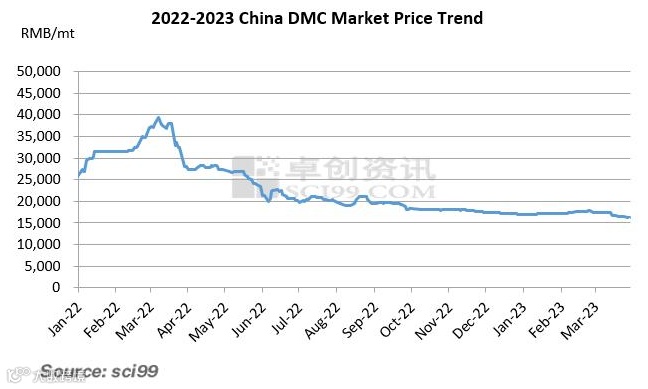
In Q1, 2023, China’s DMC price first extended gains and then dwindled. Against the optimization of prevention and control policies as well as traditional demand peak season, players adopted an optimistic sentiment toward the silicone market in Q1. Affected by that, the overall silicone industrial chain ushered in a wave of replenishment. Thus, rising demand pushed up the DMC price slightly. Heading into March, due to the soft real estate market and the slowdown in export growth, orders at downstream silicone rubber and silicone oil enterprises fell short of expectations. The demand in the DMC market still kept dull, and large downstream stock-up volume in February overdrew the demand in March ahead of time. Therefore, the demand for DMC in China was curtailed notably. Yet, the operating rate at China’s silicone monomer enterprises stayed high. Strong supply and lackluster demand weighed on the DMC price. As of March 31, the DMC price slumped to RMB 15,200/mt (delivered price without package; in cash), hitting a 5-year low. The quarterly average price of DMC in China stood at RMB 16,849/mt, down 48.30% Y-O-Y.
China’s DMC supply kept ample, due to high loads of the existing units and increments from new ones.
In Q1, the new 400kt/a silicone monomer capacity in Xinjiang was released, and the operating rate of other existing silicone monomer units remained high. Thus, the monthly output of silicone hydrolysate hiked to a new high again in 2023. According to SCI, the silicone hydrolysate output reached 537.2kt in Q1, up 12.36% Y-O-Y. The DMC supply tended to be sufficient. With new entrants emerging in the recent two years, the competition in the silicone monomer industry became fierce. In the context of lukewarm demand, DMC enterprises cut prices to promote sales due to a supply glut. Therefore, China’s DMC price faced more declines than rises in Q1, 2023.

Downstream consumption and price both pared down, hardly bolstering the DMC price.
In Q1, China’s real estate market was in the recovery period. The demand from the construction sealant sector was insufficient, dragging down the rigid demand of 107 silicone rubber sector. Besides, due to the slowdown of the foreign economy and the tightening of monetary policy, the residents’ consumption leveled down, constraining the demand release from silicone rubber products and HTV silicone rubber with a high export dependence rate. Therefore, the demand for 110 silicone gum in China cooled down notably. The rigid demand in the DMC market underperformed. Meanwhile, most downstream users purchased feedstock DMC on a need-to basis, in the wake of dipping DMC prices. The replenishment cycle was dented, so inventory at silicone monomer enterprises was transmitted slowly to downstream users. In end-March, the inventory of silicone products at enterprises reached over 100kt in China, hitting a 5-year high. Affected by weak demand and overcapacity, prices of 107 silicone rubber, 110 silicone gum and simethicone mostly headed down. Taking 110 silicone gum as an example, its average price in Q1, 2023 reached RMB 17,842/mt, down 47.42% Y-O-Y. In Q1, 2023, downstream consumption and price both put a damper on the DMC price overall.

Prices of silicon metal trended down, failing to underpin the DMC price from the cost.
Silicon metal accounts for around 50% of DMC cost, which is the main driver affecting the change in DMC cost. In Q1, the silicon metal price fluctuated downwards, taking cues from a slide in futures prices and supply-demand imbalance. Taking silicon metal 421 price at Huangpu port as an example, its average price Q1 reached RMB 18,633/mt, down 18.08% Y-O-Y. Due to the drop in silicon metal price, the average cost of DMC descended to RMB 18,354/mt, down 10.79% Y-O-Y. The Y-O-Y fall in cost further intensified players’ bearish sentiment, having an impact on the purchasing appetites. In terms of producers, despite a decline in cost, DMC producers continued to face more losses, as the decrement in DMC was higher than that in cost. Thus, silicone monomer enterprises began to cut or halt production from March.
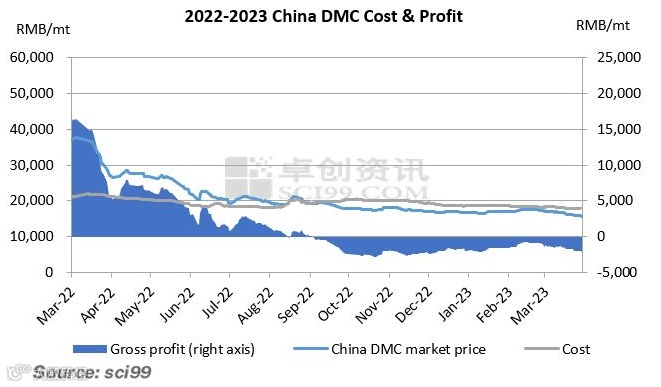
In Q2, 2023, the decrement in DMC price may slow down, taking cues from more production cuts or halt at silicone monomer enterprises.
In Q2, 2023, end demand may usher in the traditional slack season. The rainy weather may further constrain the demand release in the RTV silicone rubber market. In terms of supply, no fresh silicone monomer capacity in China is expected to be released in Q2. Meanwhile, enterprises will face more pressure on operations amid constant losses, so they will have more plans to cut or shut production. It is envisaged that the silicone hydrolysate output may be dented in Q2, alleviating the supply-demand imbalance. In terms of cost, most silicon metal enterprises in main production areas have faced losses, and the current silicon metal price slides to the lowest cost in Xinjiang gradually. Thus, the further decline in silicon metal price will be limited in the later period. The production cost fluctuation of DMC may shrink. In this context, the enterprises may face more losses if the DMC price descends greatly. At that time, some silicone monomer enterprises with high costs will cut load or take maintenance of their units increasingly. On the whole, SCI reckons that the supply-demand imbalance of DMC in Q2 may be eased gradually, but the supply glut may continue in the short run. Thus, the DMC price is likely to swing down. However, considering narrower cost fluctuation, the overall decrement in DMC price may be minor. Players should pay close attention to enterprises’ production cut or halt status in Q2.
All information provided by SCI is for reference only, which shall not be reproduced without permission.
Please click "Read more" for the full article.