

PP: Different Price Growth Rates Among Regions
Preamble: China’s PP supply pressure was not heavy in July because of extensive unit maintenance, which underpinned PP prices and market players’ sentiment. However, the demand continuity underperformed, hindering the price increase. The gap between PP supply and demand all shrank in North China, East China and South China, and the upward ranges of prices performed differently. The supply-demand pattern will probably change again in the future with supply gain and startup of new units.
PP units underwent intensive maintenance amid the summer maintenance season.
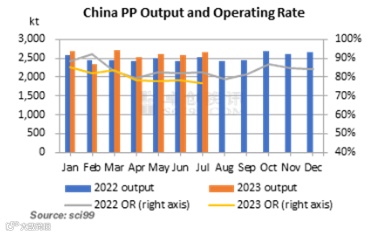
China’s PP output achieved 2,653.4kt in July after M-O-M and Y-O-Y growth with continuous capacity expansions. But operating rates of PP units dropped by 1.51 percentage points M-O-M and 5.32 percentage points Y-O-Y to 77.03%, mainly as unit maintenance was extensive amid the summer maintenance peak season. Around 20 PP producers newly arranged maintenance, such as Shaanxi Yanchang Coal Yulin Energy and Chemical and Zhongtian Hechuang Energy. However, around 19 producers finished their maintenance, such as Sinopec Qingdao Refining & Chemical and Sinopec Luoyang Company. About 25 enterprises remained in downtime.
The output loss caused by maintenance dropped by 12.2kt to around 697.8kt in July. By region, unit maintenance was concentrated in North China and South China, which led to large changes in the supply-demand pattern there. Falling supply bolstered PP prices a lot. Therein, PP output ramped up in East China because limited units underwent maintenance there and there were newly constructed units. The new unit at Sinopec Anqing Petrochemical came on stream. Meanwhile, the closed unit at Xuzhou Haitian Petrochemical was restarted, so the PP output proportion in East China increased by 1.08 percentage points M-O-M. PP output declined a lot in South China this month, and its proportion decreased by 1.75 percentage points M-O-M, mainly affected by unit maintenance at Dongguan Juzhengyuan Technology and Zhongke (Guangdong) Refinery & Petrochemical, etc. For PP units that took an overhaul in North China, their capacity was large. For instance, the 450kt/a unit at JINNENG Chemical (Qingdao), the 600kt/a units at Shandong Chambroad Petrochemicals, the 350kt/a unit at Zhongtian Hechuang Energy and so on underwent maintenance.
The producer inventory declined to a medium-to-low level in July with extensive maintenance of PP units. Besides, crude oil values spiraled up, buoying PP prices strongly. PP producers uplifted EXW offers successively, underpinning spot PP market prices. However, the PP inventory at traders fluctuated within a certain corridor with some resistance in consumption, reflecting insipid downstream demand. Generally, PP supply was not ample in July, but limited demand dampened the PP market price. In regions, the larger the gap between supply and demand was, the more noticeable the PP price growth was. Therein, the growth rate of price in North China was the largest, that in South China ranked after North China, but that in East China was the smallest.
PP prices in East China, North China and South China saw different increments.
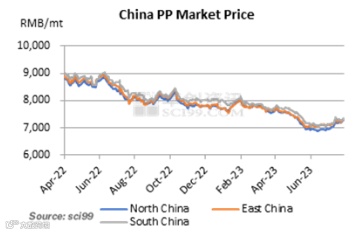
As seen from the above chart, PP prices in East China, North China and South China showed a similar trend, but the upward ranges were different. According to SCI, the price spread between East China and North China diminished to around RMB 99/mt, and that between South China and North China shrank to RMB 140/mt. Besides, that between South China and East China climbed to RMB 40/mt or so. The change in price spread was credited to the supply-demand pattern. Combined with the freight base, there is no arbitrage space among regions. With the restarting of closed units, PP supply in regions mounted up gradually. In terms of capacity expansions, they were mainly concentrated in East China and South China, so these two regions are expected to witness further changes in supply-demand patterns.

All information provided by SCI is for reference only, which shall not be reproduced without permission.
Please click "Read more" for the full article.