

Competitive Advantages of Ethylene-Based PVC Increased
Preface: Based on different feedstock, the production methods of PVC are divided into the calcium carbide method and ethylene method. In recent years, the ethylene process has obvious competitive advantages in terms of policy, cost, export, quality, etc. The proportion of ethylene-based PVC has increased constantly. In the future, ethylene-based PVC will possibly still occupy a certain advantage in the value chain competition, and the proportion of ethylene process is expected to continue to increase.
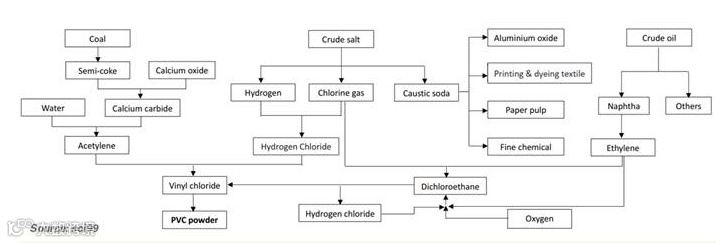
PVC, short for polyvinyl chloride, is a kind of thermoplastic synthetic resin polymerized from VCM, and it is a white powdery solid. As for the production method, based on different feedstock, the production methods are divided into the calcium carbide method and ethylene method. The production using self-produced ethylene, imported ethylene, imported EDC/VCM and outsourced VCM is usually called the ethylene method. Most of China’s PVC powder producers adopt the calcium carbide method influenced by the rich coal resources in China, while some adopt the ethylene method. However, the proportion of the calcium carbide method gradually declined, while that of the ethylene method improved.
PVC Powder Production Process Flowchart
From the perspective of the product life cycle, the PVC powder industry is obviously in a mature period. Ethylene-based PVC powder has some advantages in policy, cost, export and quality.
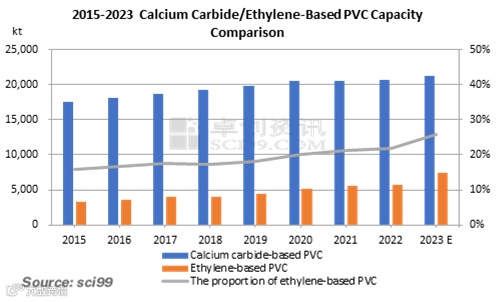
From 2015, the proportion of ethylene-based PVC powder capacity climbed constantly. As of 2023, it’s estimated that the proportion of ethylene-based PVC powder capacity will be 25.75%, up 9.97 percentage points from 2015.
As the ethylene process is relatively clean and environmentally friendly, the capacity expansion of ethylene-based PVC faces no resistance.
The Minamata Convention on Mercury entered into force on August 16, 2017, in China. As a signatory, China promised to reduce domestic mercury use as much as possible. The largest amount of mercury in China is the mercury catalyst used in the production process of calcium carbide-based PVC. Therefore, after the Minamata Convention came into effect, it becomes more difficult to pass the EIA of calcium carbide-based PVC project.
The convention has a long influencing period on the whole industry. China adopts the calcium carbide method as the predominant process to produce PVC powder, and mercuric chloride is used widely as the catalytic agent in the process, taking up over 60% of China’s mercury consumption. The implementation of the convention in China will restrict the future development of the calcium carbide-based PVC powder industry and push the industry to transform toward a green and clean path. In addition, ethylene-based PVC powder will obtain more and more market attention.
In the updated industrial structure adjustment guidance catalog in 2019, it is stipulated that high-mercury catalysts (mercury chloride content above 6.5%) and acetylene-based polyvinyl chloride production devices using high-mercury catalysts are included in the eliminated industries. In 2020, China’s calcium carbide-based market realized low mercury conversion.
China has put forward a target of “Dual Carbon”, that is, striving to reach a carbon emission peak by 2030 and realize carbon neutrality by 2060. Under such a background, Inner Mongolia, the major PVC-producing region in China, stipulated in Guarantee Measures for Ensuring the Completion of Dual Control Targets and Tasks for Energy Consumption during the 14th Five-Year Plan in 2021 that from 2021 onwards, projects producing coke (semi-coke), calcium carbide, PVC, etc. will no longer be approved.
The calcium carbide process is restricted by these policies, while the ethylene process is not limited to policies.
Ethylene-based PVC enjoys cost advantages to some extent.
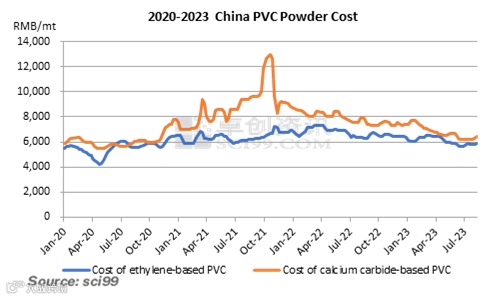
In 2018, China’s large-sized ethylene projects were launched. In 2019-2025, a couple of large-sized ethylene projects were planned to put into operation intensively in China. The compound growth rate of China’s ethylene capacity from 2019 to 2022 was 17.89%. However, as a high-energy-consuming industry, the development of the calcium carbide industry has been restricted by policies in recent years, so the growth rate of capacity has slowed down significantly. The compound growth rate of calcium carbide capacity in 2019-2022 was only 1.54%. Therefore, in recent years, the supply of calcium carbide has been relatively tight, while the supply of ethylene is more adequate. The cost advantage of ethylene-based PVC is gradually reflected amid low-priced ethylene resources. It can be seen from the following chart that the cost of ethylene-based PVC in 2020-2023 is lower than the cost of calcium carbide-based PVC, especially in 2021.
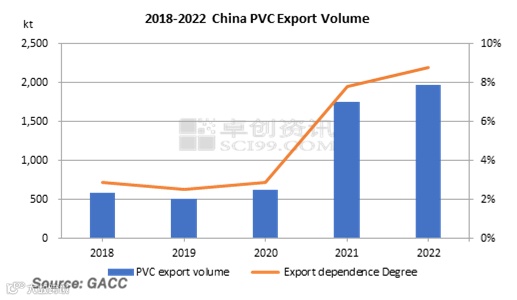
China’s PVC export dependence degree increases.
In recent years, as China’s supply-demand fundamentals have changed from a tight balance to an oversupply, the export dependence degree climbs gradually. All foreign countries produce ethylene-based PVC except China. From the comparison of the quality, ethylene-based PVC has more advantages in the water content and molecular weight of vinyl chloride, which can improve thermal stability, whiteness, aging resistance, mechanical strength, etc. In addition, the production process of ethylene-based PVC eliminates the problem of mercury pollution, so it is more environmentally friendly than the calcium carbide method. Therefore, foreign buyers prefer ethylene-based PVC resources. China’s PVC resources are mainly sold to developing countries. Export offers of calcium carbide-based PVC are generally $20-40 lower than those of ethylene-based PVC.
In the next five years, PVC demand expansion is expected to be mainly in China, India, Southeast Asia, the Middle East, Africa, etc. Most of these regions are the main export places of China’s PVC, so the future of China’s PVC exports still enjoy a passable opportunity, and this opportunity for ethylene-based PVC is better than that of calcium carbide-based PVC.
It is expected that the proportion of ethylene-based PVC powder will increase amid competitive advantages in the future.
Looking to the future, ethylene-based PVC powder will still enjoy advantages. On the one hand, newly added ethylene capacity may come on stream intensively in the future, so the cost advantages of ethylene-based PVC will continue. On the other hand, related policies will possibly benefit the ethylene-based PVC market. The calcium carbide-based PVC market still faces the challenge of mercury pollution. The Minamata Convention on Mercury stipulates that the mining of mercury will be completely banned by 2032. Thus, before 2032, the calcium carbide-based PVC market will possibly face the technical research of mercury-free catalysts, and the upgrading of the process is bound to further increase the cost of calcium carbide-based PVC. Moreover, future export opportunities are more conducive to the development of ethylene-based PVC.
In addition, China’s domestic demand structure change may be conducive to ethylene-based PVC. The application and development prospect of ethylene-based PVC in the medical industry is relatively fairish, while that of calcium carbide-based PVC in real estate-related industries is in the doldrums.
PVC downstream products mainly involved real estate-related products represented by pipes, profiles and flooring, daily necessities such as film, as well as medical supplies such as medical packing.
PVC demand from the real estate industry is expected to weaken in the next 5-10 years after experiencing 20 years of rapid growth. First, China’s demographic dividend is disappearing as China’s fertility rate drops. The potential rigid demand for the real estate industry may soften. Second, the leverage ratio of residents has reached a high level, and the willingness of residents to continue to increase leverage has declined. Second, China’s domestic urbanization rate has exceeded 65%. Although it has not yet reached the level of developed countries, there is not much room for improvement. Calcium carbide-based PVC is mainly used in the real estate industry, so the future demand for Calcium carbide-based PVC is expected to underperform.
PVC film is widely used in construction, electric power, agriculture, automobiles, clothing, daily chemicals, and food industries. Among them, the field of building materials is currently the largest field of PVC film applications, accounting for 58% of the total. Demand from the packaging industry accounts for 35%. As the real estate market enters a downward stage, PVC film demand from the building material industry is expected to shrink. However, with the expansion of the application field of PVC film, it is expected that the application of PVC film in agriculture, security, etc. may increase. However, PVC film mainly consumes calcium carbide-based PVC, and the increase in PVC film demand may be limited.
PVC sheets belong to relatively high-end products in PVC downstream products, mostly used in medical, medical packaging, etc. Due to strict requirements for impurities, PVC sheets are mainly made of ethylene-based PVC. With the acceleration of the aging of the population and the improvement of living quality in China, the demand for medical treatment is also gradually improving, so PVC demand prospects for medical packaging in the future are relatively fairish. However, PVC sheets face the challenge of being replaced by PET. In addition, PVC demand for toys is relatively stable, which benefits ethylene-based PVC.
On the whole, the ethylene-based PVC industry still has certain advantages in terms of policy, cost, export and downstream applications in the future, and the proportion of ethylene-based PVC is expected to be further improved.
All information provided by SCI is for reference only, which shall not be reproduced without permission.
Please click "Read more" for the full article.