

Styrene Inter-Regional Circulation Increased in April
In the first quarter of 2023, the regional differentiation of styrene prices in China narrowed, especially from February to March. In April, as the supply and demand contradiction in Shandong and South China regions changed, the regional price differentiation expanded and the regional arbitrage window opened, accelerating the circulation of goods.
Styrene regional price spreads widened in April.
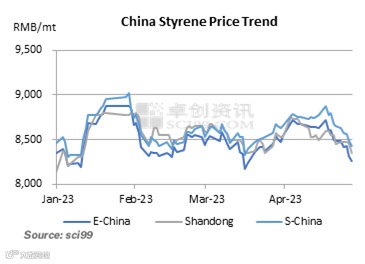
In April, the self-delivery price of styrene in Shandong averaged RMB 8,406/mt, the EXW price in Jiangsu averaged RMB 8,550/mt, and the self-delivery price in South China averaged RMB 8,600.75/mt. The price spread between Jiangsu and Shandong is RMB 144.5/mt, while that between South China and Jiangsu is RMB 50.25/mt. From the above figure, it can be seen that the price spreads between the three regions expanded in April compared to March, which is related to the changes in supply and demand contradictions between the South China and Shandong regions.
Styrene price in Shandong was the lowest due to increasing supply.
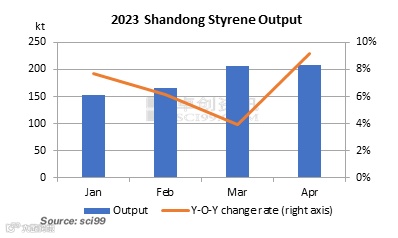
At the beginning of April, Zibo Junchen New Material put its new unit into operation and began to outsource, which increased the supply pressure in the Shandong market. However, there were intensive unit shutdowns in downstream ABS and EPS industries, and orders from other industries also improved little. Therefore, the supply and demand contradiction became fiercer, making the Shandong market price the lowest nationwide. Styrene prices in Jiangsu were far higher than those in Shandong, mainly due to the strong futures market in April. The arbitrage space between the two places expanded to RMB 275/mt, which led to increasing resources flowing from Shandong to Jiangsu. In addition, the inflow from Liangyungang to Shandong decreased, and most resources in Lianyungang were delivered to ports and surrounding markets.
Styrene prices in Guangdong firmed on descending supply.
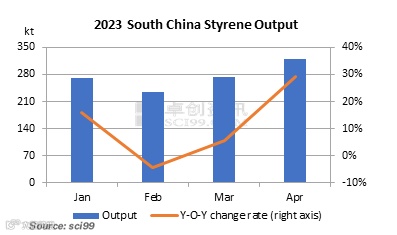
The prices in South China mainly refer to prices in Guangdong, and the overall supply increment in the South China market was mainly brought by the production of the unit at Sinopec Guangdong Petrochemical. The enterprise has not yet produced at full capacity, and the water content of styrene is relatively high, so its sales price is lower than the normal level. Moreover, some of its styrene resources are used by equipped downstream ABS units, so the overall inflow into the spot market is about 10kt. The Guangdong region normally needs to import goods or be supplemented from its surrounding regions. In April, the import volume significantly decreased, and due to the increased consumption of PS and ABS units in Zhangzhou, the internal digestion volume in the Fujian region increased, resulting in a decrease in the amount of styrene flowing into the Guangdong region. The decrease in import volume has led to a slight tightening of supply and a firm price in Guangdong.
In summary, the changes in supply and demand contradictions between regions have led to changes in price differentials and more active cargo circulation, and it is one of the reasons for the increase in inventory in East China ports. The increase in supply from the north has led to some trucks from Lianyungang entering the port, while the low-priced spot goods in Guangdong have squeezed some of the South China market shares, causing some South China goods to flow into the port. At present, the styrene price in Shandong is RMB 8,165/mt or so, which is basically the lowest price within the year. The market has high enthusiasm for replenishment, and it is expected that there may be a rebound in future prices. It is difficult to expand the price difference with Jiangsu to over RMB 250/mt again.
All information provided by SCI is for reference only, which shall not be reproduced without permission.
Please click "Read more" for the full article.