

How BTXS Moved Following Two Rounds of Oil Price Drops
Two substantial reductions in global oil prices occurred between January and May, and as the chemical industry's leader, the impact on downstream products was greater. The primary chemical product, aromatics, naturally tracked changes in oil prices. Although the amplitude of price variations varied, the trend of price changes was similar. The performances of BTXS (benzene, toluene, xylene and styrene) vary, and what drove the market trends is the supply and demand fundamentals and market psychology.
BTXS are all aromatics goods, however they have diverse product characteristics and price influencing factors. Sometimes they don’t affect one another at all, and other times they have an impact on the entire industry chain. For instance, the oil blending logic in March and April closely linked toluene, xylene, benzene and styrene. The price of oil plummeted precipitously twice between January and May, and BTXS performed differently each time. Let's examine it from the perspectives of three factors: price, supply and demand, and inventory.
Price - aromatics prices followed the downward trend of crude oil.
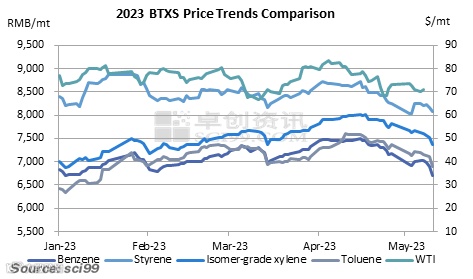
From January to May, the correlation between BTXS and crude oil prices varied. In specific, the correlation coefficient between benzene and crude oil was 0.31, between styrene and crude oil was 0.67, between toluene and crude oil was 0.18, and between xylene and crude oil was 0.002. Styrene is determined to have the strongest link with crude oil in the aromatic business, which is related to the fact that it is a futures commodity and has a significant financial feature.
Comparison of BTXS Price Following Two Rounds of Oil Price Decline
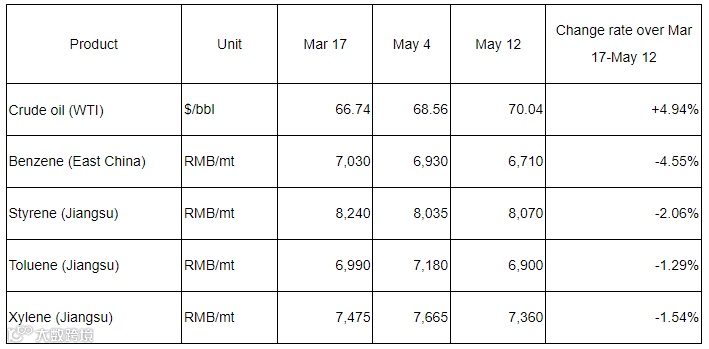
After the May Day vacation, crude oil prices dipped once more, but they were still higher than they were in March, up 4.94% M-O-M. In contrast, downstream aromatics products experienced an M-O-M decline, led by benzene and then styrene.
Price trends for benzene were on the rise before mid-April. There were two corrections during this time, although each one saw a price increase. The primary cause was that there was a high demand for oil blending in Europe and the U.S. and that the window for Chinese-foreign arbitrage was shut. Additionally, 2023 is still the peak era for the commissioning of the benzene downstream industry. Market participants had a considerable reluctance to sell at low prices because they anticipated that the benzene supplies would be tight in the future. While the benzene stockpile at major ports remained large and domestic trade products started to rise in the middle and end of April, the market attitude started to crumble. Benzene has become the species with the largest price decline in the aromatics industry.
The cost effect on the price of styrene predominated in the second quarter, and the fall in benzene prices was passively followed by styrene prices. When the price of crude oil plummeted on May 4, toluene and xylene saw a price difference from benzene and styrene.
The price of toluene and xylene compared with March 17 showed an upward trend, which was mainly supported by the tight supply. In 2023, the new production capacity of downstream PX is larger than that of toluene and xylene, and PX production profit is higher, so in the case of falling crude oil prices and less-than-expected oil blending demand, the market price trend of toluene and xylene is still higher than that of benzene and styrene. But as crude oil prices continue to fall, PX market prices are lowered, and refined oil imports increased, weighing down toluene and xylene prices.
Supply & demand relationship to impact price.
Styrene’s fundamentals were first strong and then weak, but benzene’s fundamentals changed from weak to strong, according to a comparison of the supply-demand balances of the two chemicals. The fundamentals of benzene were stronger than those of styrene during a significant decrease in the price of crude oil in March, and the price decline of styrene was constrained by the cost. Styrene and benzene both descended during the second round of decline in crude oil prices during the May holiday, but benzene’s fundamentals are predicted to be weaker than those of styrene in June. Due to market trade occurring earlier than expected, benzene prices declined more rapidly than those of styrene.
The supply and demand fundamentals of the toluene and xylene markets were weaker than expected. During the Spring Festival, the increase in the travel rate of citizens drove the domestic demand for oil blending to a better development, thus driving the market price higher. The travel rate of citizens during the May Day holiday remained high, but due to the continuous downward trend of international crude oil prices, concerns about the global economy among market participants, and issues such as the gasoline price difference between Singapore and other places in China, domestic demand for oil blending continued to be weak.
Additionally, there was still a low demand for solvents and fine chemicals. Only downstream PX producers who saw an improvement in demand and profitability boosted their purchases of MX. Besides, some enterprises decreased their MX sales volume once their PX units went into production, which supported the domestic xylene market’s fundamentals and increased toluene and xylene prices in the first quarter. The sole PX demand weakened with the ongoing cost drop, and the terminal demand was unsteady, which restrained the upward trend for toluene and xylene prices.
Inventory - styrene saw the fastest destocking.
Comparison of BTXS Inventory Following Two Rounds of Oil Price Decline
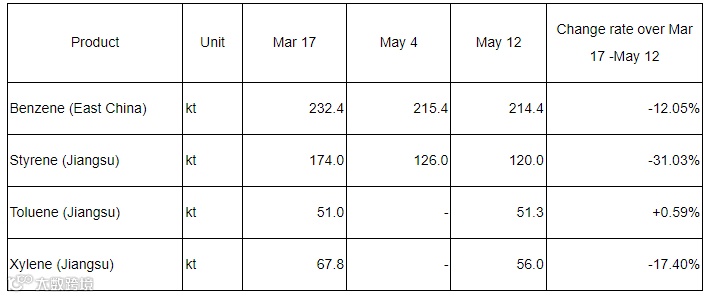
The stockpile of styrene decreased the quickest, as shown in the above table, which also explains why styrene prices dropped less than those of benzene. The total toluene and xylene supply didn’t alter much recently. The toluene and xylene markets had a significant capacity for self-regulation, and import volume stayed low. Producers that deal with toluene and xylene kept their inventories at a relatively low level by adjusting prices and self-consumption. Changes in inventory data thus had less of an effect on the market. The inventory of benzene remained at a level of over 200kt over the past two months, well below the market's anticipated rate of destocking, which put additional pressure on the spot market.
Outlook – BTXS market continues to be weak in the short term.
Since BTXS products are all downstream derivatives of crude oil, they will continue to track changes in the oil price trend. Oil prices are currently fluctuating, so it’s important to keep an eye on supply production cuts and U.S. debt ceiling worries.
The current issue with benzene is that it is challenging to destock. Demand is anticipated to decline as a result of greater maintenance and shutdown plans for downstream units in North China, South China, and Zhejiang from May to June. Destocking is still challenging in the second quarter after Zhejiang Petrochemical introduced benzene to the tank farm. Additionally, the internal and external arbitrage window has generally been closed for a long time, but in March, it was opened for a short while, and the import supplement was also reasonably adequate. As a result, the negative pressure on the supply of the benzene market will gradually develop in the middle and latter part of the second quarter.
Costs will continue to have an impact on styrene prices, and since new units are anticipated to go into production and demand is predicted to decline in June, it will be challenging to raise the styrene price.
For toluene and xylene, the game of supply and demand continues, and the market mindset remains the key to influencing changes in market pricing. The Asian arbitrage window continued to close from May to June, so China’s import volume remained low, and the overall supply was constrained. The likelihood of weak demand is high due to many unfavorable conditions, including the low level of global oil prices, the decline in downstream PX production margins, and the start of the customary off-season. The game of supply and demand will continue, and the variable lies in how people's mindsets shift as a result of macro news and changes in crude oil prices.
All information provided by SCI is for reference only, which shall not be reproduced without permission.
Please click "Read more" for the full article.