

Near-Term China Methanol Market to Fluctuate Downwards
Recently, China’s methanol market has kept moving sideways. Up to November 17, the monthly average price was RMB 2,080/mt in Inner Mongolia, down 0.57% from last month. Earlier this week, the market was filled with news about the running conditions of some downstream units. Market players tend to be cautious and pay close attention to the future market trend. Here let’s delve into the market from cost, supply-demand, etc.
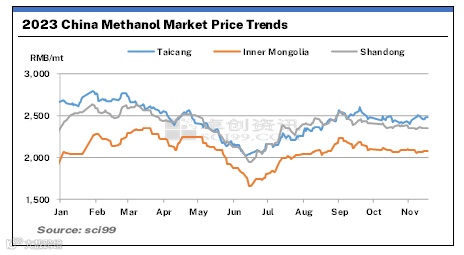
Cost: Coal consumption is in the peak season; pay attention to the daily consumption at power plants and the impact of imports
The production at China’s mainstream coal mines is stable, with the coal output staying at a relatively high level. Imported coal still has price advantages, ensuring the import supply. However, the coal inventory at domestic power plants is relatively sufficient, and the daily consumption is not high, so the support from the demand side is limited. Overall, the coal price lacks enough upward momentum and may drop in some areas. Thus, the cost support to methanol prices may be weak.
Supply: Mainstream units are running steadily; port inventory remains at a high level despite a decline.
Up to November 16, the methanol industrial operating rate was 72.22%, up 0.15 percentage points W-O-W. Earlier this week, major methanol units maintained stable operation, and the domestic supply was relatively sufficient. As for imports, the port inventory in East China and South China slid somewhat last week, as the actual unloading volume of imported cargoes decreased and the buyers with inelastic demand picked up goods steadily. Up to November 16, the port inventory dropped to 1,045kt, but remained at a relatively high level in the recent three years.
Demand: Operating rates of MTO units are expected to decline, and traditional downstream industries have entered the slack season.
Last week, with one MTO unit in Jiangsu running at a lower load, the operating rate of the CTO/MTO units fell to 86.07% up to November 16. Earlier this week, the operating rate at certain MTO plant in Shandong was cut to around 60%. In addition, whether the shutdown of PP units at a certain MTO plant in Tianjin will influence its MTO unit operation is also affecting the market mentality. However, certain olefin plant in Shaanxi plans to increase methanol purchases, which may offset the demand reduction to some extent.
As for traditional downstream industries, the weekly operating rate of acetic acid units improved notably with the unit at Hualu Hengsheng Chemical running at a higher load. However, most downstream industries will enter a slack season in winter. It is learned that the feedstock inventory at most large formaldehyde plants in East China is still at a medium-to-high level; most MTBE and acetic acid plants also mainly purchase on a need-to basis. Facing narrowing profits, traders are also cautious and operate flexibly based on market changes.
Forecast: China’s methanol market may fluctuate under downward pressure in the near term.
On the whole, the future cost support may be limited; the domestic methanol supply may be still relatively adequate, but players need to focus on the expected shutdown of the natural gas-based methanol units in Southwest China; downstream demand is expected to be weak, and players need to pay attention to the feedstock purchase from certain olefin plant in Shaanxi. In addition, considering the impact of weather, some methanol producers in Northwest China still have destocking demand, and the drop in futures prices has exerted a bearish impact on the mentality. Rising freight has increased the transportation cost. To sum up, bullish and bearish factors are mixed in the market. It is predicted that the methanol price may fluctuate downwards in the near term, but the price decline may be limited.
All information provided by SCI is for reference only, which shall not be reproduced without permission.
Please click "Read more" for the full article.