

PDH OR Slides with Profit Loss & Capacity Release
Preface: The PP capacity expansions since 2020 have reflected the diversification of raw materials. PDH technology has become the main driver in China’s newly added capacity with its more environmentally friendly advantage. However, China’s PP supply has become gradually ample with capacity expansions, and the supply pattern and gross profits of PP producers have changed a lot. PDH enterprises also face profit losses, which make them adjust operating rate (OR) and suspend production more frequently. There may be a lot of PDH-based PP units to come on stream in the future, but lower profits have increased the operation pressure on producers.
China’s PP capacity expansions are diversified in enterprise nature, and expansions have successively experienced coal-based PP capacity growth at coal chemical enterprises around 2014, crude oil-based PP capacity expansions at local refineries and PDH-based PP capacity increases after 2020 at private enterprises. There are still a lot of capacity expansion plans at present, and PDH-based PP capacity may still be the main force from 2024 to 2028. However, PDH-based PP production profits are poor, which may render frequent adjustments in operating rates and unit shutdown by producers.
The rapid development of feedstock source diversification accelerated the PP capacity expansions.
The growth rate of PDH-based PP capacity was marginally lower than that of crude oil-based PP capacity, further compressing the PP capacity via other feedstock sources. According to SCI, the newly added capacity of PDH-based PP units was 5,250kt/a from 2019 to 2023. As of now, PDH-based PP capacity reached 6,850kt/a, taking up 17.80% of the total PP capacity in China.
China’s PP capacity continued expanding, despite poor profits.
PDH-based PP capacity release is concentrated, mainly backed by the high rate of return of PDH units. According to SCI, the profit from PDH-based PP production was basically more than RMB 1,500/mt before June 2021, with a maximum of more than RMB 3,700/mt. However, driven by the rise in crude oil and other bulk commodities, propane prices have also surged since July 2021 and have hovered at highs for a long time due to factors such as tight supply and higher freight rates. However, PP mainstream prices went down with extensive capacity expansions, so PDH-based PP production profits became negative and hardly improved, further dragging down the overall operating rate of PDH-based PP units.
Crude oil values started to fluctuate downwards after mid-October, and propane prices also slid somewhat. However, propane prices declined at a slow rate, as CP prices rose more than expected, and the overall propane supply was not plentiful. PDH-based PP production costs stayed higher than PP prices, causing negative profits, and profit losses failed to improve.
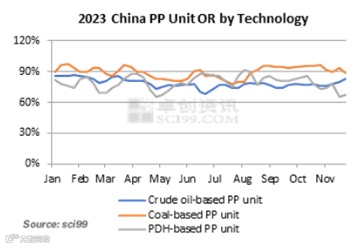
Lower profits brought an adjustment in PDH-based PP unit operating rates.
Propane prices ramped up after mid-October, while PP prices hovered at lows, compressing the profitability at PDH-based PP enterprises. Thus, enterprises were more inclined to cut back operating rates or shut units down. Therefore, the overall operating rate in the PP industry began to drop in the middle of October, and therein, PDH-based PP unit operating rates decreased the most and were below 80%. At present, a lot of PDH units remain in downtime.
China’s PP capacity is projected to continue expanding in 2024, leaving challenges and opportunities for producers.
In the later stage, China’s domestic PP industry may still be on the road of capacity expansion, and PDH-based PP is still the main force in capacity expansion. Ningbo Kingfa Advanced Materials, Quanzhou Grand Pacific Chemical, etc. have chosen propane as a new raw material, so the PDH-based PP supply is expected to gradually increase. According to SCI, China’s PP capacity will probably reach 47,190kt/a, and PDH-based PP newly added capacity may realize 4,150kt/a. As of end-2024, the proportion of PDH-based PP capacity will probably exceed that of coal-based one and then rank second. In the context of continuous capacity expansion, PP price competition will become more intense. However, relevant producers are also constantly investigating changes in customer-used materials and making timely adjustments to product production structures. Thus, differentiated production is likely to become the mainstream tendency among producers in the future.
All information provided by SCI is for reference only, which shall not be reproduced without permission.
Please click "Read more" for the full article.