

Aug Chemical Market Expected to Further Rise
Preface: In July, the chemical market stopped falling and stabilized gradually, with the prices of some products rising slightly. Crude oil prices kept advancing, which boosted the chemical market. However, relatively weak demand was still a restriction on price rises. Looking ahead to August, crude oil prices may continue to fluctuate at a high level, and chemicals demand is expected to continue to improve Therefore, it is predicted that the chemical market may further go up in August, but the slow transmission of end demand may restrict the rise extent.
In July, most chemicals saw price rises, but the overall profitability slid.
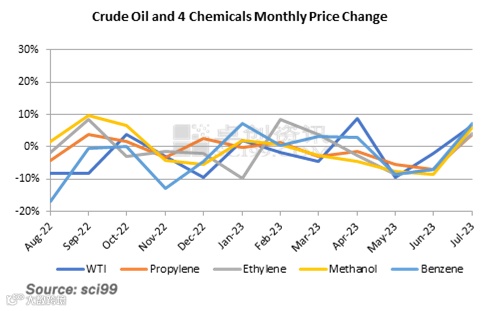
In July, the prices of most chemicals increased. Among the 53 major chemicals that SCI monitors, 39 products saw rises in their monthly average prices, such as acetone (13%), phenol (10%), BPA (10%) and acrylic acid (9%). 10 products witnessed declines in their monthly average prices, such as aniline (-10%), DMC (-7%), DME (-4%) and EPDM (-3%).
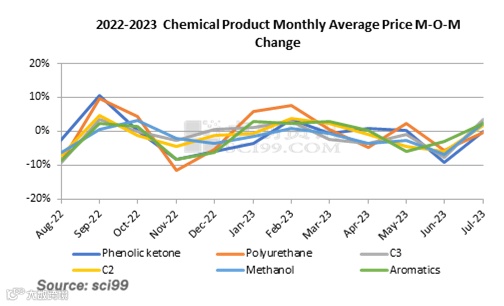
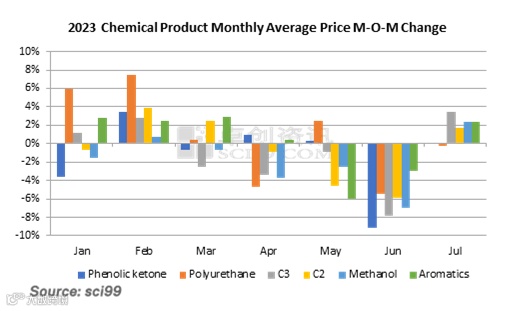
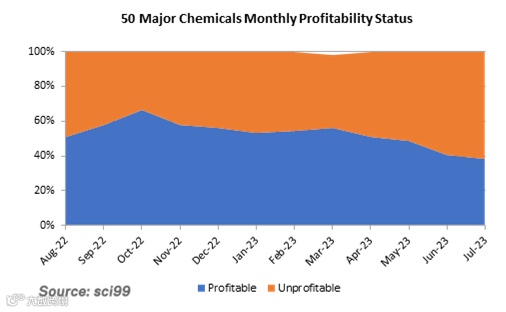
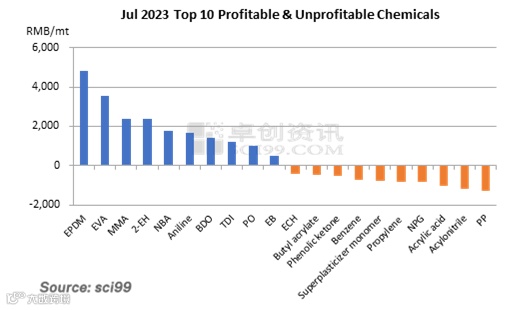
Reduced macro pressure and rising crude oil prices boosted the chemical market significantly, but the slow transmission of end demand curbed the price rise extent. As a result, the profits from producing most chemicals further narrowed due to larger feedstock price growth.
With the Fed’s interest rate hike cycle coming to an end, the macro pressure has subsided in the second half of the year, and market sentiments have gradually improved. Meanwhile, China’s domestic economy has gradually repaired, and the overall macro environment for chemicals has picked up.
The production cut at OPEC+, the dollar index decline and other factors pushed up crude oil prices constantly, providing cost support to chemicals. In addition, seasonal unit maintenance and production limitations caused by slow end demand recovery led to temporary supply tightness, pushing up the prices of chemicals. However, for most chemicals, the rise in product price was smaller than that in feedstock price, so the overall profitability of the chemical market declined.
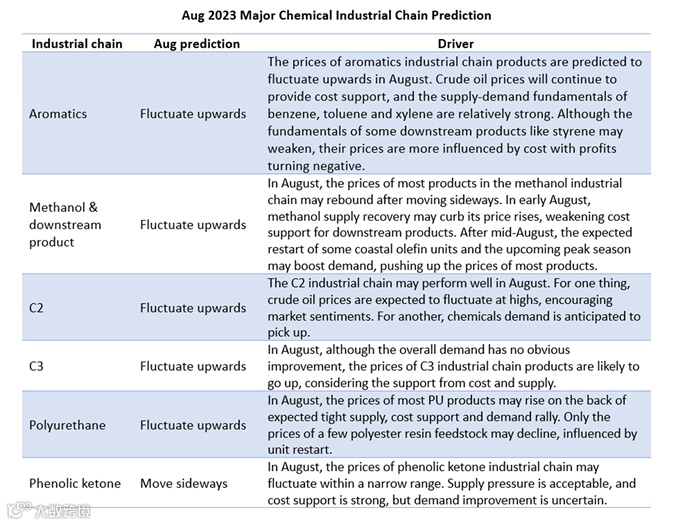
August forecast: The chemical market is still likely to go up, but weak end demand will continue to exert some pressure on market prices. Factors like macro-environment improvement, rising crude oil prices, supply contraction, and market expectations are more responsible for the uptrend in chemicals prices in July. However, end demand recovery is weak, and there is some uncertainty about the continuing rise of crude oil prices. The chemical market still faces downward pressure with supply increasing. However, September and October are traditional consumption peak seasons for chemicals, and market players usually start stockpiling around mid-August, which may support the market to some extent.
Global economy remains in a downtrend with low index.
In July 2023, the global manufacturing PMI was 47.9%, up 0.1 percentage points from the previous month and ending the trend of four consecutive months of decline. However, the index has been at a low level below 48% for two consecutive months, indicating that the global economic downturn has not changed. The U.S. economy is expected to fall into recession, and Europe’s economic recovery has been slow.
Chinese economic growth momentum has further accumulated and signs of recovery have emerged
In July 2023, China’s manufacturing PMI was 49.3%, up 0.3 percentage points from the previous month. The expected index of production and business activities, the purchasing volume index, and the inventory index of raw materials in the PMI all rose to varying degrees, suggesting that business confidence has improved and production and operation activities have signs of recovery. At the same time, it should be noted that the problem of insufficient demand is still prominent.
Crude oil prices are predicted to fluctuate at highs, providing stable cost support to chemicals.
On the one hand, the Fed’s 25 basis point interest rate hike in July had little impact on markets, but the market remains divided on whether the Fed will raise rates in September. On the other hand, whether Saudi Arabia’s voluntary production cut will be extended, and the summer demand peak is about to pass, there are downward expectations for US refined oil demand, which are disturbing the market.
Industrial chain transmission improves with demand recovering.
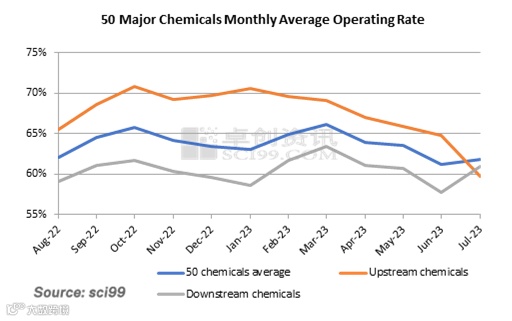
Among the 50 major chemicals that SCI monitors, the monthly average operating rate rebounded to 61.87% in July, up 0.69 percentage points M-O-M. The operating rates of downstream chemicals rallied slightly, indicating gradual improvement of end demand. The operating rates of upstream products dropped notably, pushing up feedstock prices.
In August, downstream demand is expected to increase from mid-August in line with periodic stockpiling for the traditional peak season, but the overall supply may see an uptrend in spite of unstable operation in some industries. The supply-demand fundamentals of chemicals may be relatively loose in August.
All information provided by SCI is for reference only, which shall not be reproduced without permission.
Please click "Read more" for the full article.