

2023 PX Industry Key Indicators Interpretation
2023 is a year of rapid development in China’s PX industry. Under the complex internal and external environment of frequent geopolitical conflicts, unprecedented global economic tensions, and drastic fluctuations in the oil market, the instability of the global market’s industrial and supply chains has significantly increased.
Falling price and narrowed amplitude space
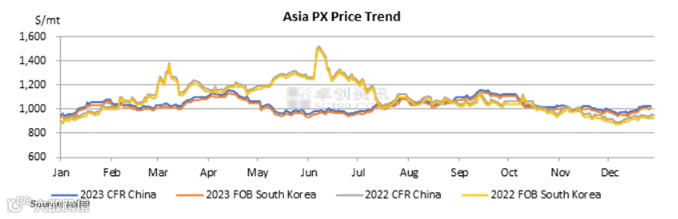
In 2023, Asian PX prices were in a range-bound tendency, showing an M-shaped trend. The annual average price was $1,036.45/mt, down 6.11% Y-O-Y. The yearly highest price was $1,161/mt, while the lowest one was $941/mt, with an amplitude of 23.38%. The drivers of the PX price increment were from the cost and demand sides, brought by rising crude oil prices and the intensive start-up of new PTA units. The PX price decline was caused by two factors: the end of the peak season for oil-blending demand, which highlighted the supply-demand contradiction, and the mounting cost pressure resulting from declining crude oil prices.
Restoration of profit margins and enhancement of integration advantages
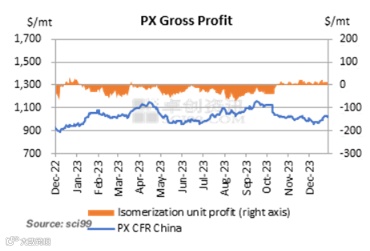
In 2023, the profit of isomerization unit averaged $-20.25/mt, exhibiting a Y-O-Y increase of 47.20%. The highest profit was $25/mt, while the lowest one was recorded at $-75/mt. The cash flow of the PX-MX industry chain was at a loss most of the year. The strengthening of the “refining-chemical-polyester” industry chain development model and China’s increased self-sufficiency have improved the PX buyer’s voice and significantly compressed PX profits. Due to the high travel season, there were few gasoline stockpiles in the United States from June to August, and there was a strong demand for oil blending. Due to the arbitrage area that existed between the United States and Asia, MX prices sharply rose, placing further cost strain on producers who use MX outsourcing to create PX. Because of this, some local and international producers purposefully stopped making PX and began making ingredients for oil blending instead. Integrated units were still rather profitable, nevertheless, with an average yearly price difference of $435/mt between PX and crude oil.
Steady increase in capacity
In 2023, there were a total of 26 PX enterprises in China, with a total PX capacity of 43.81 million mt/a, a Y-O-Y increase of 21.83%. In 2023, four additional units were added: the 2.6 million mt/a unit at PetroChina Guangdong Petrochemical, the 1.5 million mt/a unit at CNOOC Huizhou Petrochemical, the 1.6 million mt/a unit at CNOOC Ningbo Daxie Petrochemical, and the 2 million mt/a unit at Shenghong Petrochemical. In addition, Sinopec Zhenhai Refining & Chemical expanded its existing capacity from 650kt/a to 800kt/a. The newly added units were concentrated in the first half of the year.
Rapid growth in output and effective operating rate
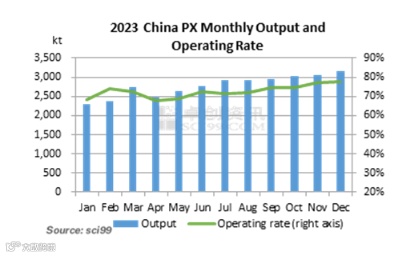
In 2023, the total PX output read 33,310kt, up 39.76% Y-O-Y. The annual average operating rate was 76.03%, up 9.76 percentage points Y-O-Y. Since PTA in China is still in the midst of its second round of expansion, it has a big capacity base. This has led to a particularly strong demand for PX, which has prompted the gradual deployment of additional PX capacity. As a result, the effective output of PX has grown rapidly. Simultaneously, as the number of businesses spanning the whole industrial chain has increased, operational stability has also improved, and the PX industry's operating rate has seen a slight Y-O-Y improvement. However, the domestic operating rate has not yet surpassed 80% because of sporadic unplanned shutdowns and abrupt output halts. In addition, certain recently added units that were operational later in the year have lower effective output, which is also one of the reasons that affect the annual operating rate.
Shrinking PX imports and a minor decline in import prices
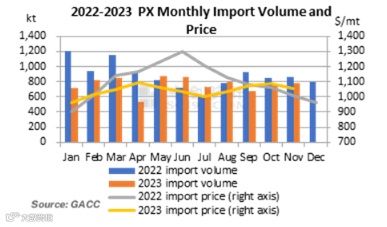
The total import volume of PX from January to November 2023 was 8,413.5kt, a Y-O-Y decrease of 20.50%. The average import price was $1,037.12/mt, a Y-O-Y decrease of 4.75%. China has achieved a major improvement in its rate of self-sufficiency due to the intensive release of additional PX capacity. The PX supply deficit is accelerating to narrow as a result of China’s PTA businesses progressively outfitting supporting PX units. The PX’s reliance on imports dropped to 21.81% in 2023. China’s PX is progressively reducing its reliance on imports. Nonetheless, there are still over 800kt of imported commodities each month to support market demand because of the sizable PTA capacity base.
Climbing PX inventory
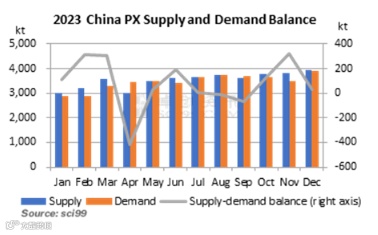
In 2023, the total annual supply was 42.5 million mt, a Y-O-Y increase of 23.48%, and the total demand was 41.56 million mt, a year-on-year increase of 17.56%. Due to the concentrated release of multiple sets of PX projects in China and the lower-than-expected demand from polyester and even the end market, the supply growth rate exceeded the demand growth rate by 5.92 percentage points. The inventory level of PX increased as a result, with monthly inventory growth exceeding 300kt in February, March, and November. Inventory build-up has emerged as the primary theme of PX social inventory, placing increasing pressure on downstream PTA factories and PX manufacturers.
The PX market still has a lot of obstacles to overcome in 2024. With the gradual end of the PX expansion cycle, the supply-demand contradiction is expected to experience a temporary respite. However, the commodities environment risk level will rise, although the global economic environment will be in a poor recovery stage.
All information provided by SCI is for reference only, which shall not be reproduced without permission.
Please click "Read more" for the full article.