

Northern Benzene Demand to Improve
China benzene prices hit 20-year lows in 2020. Meanwhile, the price spread between the northern market and the southern market was widened. In East China, the port inventory kept piling up, and downstream demand slowed down. In North China, independent refineries cut their operating load rates, and coal-based benzene producers ran at lows. Therefore, the supply declined. As a result, northern downstream enterprises had to replenish goods from the southern market. Will Shandong continue to be in short supply?
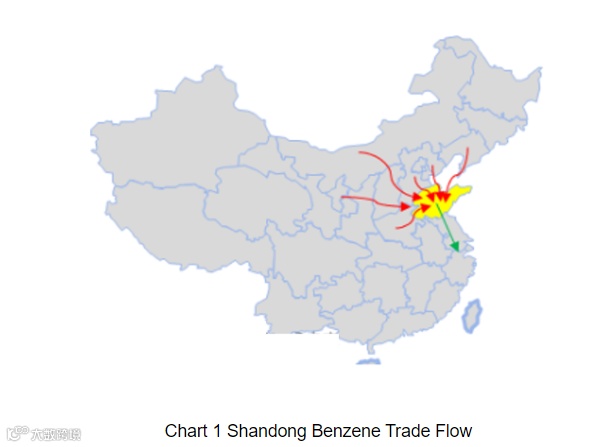
Feature 1: Low-priced substitutes
With the improvement in the quality in recent years, the purity of coal-based benzene can reach as high as 99.95%. Therefore, coal-based benzene and oil-based benzene are alternatives in some downstream industries. However, some microelements will affect the catalyst, so the proportion of oil-based benzene and coal-based benzene is mostly 7:3 or 5:5. The capacity of coal-based benzene in Shandong and Hebei is large, and their prices hit the oil-based benzene somewhat.
Feature 2: Small Capacity and scattered distribution
In Shandong, a total of 73 independent refineries are seen in Shandong, among which, 23 refineries involve aromatics production. The total capacity is large, but the single capacity is small. Taking oil-based benzene as an example, the average capacity is 76.5kt/a in Shandong, much lower than 247.5kt/a in Jiangsu.
Sinopec has a low right of speech in Shandong. On the one hand, its producers (Qilu Company, Qingdao Refining & Petrochemical Company, Jinan Refining & Petrochemical Company together with Qingdao Company) only takes up 20% of market share. On the other hand, coal-based benzene producers are centralized in Shandong and Hebei.
Feature 3: Short industry chain and low cost conversion rate
Most enterprises in Shandong have been committing to the development of the oil refining industry except for Sinopec. In addition, another reason was intensive commissioning of reformers from independent refineries in 2017 due to the upgrade in the quality of oil products. And these enterprises mainly sell their benzene, as their benzene has no matched downstream units or downstream capacity is low.
Taking benzene as an example, there are 18 benzene downstream producers in Shandong, among which, only 5 enterprises have matched upstream units. And the left downstream producers adopt multiple purchase modes. On the one hand, they sign term contracts with Sinopec, PetroChina, surrounding independent refineries and coal-based benzene producers to quarantine most of the demand volume. On the other hand, they buy sport to reduce the procurement cost.