

2021 China Domestic PP and Import PP Price Spread Enlarged
Highlights
China’s domestic PP prices and imported PP prices shared a similar trend from 2017 to 2021, and imported PP prices changed mainly according to changes in China’s domestic PP prices. The following analysis will make you access to China’s domestic PP price and import price spread through analyzing changes in price drivers.
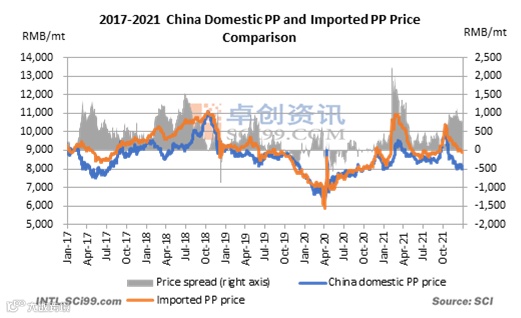
China’s domestic PP prices and imported PP prices shared a similar trend from 2017 to 2021, and imported PP prices changed mainly according to changes in China’s domestic PP prices. The main price drivers included PP fundamentals, the financial attribute of PP, national policies, cost and prices of related products. In Q1, 2021, imported PP prices saw an uptrend. Some imported resources were even exported for profit gains, and so were China-origin resources. FOB prices of PP proved resilient because of favorable market internationally, and this also pushed China-origin PP prices up.
In 2021, the highest imported PP price and the lowest one both appeared in Q1. The lowest price was RMB 8,212/mt in January, while the highest price was RMB 10,960/mt in H2 February. The largest price spread between China-origin PP and imported PP occurred in February, reaching RMB 2,258/mt, as international prices ramped up amid the dearth of supply. Especially in the Middle East, PP units underwent intensive turnarounds, or the production was affected by other force majeure incidents. However, as overseas PP units resumed production and the export profits lowered, China’s PP market gradually returned to normal and was dominated by fundamentals. From January to May, the PP supply-demand pattern in China was impacted by the total export volume. In Q3 and Q4, the export window was still open, reflecting an increase in export volume. The export volume this year was higher than previous years even though the export window shrank in the later period.
China’s PP capacity kept expanding, resulting in sufficient supply domestically. The support to prices became limited, so China’s domestic PP prices remained at low levels. Therefore, the price spread between imported PP and Chinese-made PP was notable.
All information provided by SCI is for reference only,which shall not be reproduced without permission.
Please click "Read more" for the full article.