

Where Will Pulp Market Go Under the Influence of Futures Volatility and Fundamentals Imbalance?
China pulp market saw drastic swings
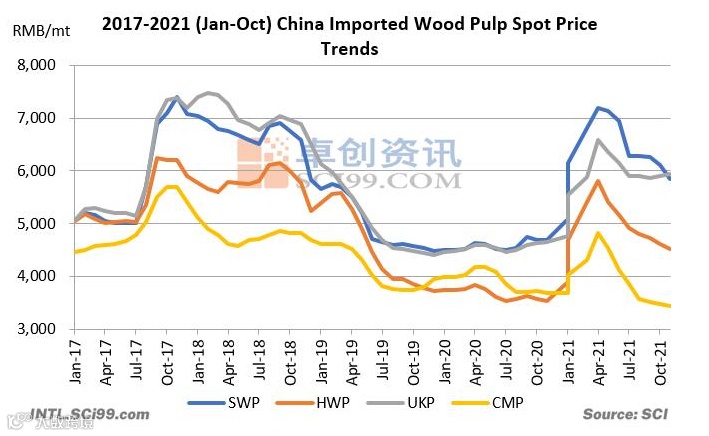
From 2017 to 2021, there have been two complete cycles in the imported wood pulp spot market in China. In 2021, the wood pulp spot market price showed an N-shaped trend affected by multiple factors including the resurgence of the public health event, futures market volatility, supply chain issues in Canada, policy-related changes. SCI data indicates the price gaps between the highest and lowest wood pulp prices in 2021 were RMB 1,458-2,938/mt as of early December.
China pulp import structure changed subtly
From 2017 to 2021, the pulp import volume of China continued to increase with an average annual growth rate of 8.25%. The increment of pulp imports was mainly contributed by HWP, UKP and other pulp varieties. In 2021, the pulp import structure in China has changed subtly. Therein, SWP, HWP and CMP import proportions went down Y-O-Y, while the proportions of UKP and others ramped up. It is estimated that in 2022, the import proportions of SWP, HWP, UKP, CMP and others will change by -3.41%, 3.34%, -0.14%, -0.66% and 0.87% respectively Y-O-Y.
Downstream demand grew steadily
From 2017 to 2021, the pulp demand growth was steady. Under policy changes in 2021, the domestic pulp consumption was firm in H1, but the consumption was dragged down but COVID resurgence and decline in paper exports during H2 of the year. In 2021, the downstream consumption volume rose by 2.32% Y-O-Y, and the growth rate was relatively low mainly affected by the hindered paper exports and extensive turnarounds at paper mills in H2. The total pulp consumption volume rose 2.41% Y-O-Y, and the market was still in a tenuous balance.
High pulp inventory remained normal
The pulp port inventory in China continued to fluctuate at a high level of around 1,900kt, but the influence of the port inventory changes has become marginalized as high inventory is now the new normal. In early December, the pulp inventory went down by 5.2% due to rising pulp prices and a steady pick-up rate.
Policy factors have bullish impacts on the pulp market in general
Several policies including the plastic ban, solid waste import ban, carbon neutrality and carbon emission peak will project supportive impacts on the pulp market in the long term, but attention should be paid to the actual consumption volume increase and the implementation schedule. In contrast, the “double reduction” policy will curb the consumption of printing and writing paper in the short term and hinder pulp demand indirectly in the short term. But in the long-term, the implementation of competence education may bring more paper consumption for education purposes.
Outlook
After 2022, there will be intensive pulp capacity expansion around the world, and the anticipated pulp capacity addition will be over 40 million mt/a, leading to abundant supply. Therein, several HWP units with capacity of over 1 million mt/a will be launched in South America, and the notable price spread between SWP and HWP will remain. In the meantime, with the pulp and paper integration process accelerated in China, players with self-owned power plants and woodlands will have apparently higher profitability. Attention should be paid to macro policy changes, capital flow, economic growth, commissioning dates of newly added pulp and paper capacity, pulp futures market changes, etc.
In 2022, around 46% of the newly added pulp capacity will produce HWP, and the HWP price may trend under pressure, leading to a persistently high SWP-HWP price gap. From 2023 to 2024, over 10 million mt/a of new pulp capacity may be added globally, and the supply-demand balance in China will continue to adjust.
2021-2022 China Pulp Market Annual Report
In 2021, COVID-19 continues to haunt the global economy, in addition to the constantly changing macro-expectation and speculative pulp futures market, the wood pulp spot market price in China surged and fell. The wood pulp import volume of China rose by 5.12% Y-O-Y during the first 7 months of 2021.
New pulp capacity is also being released worldwide. Therein, new integrated pulp and paper projects have been announced in China throughout 2021, and the industry concentration ratio will rise constantly with the commissioning of new integrated projects of APP and Sun Paper during H2 of the year. The 2,800kt/a BEK capacity of Bracell is scheduled for commissioning in Q3 of 2021, and low-priced HWP import from Indonesia continues to affect the market. In the meantime, Brazilian pulp producers maintain high export volume to China benefited from low production costs.
How will domestic pulp producers react in the face of rising supply pressure in the HWP spot market? Will the spread between SWP and HWP continue to expand? What changes will take place in paper mills' feedstock structure if the price spread does expand? The SCI Pulp Market Annual Report will review the industry fundamentals changes and forecast future development through comprehensive and detailed data analysis.
Report value
1. To provide comprehensive understandings of the changes in the pulp market through analyzing the pulp market demand and supply factors both in China and overseas.
2. To provide analysis on changes in downstream market consumption patterns and pulp demand.
3. To review the pulp price trend and decipher its key drivers.
4. To provide a forecast for the pulp market in 2022-2024 based on factors in regards to market fundamental and macro-environment changes.
……
Please click "Read more" for the full article.